Average Values with Calculus Integrals
Understanding Integrals
The Idea of Accumulation
Calculus is all about change. We've seen how derivatives describe the rate of change, like the speed of a car at a specific moment. But what if we want to go the other way? If we know a car's speed at every moment of a trip, can we figure out the total distance traveled? This is where integrals come in.
Integrals are the tool for calculating accumulation. They let us add up countless tiny pieces to find a whole. Imagine filling a bathtub. If the water flows at a constant rate, it's easy to calculate the total water after 10 minutes. But if the flow rate varies, sputtering and gushing, you can't just multiply the rate by the time. To find the total, you'd have to sum up the amount of water added over many tiny moments. Integration is a formal way of doing exactly that.
Integral Calculus is the study of accumulations—finding areas under curves, volumes, and more.
The most common way to visualize an integral is by finding the area under a curve. Let's say a function represents our varying flow rate over time . The total accumulation is the area between the function's graph and the x-axis over a specific interval.
Area Under a Curve
How do we find the exact area of an irregular shape, like the space under a curve? The strategy is to approximate it with shapes we know how to measure, like rectangles. We can slice the area into thin vertical strips, treat each one as a rectangle, and add up their areas. This is called a Riemann sum.
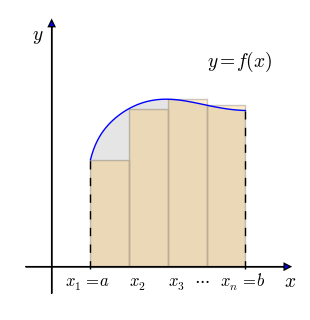
This approximation gets better as we use more, and narrower, rectangles. Integration is what happens when we take this idea to its logical extreme. We use an infinite number of rectangles, each one infinitesimally thin. This process gives us the exact area, not an approximation.
The notation for this is the definite integral:
Let's break that down:
- The symbol is the integral sign. It looks like a stretched-out 'S' for "sum."
- and are the limits of integration. They define the interval on the x-axis we're interested in, from to .
- is the function we're integrating, called the integrand. It's the curve that defines the top of our area.
- indicates that we're slicing our area along the x-axis into infinitely thin pieces.
One important detail: an integral calculates signed area. If the function dips below the x-axis, the area in that region is counted as negative.
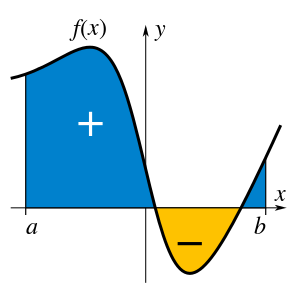
Think of it like profit and loss. If represents your daily profit, the integral from Monday to Friday tells you your net earnings. Days with a profit (when is above the axis) add to the total, while days with a loss (when is below the axis) subtract from it.
Fundamental Properties
Integrals follow a few straightforward rules that make them easier to work with. These properties are direct consequences of how we define integrals as sums of areas.
First, if you're integrating a function multiplied by a constant, you can pull the constant out of the integral. For example, if you double the flow rate of water at every moment, the total amount of water also doubles.
Second, the integral of a sum of functions is the sum of their individual integrals. This is like having two separate faucets filling the same tub. The total water is the sum of the water from the first faucet plus the water from the second.
Finally, you can split an integral into parts. The area from to is simply the area from to plus the area from to , as long as is between and .
This is like measuring the distance traveled in a road trip. The total distance from the start to the end is the distance from the start to a midway point, plus the distance from that midway point to the end.
Let's test your understanding of these core concepts.
In calculus, what fundamental problem are integrals used to solve?
A definite integral, represented as , is most commonly visualized as what?
These ideas of accumulation and area are the foundation of integral calculus, a powerful tool for solving a vast range of problems.