Automotive Systems Explained
Engine Basics
The Heart of the Machine
An internal combustion engine is a powerful air pump. It pulls in air, mixes it with a tiny bit of fuel, creates a small, controlled explosion, and uses the force of that explosion to create motion. This process converts the chemical energy stored in fuel into the mechanical energy that turns a car's wheels.
Specifically, an internal-combustion engine is a heat engine in that it converts energy from the heat of burning gasoline into mechanical work, or torque.
This all happens inside a sturdy metal casing called the engine block, which houses the key components that work together in a precise, rapid rhythm.
Meet the Core Components
At the center of the action are a few key parts. The main stage is the cylinder, a hollow tube bored into the engine block. It's the chamber where the fuel burns and energy is released.
Moving up and down inside each cylinder is a piston, a solid plug that forms a tight seal against the cylinder walls. Its job is to be pushed by the force of the explosion. The valves are like tiny doors at the top of the cylinder. One opens to let a mixture of air and fuel in (the intake valve), and another opens to let the burnt gases out (the exhaust valve).
Finally, the crankshaft is a cleverly shaped rod at the bottom of the engine. It's connected to the pistons and its purpose is crucial: to convert the pistons' straight, up-and-down movement into the spinning motion needed to power the vehicle.
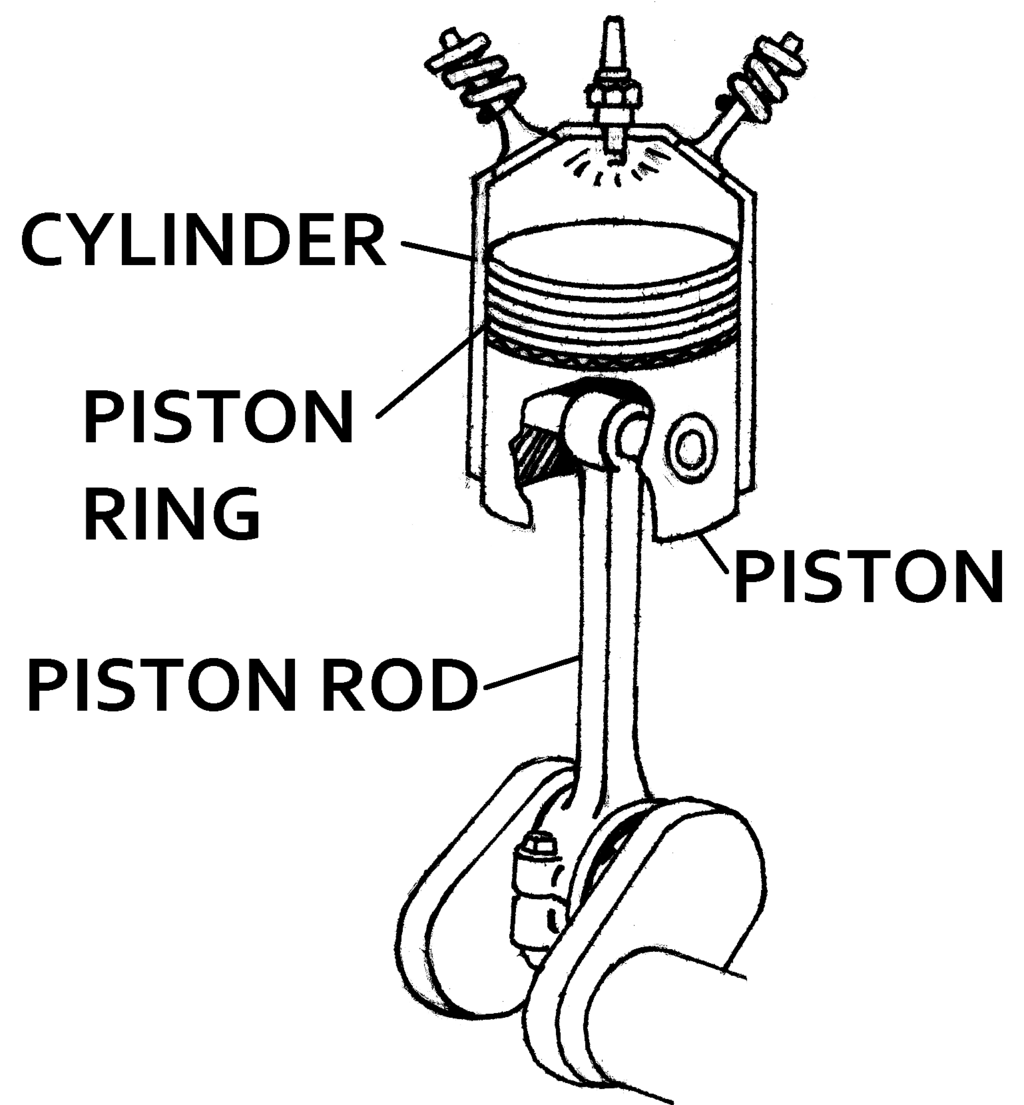
Think of it like riding a bicycle. Your leg pushing down on the pedal is the piston. The pedal and crank arm that turn the wheel are the crankshaft. The engine just does this thousands of times per minute.
The Four-Stroke Cycle
Most car engines operate on what's called a four-stroke cycle. This is the repeating sequence of four events, or strokes, that a piston completes to generate power. This entire process is often nicknamed "suck, squeeze, bang, blow."
- Intake: The piston moves down, creating a vacuum. The intake valve opens, and a mixture of air and fuel is sucked into the cylinder.
- Compression: The intake valve closes, and the piston moves back up, squeezing the fuel-air mixture into a much smaller space. This makes it more combustible.
- Combustion (or Power): With both valves closed, a spark plug ignites the compressed mixture. The resulting explosion creates immense pressure, forcing the piston down with great force. This is the stroke that produces power.
- Exhaust: The piston moves up one last time. The exhaust valve opens, and the piston pushes the burnt gases out of the cylinder to make way for the next cycle.
This cycle happens incredibly fast in each cylinder, creating the continuous power needed to move a vehicle.
Gasoline vs. Diesel
While most engines follow the four-stroke cycle, there's a key difference in how the combustion is triggered. This leads to two main types of engines: spark ignition (gasoline) and compression ignition (diesel).
A spark ignition engine uses a spark plug to ignite the fuel-air mixture. This is what you'll find in most gasoline-powered cars.
A compression ignition engine, on the other hand, doesn't need a spark plug. Instead, it compresses the air in the cylinder so much that it becomes extremely hot. When fuel is injected into this superheated air, it ignites instantly from the heat and pressure alone. This is how diesel engines work, and it's why they are often more powerful and efficient, especially in larger vehicles like trucks and buses.
| Feature | Spark Ignition (Gasoline) | Compression Ignition (Diesel) |
|---|---|---|
| Ignition Method | Spark plug ignites fuel-air mixture | Fuel ignites from high heat of compressed air |
| Fuel Type | Gasoline | Diesel |
| Compression | Lower pressure | Higher pressure |
| Common Use | Cars, motorcycles, light trucks | Trucks, buses, trains, ships |
These fundamental principles—the core components and the four-stroke cycle—are the building blocks for understanding nearly every internal combustion engine on the road today.
Time to check your understanding of how these engines work.
What is the primary function of the crankshaft in an internal combustion engine?
The four-stroke cycle is often nicknamed "suck, squeeze, bang, blow." Which part of this nickname corresponds to the compression stroke?
With these basics down, you have a solid foundation for how millions of vehicles generate their power every day.