Automotive Engine Systems Explained
Engine Basics
Turning Fuel into Motion
An internal combustion engine is a machine that generates power by burning fuel inside itself. The core purpose is simple: to convert the chemical energy stored in fuel, like gasoline, into mechanical energy, which is the force that moves a car's wheels. This entire process happens inside a set of cylinders.
Inside each cylinder is a piston that moves up and down. This linear motion is the key to creating power. The piston is connected to a crankshaft, a specially designed rotating shaft. As the piston moves up and down, it forces the crankshaft to spin. This rotational motion is what ultimately powers the vehicle.
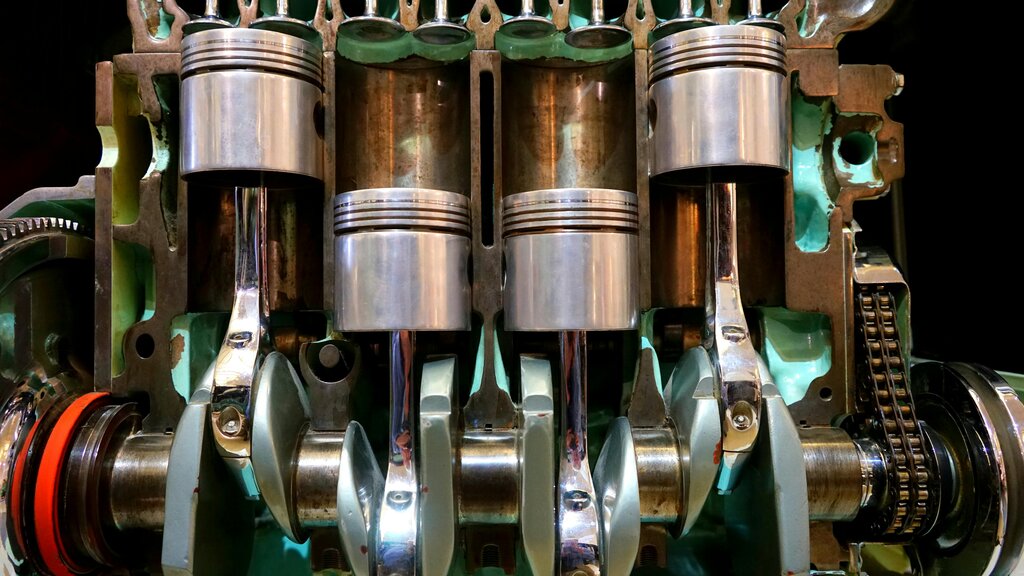
The engine makes the piston move by igniting a mixture of air and fuel in a precisely timed sequence. This sequence is a continuous loop known as the four-stroke cycle.
The Four-Stroke Cycle
Most car engines operate on this cycle, also called the Otto cycle. It consists of four distinct stages, or strokes, that the piston completes for every single power-generating explosion inside the cylinder. A good way to remember the four strokes is with the phrase: "Suck, Squeeze, Bang, Blow."
Each stroke corresponds to a full up or down movement of the piston.
Breaking Down the Strokes
1. Intake Stroke The cycle begins with the piston at the top of the cylinder. It moves downward, creating a vacuum. The intake valve opens, and this vacuum sucks a mixture of air and fuel into the cylinder. Think of it like drawing back the plunger on a syringe.
2. Compression Stroke Once the cylinder is full of the air-fuel mixture, the intake valve closes. The piston then moves back up the cylinder, squeezing the mixture into a much smaller space. Compressing the mixture makes the subsequent explosion much more powerful.
3. Power Stroke With the piston at the top of the cylinder and the mixture tightly compressed, a spark plug ignites it. The resulting explosion creates a massive amount of pressure that violently pushes the piston back down. This is the stroke that generates the power to move the car. It's the "bang" that drives the crankshaft.
4. Exhaust Stroke After the power stroke, the cylinder is full of burnt gases. The exhaust valve opens, and the piston moves back up, pushing these waste gases out of the cylinder and into the exhaust system. Once the piston reaches the top, the cycle is complete and ready to begin again with another intake stroke.
This is a four-part process—intake, compression, power, and exhaust—that repeats thousands of times per minute.
This four-stroke cycle happens incredibly fast, thousands of times every minute, in each of the engine's cylinders. The coordinated power from all cylinders, transmitted through the crankshaft, provides the smooth, continuous force needed to drive a vehicle.
What is the primary function of an internal combustion engine?
Which component is responsible for converting the piston's up-and-down motion into rotational motion?
Understanding this fundamental cycle is the first step to knowing how an engine truly works.