Automatic Control Systems Explained
Introduction to Control Systems
What is a Control System?
At its heart, a control system is simply something that manages the behavior of another system. Its job is to make sure a system does what we want it to do, even when things change. You interact with control systems all day long, from the cruise control in a car that maintains a steady speed to the thermostat that keeps your home at a comfortable temperature.
The main goal is to get a desired output. To do this, a control system processes inputs and adjusts its actions to steer the system toward that goal. Think about riding a bicycle. Your brain is the controller, your eyes are sensors, and your arms and legs are actuators. You constantly make small adjustments to the handlebars and your balance to keep the bike upright and moving in the right direction. That's a control system in action.
Open-Loop vs. Closed-Loop
Control systems come in two main varieties: open-loop and closed-loop. The difference is all about one crucial concept: feedback.
An open-loop system operates without feedback. It follows a pre-set path, regardless of what the final result is.
A simple toaster is a perfect example. You put bread in, set a timer, and the heating elements turn on. When the timer runs out, they turn off. The toaster doesn't know or care if your bread is perfectly golden or burnt to a crisp. Its action is completely independent of the output. Other examples include a typical microwave oven or a clothes dryer running on a timer.
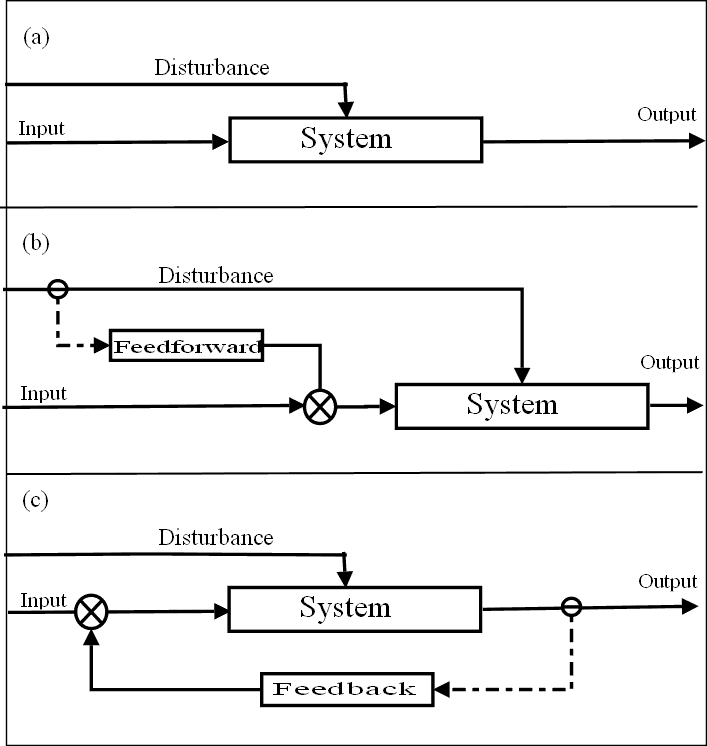
A closed-loop system uses feedback. It measures the output and compares it to the desired goal, then adjusts its actions to minimize any difference.
This is where things get smarter. Your home's thermostat is a classic closed-loop system. You set a desired temperature (the setpoint). The thermostat has a sensor that measures the actual room temperature. It compares the actual temperature to your setpoint. If the room is too cold, the controller tells the furnace to turn on. Once the sensor reports that the room has reached the desired temperature, the controller shuts the furnace off. This continuous loop of measuring, comparing, and adjusting is called feedback.
The Building Blocks
Whether simple or complex, most control systems are made of the same fundamental parts. Let's use the thermostat example to break them down.
| Component | Role | Thermostat Example |
|---|---|---|
| Process | The system or environment being controlled. | The temperature of the air in your house. |
| Sensor | Measures the output of the process. | The thermometer inside the thermostat unit. |
| Controller | The 'brain' that makes decisions. | The thermostat's internal logic that compares the sensor reading to the setpoint. |
| Actuator | The 'muscle' that takes action on the process. | The switch that turns the furnace on or off. |
These components work together in a cycle. The sensor measures the process, the controller compares this measurement to the goal and decides what to do, and the actuator carries out the controller's command to change the process. This loop is what makes closed-loop systems so powerful and stable.
Why Feedback Matters
Feedback is the secret sauce. It allows a system to automatically correct for unexpected changes, or what engineers call disturbances. Imagine you're using cruise control set to 65 mph. That's a closed-loop system. When you start driving up a hill, the car naturally begins to slow down. The speed sensor detects this drop, the controller notices the difference from the 65 mph setpoint, and it signals the engine's actuator (the throttle) to give the car more gas, bringing it back up to speed.
Without feedback, you'd have an open-loop system. You would press the gas pedal to a certain position that should result in 65 mph on a flat road. But as soon as you hit a hill, the car would slow down, and on a downhill slope, it would speed up. You would have to constantly adjust it yourself. Feedback automates that adjustment process, making systems more accurate, reliable, and robust.
Automated feedback loops are closed-chain processes in which a system’s outputs are recurrently used as inputs to influence future system behavior, enabling self-regulation, dynamic adaptation, optimization, or stability.
This principle is everywhere, from industrial manufacturing plants that need to maintain precise temperatures and pressures, to robotics, aviation, and even economic systems. Understanding these basic building blocks is the first step to seeing how the modern world runs.
What is the key feature that distinguishes a closed-loop control system from an open-loop system?
In a home heating system, a thermostat measures the room's temperature, compares it to the desired temperature, and signals the furnace to turn on or off. What is the role of the thermostat in this system?