Automata Theory Essentials
Introduction to Automata Theory
What Are Automata?
Think about a simple vending machine. You insert a coin, press a button, and a snack comes out. The machine doesn't need to understand who you are or why you want a snack. It just follows a simple, rigid set of rules based on your inputs. It's in one state (waiting for money), then your coin moves it to another state (waiting for selection), and your button press moves it to a final state (dispensing the item). In essence, it's a simple abstract machine.
This is the core idea behind an automaton. It's a model of computation, a blueprint for a machine that follows a predefined sequence of operations automatically. These models help us understand the fundamental capabilities and limitations of computers.
Automaton
noun
An abstract self-propelled computing device which follows a predetermined sequence of operations automatically.
Automata don't have to be physical. They are theoretical concepts that allow computer scientists to reason about computation without getting bogged down by the specifics of hardware. They are the building blocks for understanding how a computer processes information.
Languages and Grammars
When we communicate, we use languages that follow specific rules, or grammars. The sentence "The cat sat" is valid in English, but "Sat the cat" is not. The rules of English grammar tell us which sequences of words are correct.
Computers also work with languages, but these are formal languages. A formal language is simply a set of strings that are considered valid according to a specific set of rules. For example, a formal language might include all binary strings that start and end with a '1'.
The rules that define a formal language are called its grammar. A grammar is a precise, mathematical set of rules for generating all possible valid strings in a language. Just as English grammar tells you how to form a valid sentence, a formal grammar tells a computer how to form a valid string.
So, a grammar defines the rules, a language is the set of all things that follow those rules, and an automaton is a machine that can determine if a given string follows the rules.
Why Does This Matter?
This might seem abstract, but automata theory is the backbone of many technologies we use daily. It provides a framework for solving complex computational problems in a systematic way.
For example, every time you type into a search engine or a word processor, an automaton is likely working behind the scenes. It checks your spelling, suggests corrections, and helps parse your query. This process is called lexical analysis.
Other applications include:
- Compilers: When programmers write code in languages like Python or Java, a compiler translates it into machine code that the computer's processor can execute. A key part of the compiler, the parser, is built using principles from automata theory to check if the code follows the language's syntax rules.
- Software Verification: How do you prove that a complex system, like an airplane's control software, will work correctly under all possible conditions? Automata theory provides methods to model the software's states and verify that it never enters a dangerous one.
- Natural Language Processing (NLP): Understanding human language is incredibly complex. Automata help model grammatical structures, enabling applications like translation services and voice assistants.
A Glimpse of the Family
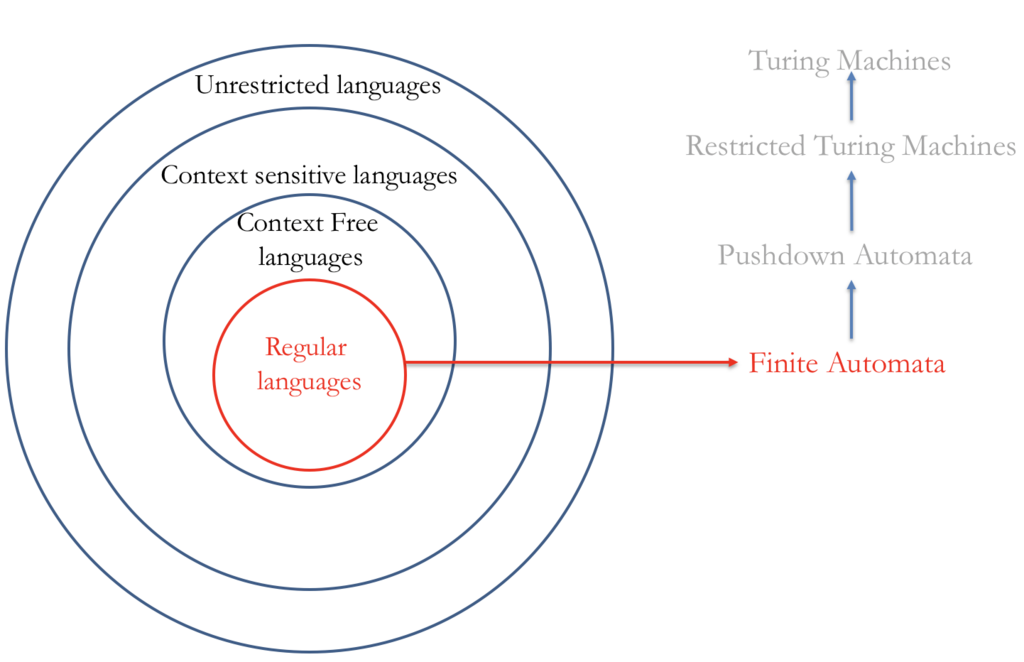
Not all computational problems are equally difficult. Correspondingly, there are different types of automata with varying levels of power. The simplest automata have no memory of past events, while more complex ones can store and retrieve information. This hierarchy allows computer scientists to match the complexity of a problem with the right computational model.
For instance, the task of checking if a number is even requires a very simple automaton. But checking if a piece of code has correctly matched every opening bracket with a closing bracket requires a more powerful machine with some form of memory.
| Automaton Type | Key Feature | Example Task |
|---|---|---|
| Finite Automata | No memory | Recognizing text patterns, like an email address. |
| Pushdown Automata | A stack (last-in, first-out) | Parsing programming language syntax. |
| Turing Machines | An infinite tape (unlimited memory) | Modeling any algorithm a computer can run. |
We will explore these different types in detail later. For now, the key takeaway is that automata theory provides a powerful toolkit for thinking about computation, from the simplest tasks to the most complex algorithms.
What is the primary role of an automaton in theoretical computer science?
The set of rules that define all valid strings in a formal language is called its ______.