Authentic Academic Writing and Independent Reasoning
Cognitive Foundations
Thinking Before Writing
You already know how to build an essay. You have the blueprint for an introduction, body paragraphs, and a conclusion. But a well-built house with nothing inside is just an empty shell. The real work of academic writing happens before you lay the first structural beam. It's about the quality of thought you put into it.
Strong academic essays don't just present information; they solve intellectual problems. They enter a conversation and say something new. The first step is to stop thinking like a reporter who gathers facts and start thinking like a detective who investigates a case. Your goal is to find the point of tension, the complication, or the unanswered question in a topic. This is the 'problematic,' and it's the catalyst for every insightful argument.
Active Interrogation
The fastest way to find the problematic is to stop passively accepting information. Instead, you must actively interrogate your sources and, more importantly, your own assumptions. Before you write a single sentence of your draft, put the topic on trial and cross-examine it. This isn't about finding flaws just for the sake of it. It's about uncovering the complexities and nuances that a surface-level reading would miss.
Start by asking a series of probing questions:
- Why is this topic important? Who cares, and why should they?
- What are the underlying assumptions? What does the author or the prompt take for granted as true?
- What is being left out? What perspectives or pieces of evidence are missing from the conversation?
- How would a different context change things? How would this idea apply in a different time, place, or culture?
- What are the contradictions? Where do different sources or even different parts of the same source disagree?
This method is a modern application of the , a form of disciplined questioning that can be used to explore complex ideas and uncover deep-seated assumptions.
The answers to these questions don't go into your essay directly. Their purpose is to help you find your unique angle. Your thesis statement isn't just a summary of a topic; it's your proposed solution to the intellectual problem you've discovered through interrogation.
The Art of Synthesis
Rarely will all your sources agree. You'll find scholars who contradict each other and data that points in different directions. A novice writer might feel the need to pick a side, siding with the argument that seems most convincing. A sophisticated writer knows that their most powerful contribution comes from holding these conflicting viewpoints in their mind simultaneously.
This is synthesis. It's not about finding a lazy compromise or a simple middle ground. It's about creating a new, more nuanced understanding that accounts for the contradictions. Think of it as a for your own thoughts: you have a thesis (one source's argument) and an antithesis (a conflicting source's argument). Your job is to generate a synthesis—a new idea that resolves the tension between the two, creating a more comprehensive perspective.
Managing this cognitive load can be challenging. A useful technique is mental mapping. Instead of a linear outline, sketch out the arguments visually. Place the central problem in the middle of a page. Then, create branches for different authors or viewpoints. Use sub-branches to link specific pieces of evidence to their claims. Draw lines and arrows between the branches to map out the relationships: where do they agree, disagree, or intersect?
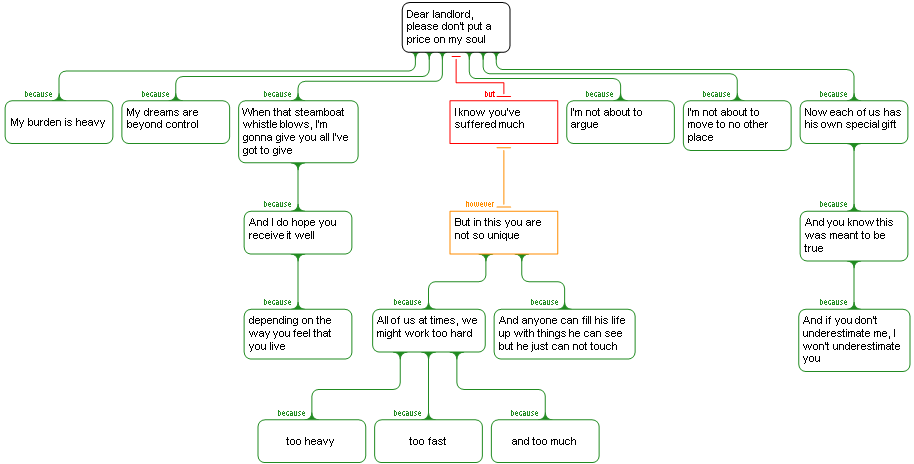
This visual approach helps you see the entire conversation at once. It frees your mind from trying to hold everything in a linear sequence, allowing you to spot new connections and identify the perfect place to insert your own, unique contribution.
According to the text, what is the primary goal of a strong academic essay?
The act of cross-examining a topic by asking probing questions about assumptions, contradictions, and context is compared to what classical technique?