Attentional Intelligence in Women
Introduction to Attention
The Spotlight in Your Mind
Every second, your brain is flooded with information. Sights, sounds, smells, thoughts, and feelings all compete for your mental resources. If you had to process every single piece of data, you’d be completely overwhelmed. This is where attention comes in. It’s the cognitive process of selectively concentrating on one thing while ignoring others.
Think of attention as a spotlight. You can shine it on a specific conversation in a noisy room, a line of text in a book, or the feeling of the sun on your skin. Everything outside that beam of light fades into the background.
Attention
noun
The cognitive process of selectively concentrating on a discrete aspect of information, whether deemed subjective or objective, while ignoring other perceivable information.
Four Ways to Focus
Attention isn't a single skill; it's a set of abilities that we use in different situations. Psychologists generally break it down into four main types.
| Type | What It Is | Everyday Example |
|---|---|---|
| Selective Attention | Focusing on one stimulus while ignoring distractions. | Chatting with a friend at a loud concert, tuning out the music. |
| Sustained Attention | Maintaining focus on a single activity for a long time. | Watching a feature-length movie without getting distracted. |
| Divided Attention | Concentrating on two or more tasks at the same time. | Driving a car while listening to a podcast. |
| Alternating Attention | Shifting focus back and forth between different tasks. | Cooking dinner while switching between a recipe and checking on your kids. |
While we often praise multitasking (divided attention), research shows that our brains aren't truly doing two complex things at once. Instead, we're rapidly using alternating attention, switching our mental spotlight back and forth. This constant shifting can be mentally taxing and often leads to more errors than focusing on one task at a time.
The Brain's Command Center
Attention isn't located in one single spot in the brain. It's managed by a network of interconnected regions, primarily in the cerebral cortex. Two key players are the prefrontal cortex and the parietal lobes.
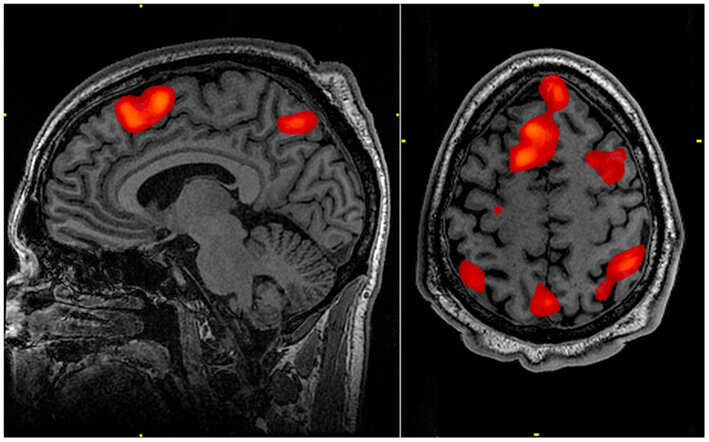
The prefrontal cortex, located right behind your forehead, acts as the executive director. It helps you set goals, make decisions, and direct your attentional spotlight. It’s what you use to consciously decide to focus on your work instead of scrolling through your phone.
The parietal lobes, situated toward the back and top of your head, are more involved in orienting you to sensory information. They help you disengage from one target, move your attention to another, and then engage with the new target. Think of it as the stagehand that moves the spotlight where the director tells it to go.
This network is crucial for nearly every other cognitive function. You can't learn, remember, or solve problems effectively without the ability to first pay attention. It's the gateway to all higher-level thinking.
What is the primary cognitive function of attention?
When a person believes they are 'multitasking' between two complex activities, what is actually happening in their brain?