Attention is All You Need Explained
Introduction to Neural Networks
The Brain as a Blueprint
Neural networks are computing systems inspired by the way our own brains work. Just as our brain is made of billions of cells called neurons that connect to each other, an artificial neural network is built from simple processing units, also called neurons. These artificial neurons are the fundamental building blocks.
Each neuron receives one or more inputs. It then performs a simple calculation. Each input has an associated weight, which is just a number. The weight determines how much influence that input has. A higher weight means the input is more important. The neuron sums up all the weighted inputs, adds a value called a bias, and then passes this sum through an activation function to produce an output.
But a single neuron can't do much on its own. The real power comes from organizing them into layers. A typical neural network has at least three types of layers:
Input Layer: This is the network's front door. It takes in the raw data, like the pixels of an image or the words in a sentence. Hidden Layers: These are the layers between the input and output. This is where most of the computation happens. A network can have one or many hidden layers. The more hidden layers, the "deeper" the network. Output Layer: This is the final layer. It produces the network's result, such as a prediction or a classification.
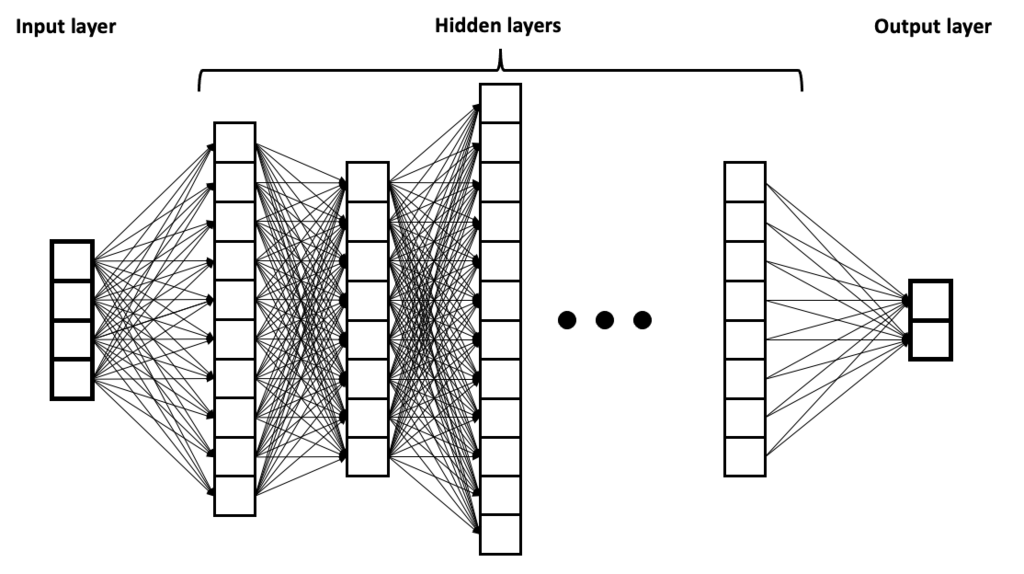
Information flows from the input layer, through the hidden layers, to the output layer. Each neuron in a layer is typically connected to every neuron in the next layer, passing its output forward.
Making Decisions with Math
So, a neuron sums up its weighted inputs. What happens next? It passes that sum through an activation function. This function is a crucial step that helps the network learn complex patterns. Without it, a neural network, no matter how many layers it has, would just be doing simple linear calculations.
The activation function decides whether a neuron should be activated or not, essentially determining if the information it received is important enough to pass on. It introduces non-linearity into the process, allowing the network to model sophisticated relationships in the data.
Think of it like a gatekeeper. It looks at the total signal coming in and decides whether to open the gate and let the signal through to the next layer of neurons.
There are many types of activation functions, but a classic example is the Sigmoid function. It squishes any input value into a range between 0 and 1. This is useful for turning numbers into probabilities. For example, a 0.9 output could mean a 90% chance that an image contains a cat.
The entire process of data moving from the input layer to the output layer is called forward propagation. The network takes your data, passes it through the layers and their activation functions, and makes a guess, or prediction.
Learning From Mistakes
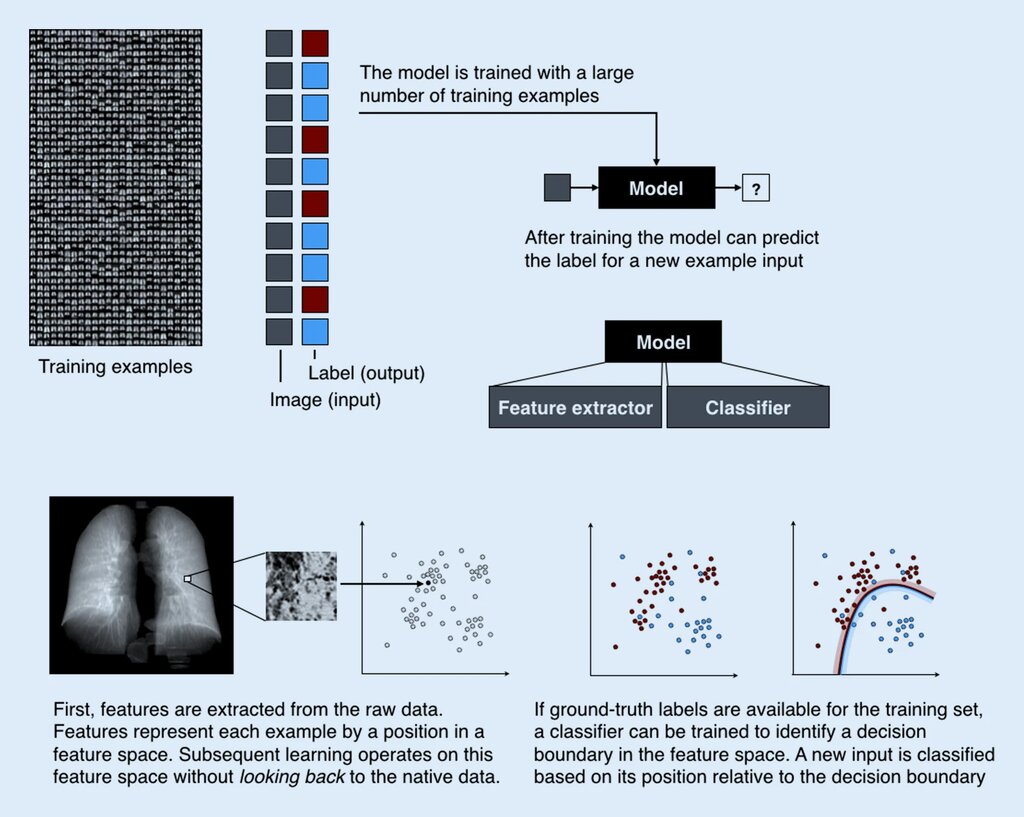
When a network first starts, its weights and biases are random. Its initial predictions are just wild guesses. The process of turning these guesses into accurate predictions is called training.
Training starts by measuring how wrong the network's prediction is. We use a loss function (or cost function) to calculate a score that represents the error. A high loss score means the network's prediction was far from the actual, correct answer. A low score means it was close.
The goal of training is simple: minimize the loss. We want to adjust the network's weights and biases so that its predictions get closer and closer to the right answers.
To do this, we use a process called optimization. The most common optimization algorithm is gradient descent. Imagine the loss function as a hilly landscape, and we want to find the lowest valley. Gradient descent is like taking small steps downhill from our current position until we can't go any lower.
But how does the network know which direction is "downhill"? That's where backpropagation comes in. It's a clever algorithm that works backward from the output layer. It calculates how much each weight and bias contributed to the overall error. These contributions are the gradients, which tell us the direction and magnitude to adjust the weights to reduce the loss.
This cycle of forward propagation, calculating the loss, and backpropagation to update the weights is repeated thousands or even millions of times with lots of training data. With each cycle, the network gets a little bit smarter.
Avoiding Bad Habits
A common problem during training is overfitting. This happens when the model learns the training data too well. It's like a student who memorizes the answers to a specific practice test but hasn't actually learned the underlying concepts. When given a new, unseen test, the student fails.
An overfitted model performs great on the data it was trained on, but it can't generalize its knowledge to new, unseen data. It has memorized the noise and specific details of the training set instead of learning the general patterns.
To combat overfitting, we use techniques called regularization. Regularization methods discourage the model from becoming too complex. For example, one common technique, known as L2 regularization, adds a penalty to the loss function for large weight values. This encourages the network to use smaller, more distributed weights, making it less likely to rely too heavily on any single input feature.
Another popular method is Dropout, where a random fraction of neurons are temporarily "dropped out" or ignored during each training cycle. This forces the other neurons to step up and learn to make predictions without relying on any specific colleagues. It helps create a more robust and less co-dependent network.
Now, let's test what you've learned about the building blocks of neural networks.
What is the primary role of an activation function in a neural network?
Which of the following best describes the process of 'overfitting'?
These fundamental concepts form the basis of nearly all modern deep learning models. By understanding how neurons, layers, and the training process work, you're ready to explore more advanced architectures.