Atomic Structure Unveiled
Subatomic Particles
The Particles Within Particles
You already know that atoms have a nucleus made of protons and neutrons, with electrons orbiting around it. But that's not the end of the story. It turns out that protons and neutrons aren't fundamental. They're made of even smaller, more elementary particles.
Protons and neutrons are built from tiny particles called quarks. There are several types of quarks, but the ones that make up ordinary matter are the "up" quark and the "down" quark. A key feature of quarks is that they have fractional electric charges.
An up quark has a charge of . A down quark has a charge of .
By combining these in different ways, we get the familiar charges of the proton and neutron.
- A proton is made of two up quarks and one down quark (uud). Its total charge is .
- A neutron is made of one up quark and two down quarks (udd). Its total charge is .
Quarks are never found alone; they are always bound together inside larger particles like protons and neutrons.
The Electron's Family
Unlike protons and neutrons, electrons are truly fundamental particles. They are not made of anything smaller. Electrons belong to a family of particles called leptons.
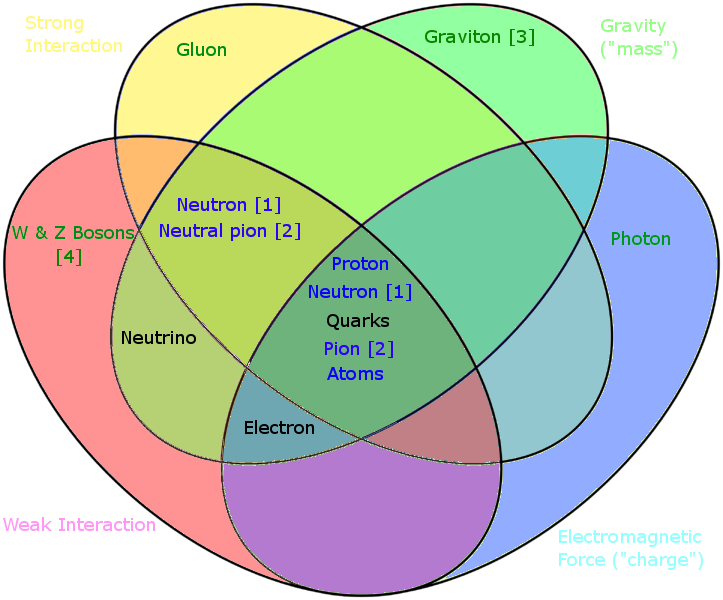
The electron is the most well-known lepton, but it has two heavier, unstable cousins: the muon and the tau. Each of these three charged leptons also has a neutral, nearly massless partner called a neutrino: the electron neutrino, the muon neutrino, and the tau neutrino. Leptons do not feel the strong nuclear force, which is why they are not bound inside the nucleus.
The Messengers of Force
So what holds quarks together inside a proton, or keeps an electron in orbit around a nucleus? In particle physics, forces are not just mysterious pulls or pushes. They are transmitted by an exchange of particles called gauge bosons.
You can think of them as messenger particles. Imagine two people on ice skates throwing a basketball back and forth. The exchange of the ball pushes them apart. Gauge bosons work in a similar way, carrying the fundamental forces of nature between other particles.
| Force | Carrier Particle (Boson) | What it Does |
|---|---|---|
| Strong Nuclear | Gluon | Binds quarks together inside protons & neutrons |
| Electromagnetic | Photon | Governs electricity, magnetism, and light |
| Weak Nuclear | W and Z bosons | Responsible for certain types of radioactive decay |
| Gravity | Graviton (hypothetical) | The force of attraction between masses |
The strong force, carried by gluons, is incredibly powerful at short distances, effectively “gluing” quarks together. The electromagnetic force, carried by photons, is what holds atoms together by binding electrons to the nucleus.
The Origin of Mass
One final piece of the puzzle is the Higgs boson. For a long time, physicists couldn't explain why fundamental particles have mass. Why isn't a W boson massless like a photon? The answer lies with the Higgs field, an energy field that permeates the entire universe.
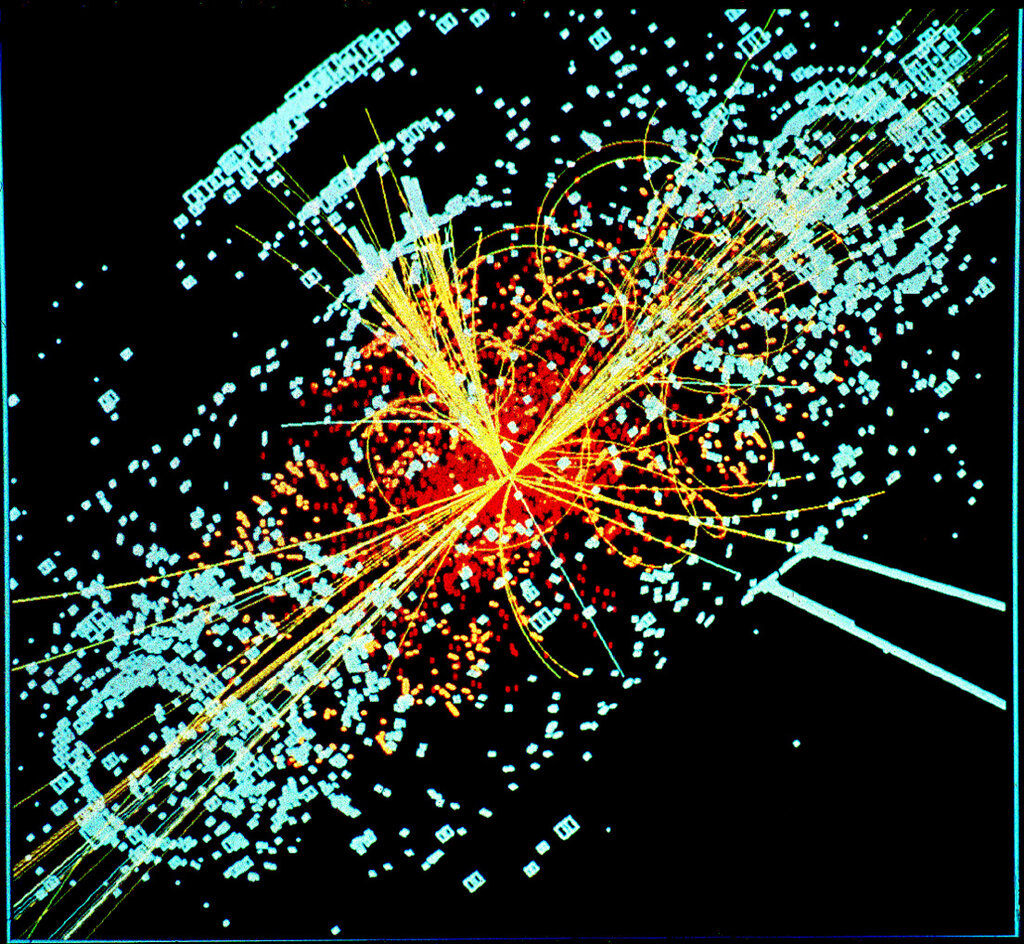
Particles acquire mass by interacting with this field. You can imagine the Higgs field as a room full of people at a party. A very famous person walking through the room will attract a crowd, making it difficult for them to move. They have a lot of “mass.” Someone less known can walk through easily with little interaction, like a particle with less mass.
The Higgs boson is an excitation, or a ripple, in this field. Its discovery in 2012 at the Large Hadron Collider was a monumental achievement, confirming this long-held theory about how fundamental particles get their mass.
Now, let's test your understanding of these fundamental building blocks of our universe.
What is the quark composition of a proton?
Which of the following is considered a fundamental particle, meaning it is not made up of smaller particles?
Together, quarks, leptons, and bosons form the basis of the Standard Model of Particle Physics, our current best description of the fundamental particles and forces that make up everything around us.