Atomic Structure Fundamentals
Subatomic Particles
Inside the Atom
Atoms are the basic building blocks of all matter, from the air we breathe to the stars in the sky. But atoms themselves are made of even smaller pieces. These are called subatomic particles. The three main ones you need to know are protons, neutrons, and electrons. Each one has a unique role in the structure and behavior of an atom.
Subatomic
adjective
Smaller than or existing within an atom.
Let's start at the center. Every atom has a dense core called the nucleus. It's tiny compared to the whole atom, like a marble in the middle of a football stadium. The nucleus is where we find two of our key particles: protons and neutrons.
Protons carry a positive electrical charge. Think of it as a fundamental property, like being hot or cold. A proton is always positive. They also have a significant mass, at least compared to other subatomic particles.
The number of protons in an atom's nucleus is what defines the element. An atom with one proton is always hydrogen. An atom with six protons is always carbon. Change the number of protons, and you change the element entirely.
Neutrons are the proton's partner in the nucleus. As their name suggests, they are neutral. They have no electrical charge at all. Their mass is almost identical to that of a proton. So, the nucleus is a tightly packed bundle of positively charged protons and neutral neutrons, giving it an overall positive charge.
The Electron Cloud
What about the electrons? Electrons carry a negative electrical charge, exactly opposite to the proton's positive charge. In a neutral atom, the number of electrons equals the number of protons. This balance of positive and negative charges is what makes the atom electrically neutral overall.
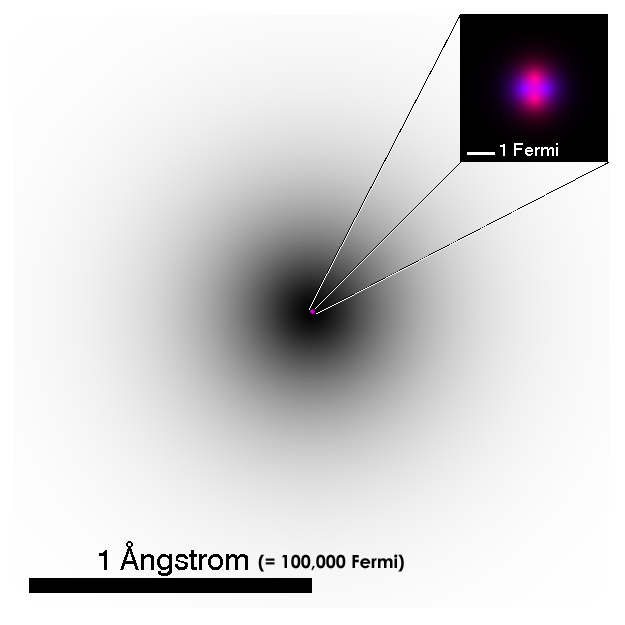
Unlike protons and neutrons, electrons are not in the nucleus. Instead, they exist in a region surrounding the nucleus called the electron cloud. This isn't a literal cloud; it's a way to describe the area where electrons are most likely to be found. They are constantly in motion, zipping around the nucleus at incredible speeds.
The other key difference is mass. An electron's mass is tiny, almost negligible when compared to a proton or a neutron. It takes nearly 2,000 electrons to equal the mass of a single proton. For this reason, most of an atom's mass is concentrated in its nucleus.
| Particle | Charge | Relative Mass | Location |
|---|---|---|---|
| Proton | Positive (+1) | ~1 | Nucleus |
| Neutron | Neutral (0) | ~1 | Nucleus |
| Electron | Negative (-1) | ~1/1836 | Electron Cloud |
These three particles build the atoms that make up everything. The positive protons in the nucleus hold the negative electrons in their cloud through electrical attraction, forming a stable atom.
Ready to check your understanding? Let's see what you've learned.
Which subatomic particles are found in the nucleus of an atom?
What is the electrical charge of a neutron?
Understanding these fundamental pieces is the first step to exploring the fascinating world of chemistry and physics.