Atomic Structure and the Building Blocks of Matter
Early Atomic Models
Dalton's Solid Sphere
In the early 1800s, English chemist John Dalton revived an ancient Greek idea: that all matter is made of tiny, fundamental particles called atoms. He wasn't the first to think of atoms, but he was the first to base the idea on experimental evidence from his work with gases.
Dalton's atomic theory had a few key points:
- All matter is composed of atoms.
- Atoms are indivisible and indestructible.
- Atoms of a given element are identical in mass and properties.
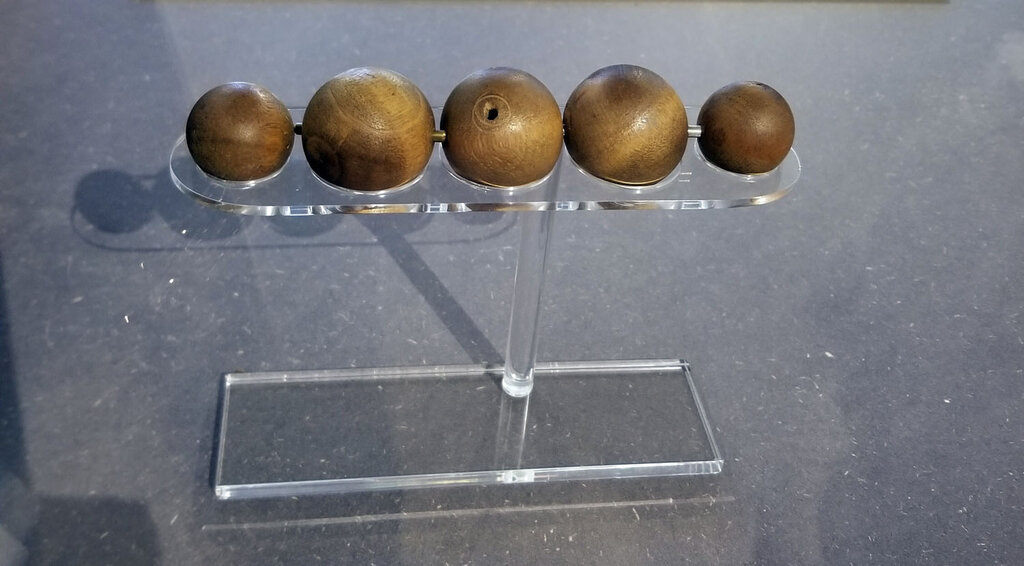
Think of his model as a tiny, solid, featureless sphere, like a microscopic billiard ball. For Dalton, the atom was the absolute smallest unit of matter. There was nothing smaller.
A Crack in the Sphere
Dalton's model was a huge step forward, but it didn't last. Near the end of the 19th century, a physicist named J.J. Thomson was experimenting with cathode ray tubes. These are glass tubes with the air pumped out, containing two metal electrodes.
When a high voltage is applied across the electrodes, a mysterious beam, or "cathode ray," flows from the negative electrode (the cathode) to the positive one (the anode). Thomson wanted to figure out what this beam was made of.
Thomson placed electric plates around the beam. He observed that the ray bent towards the positive plate. Since opposites attract, this meant the beam had to be made of negatively charged particles.
By measuring how much the beam bent, Thomson calculated the mass-to-charge ratio of these particles. He discovered they were about 1,800 times lighter than a hydrogen atom, the lightest known atom. This was a shocking result. Dalton's indivisible atom could, in fact, be broken apart. Thomson had discovered the first subatomic particle.
electron
noun
A stable, subatomic particle with a negative electric charge. Electrons are found in all atoms.
The Plum Pudding Model
The discovery of the electron meant the atomic model needed a major update. Atoms as a whole are electrically neutral, so if they contain tiny negative particles (electrons), they must also contain a positive charge to balance things out.
In 1904, Thomson proposed the "plum pudding" model. He pictured the atom as a sphere of uniformly distributed positive charge, sort of like the dough of a pudding. Scattered throughout this positive sphere were the negatively charged electrons, like plums or raisins stuck in the pudding. This model was the first to suggest that atoms have an internal structure.

Let's review the shift from Dalton's simple sphere to Thomson's more complex model.
Which of the following was a key point of John Dalton's atomic theory?
What crucial discovery by J.J. Thomson proved that Dalton's model of an indivisible atom was incorrect?
Thomson's model explained the existence of the electron and the neutrality of the atom. But it was just another step in the journey. New experiments would soon challenge the idea of a uniform positive pudding and lead to an even more refined picture of the atom.