Atomic Mechanics and Matter Transformation
Quantum Electron Dynamics
An Electron's Address
Electrons don't circle the nucleus in neat, planet-like orbits. Instead, they exist in fuzzy, three-dimensional regions of probability called orbitals. To pinpoint an electron's location and energy within an atom, we need a system more precise than simple shells. This system is a set of four quantum numbers.
Think of these numbers as an electron's unique address. Just as no two houses share the exact same address, no two electrons in an atom can have the same four quantum numbers. This is a fundamental rule known as the Pauli exclusion principle.
The four quantum numbers—principal, angular momentum, magnetic, and spin—work together to describe the state of any electron in an atom.
Let's break down this atomic address system:
-
Principal Quantum Number (): This describes the main energy level, or shell. It's like the city an electron lives in. Higher values of (1, 2, 3, ...) mean the electron is in a higher energy level and generally farther from the nucleus.
-
Angular Momentum Quantum Number (): This defines the shape of the orbital within a shell. It's the street name. Its value can be any integer from 0 up to . Each value of corresponds to a different subshell, often denoted by letters: is an 's' orbital, is a 'p' orbital, is a 'd' orbital, and is an 'f' orbital.
-
Magnetic Quantum Number (): This specifies the orbital's orientation in space. It's the house number on the street. It can be any integer from to , including 0. For a p-orbital (), can be -1, 0, or +1, representing three different spatial orientations.
-
Spin Quantum Number (): This describes the intrinsic angular momentum of the electron, a property we call 'spin'. It's like identifying one of two possible residents in the house. It can only have one of two values: ('spin up') or ('spin down').
| Quantum Number | Symbol | Possible Values | Describes |
|---|---|---|---|
| Principal | Energy level and size | ||
| Angular Momentum | Orbital shape (subshell) | ||
| Magnetic | Orbital orientation in space | ||
| Spin | Electron spin direction |
Orbital Shapes
The angular momentum quantum number, , directly determines the shape of the electron's orbital. These shapes aren't random; they are mathematical solutions to the Schrödinger equation, representing regions where an electron is most likely to be found.
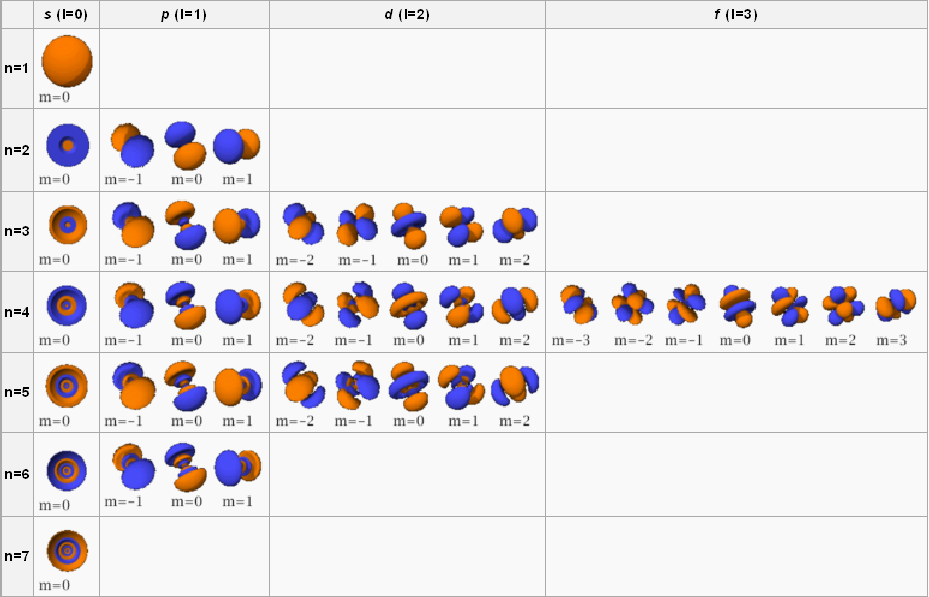
The simplest orbital is the s orbital (). It's a sphere centered on the nucleus. Every energy level ( etc.) has one s orbital.
Next are the p orbitals (), which appear starting from the second energy level (). They have a dumbbell shape and are oriented along the x, y, and z axes. Since can be -1, 0, or +1 for , there are three p orbitals in each subshell, each pointing in a different direction.
At the third energy level (), we encounter the d orbitals (). These have more intricate shapes, often resembling cloverleaves. There are five d orbitals, corresponding to the five possible values for (-2, -1, 0, +1, +2).
Finally, the f orbitals () appear from onwards. They have even more complex, multi-lobed shapes. There are seven distinct f orbitals in each f subshell.
Filling the Orbitals
With the orbital structure in place, we can determine the electron configuration of any atom, which is the specific arrangement of its electrons. Three rules govern this process.
- Aufbau Principle: Electrons fill the lowest available energy orbitals first.
- Pauli Exclusion Principle: Each orbital can hold a maximum of two electrons, and they must have opposite spins.
- Hund's Rule: When filling orbitals of equal energy (like the three p orbitals), electrons fill each orbital singly before any orbital gets a second electron.
The energy of orbitals doesn't always follow the simple numerical order of the principal quantum number . For instance, the 4s orbital is actually lower in energy than the 3d orbitals. This overlap is crucial for understanding the properties of transition metals.
Let's apply these rules to Scandium (Sc), the first transition metal, with 21 electrons.
Following the Aufbau principle, we fill orbitals in order of increasing energy: $1s, 2s, 2p, 3s, 3p, 4s, 3d$.
- $1s^2 2s^2 2p^6 3s^2 3p^6$: This configuration accounts for the first 18 electrons, matching the noble gas Argon (Ar).
- $4s^2$: The next two electrons go into the 4s orbital.
- $3d^1$: The final electron goes into the 3d subshell.
The full electron configuration for Scandium is $1s^2 2s^2 2p^6 3s^2 3p^6 4s^2 3d^1$. It is often abbreviated using the preceding noble gas: $[Ar] 4s^2 3d^1$.
Shielding and Nuclear Charge
The chemical behavior of an atom is dominated by its valence electrons, those in the outermost shell. How strongly these electrons are held by the nucleus explains many periodic trends, like atomic size and ionization energy.
Two competing forces are at play:
- The attraction between the positively charged nucleus and the negatively charged electrons.
- The repulsion between the inner-shell (core) electrons and the outer-shell (valence) electrons.
This repulsion from core electrons creates a shielding effect. The core electrons essentially block or 'shield' the valence electrons from the full attractive pull of the nucleus. This leads to the concept of effective nuclear charge ().
Imagine being in a crowded room trying to listen to someone on a stage. The people between you and the stage () make it harder to hear the speaker (). The actual volume you perceive is the effective sound ().
How does change across the periodic table?
-
Across a period (left to right): The number of protons () increases, pulling electrons in more tightly. Electrons are added to the same shell, so they don't shield each other very effectively. The result is that increases significantly.
-
Down a group: The number of protons () also increases, but a new electron shell is added. This new shell is farther from the nucleus, and the electrons within it are heavily shielded by all the inner shells. The increase in shielding largely cancels out the increase in nuclear charge, so increases only slightly.
The key insight is that almost every periodic trend traces back to the same fundamental forces: the attraction between positive protons and negative electrons, modified by distance and shielding.
This concept of is the 'why' behind the periodic trends you're familiar with.
For example, ionization energy—the energy required to remove an electron—increases across a period. This is because a higher holds the valence electrons more tightly, making them harder to remove. It decreases down a group because the valence electrons are in a higher energy level, farther from the nucleus and better shielded, making them easier to remove.
Similarly, electronegativity, an atom's ability to attract electrons in a chemical bond, follows the same pattern. A higher means a stronger pull on electrons, leading to higher electronegativity across a period.
Which of the following quantum numbers primarily describes the main energy level of an electron?
According to the Pauli exclusion principle, no two electrons in the same atom can have the identical set of four quantum numbers.