Atomic Architecture and Matter Transformation
Quantum Orbital Dynamics
Beyond Fixed Orbits
The Bohr model gave us a useful picture of electrons in neat, circular orbits around a nucleus. But the reality is much stranger and more interesting. Electrons don't follow predictable paths like planets. Instead, they exhibit wave-particle duality, meaning they have properties of both particles and waves. This wave-like nature means we can't pinpoint an electron's exact location.
To describe this behavior, we turn to the Schrödinger wave equation. It's the central equation of quantum mechanics for atoms. Solving it doesn't give us a precise path; it gives us a wave function, represented by the Greek letter psi, .
The wave function itself isn't directly observable. Its real significance comes from its square, . This value represents the probability density—the likelihood of finding the electron at a particular point in space. Instead of a fixed orbit, we get a three-dimensional region of high probability, which we call an orbital. Think of it as a cloud of probability, densest where the electron is most likely to be found.
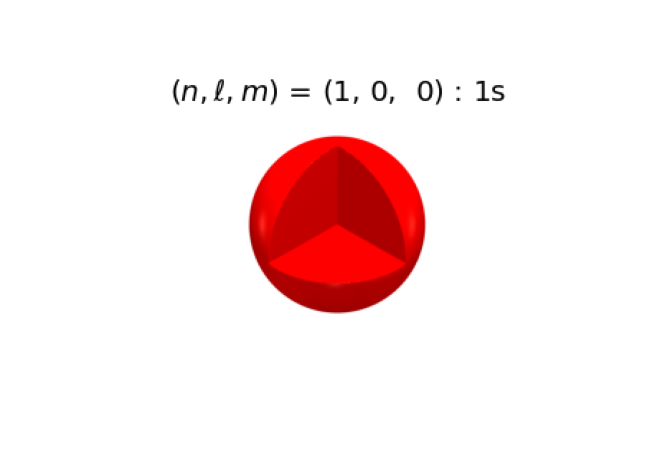
An Electron's Address
The solutions to the Schrödinger equation yield a set of four quantum numbers that describe the state and location of each electron in an atom. They act like a unique address, specifying the electron's energy, the shape of its orbital, its orientation in space, and its intrinsic spin. No two electrons in the same atom can have the exact same four quantum numbers—this is known as the Pauli exclusion principle.
| Quantum Number | Symbol | Describes | Allowed Values |
|---|---|---|---|
| Principal | Energy level & size | Integers: | |
| Angular Momentum | Orbital shape | Integers from to | |
| Magnetic | Orbital orientation | Integers from to | |
| Spin | Electron spin | or |
The principal quantum number, , is the most important factor in determining an electron's energy and its average distance from the nucleus. Higher values of mean higher energy and a larger orbital.
The angular momentum quantum number, , defines the shape of the orbital. Chemists often use letters as shorthand for the value of : an orbital is called an s orbital (sharp), is a p orbital (principal), is a d orbital (diffuse), and is an f orbital (fundamental). For a given , there can be multiple subshells, each with a different shape.
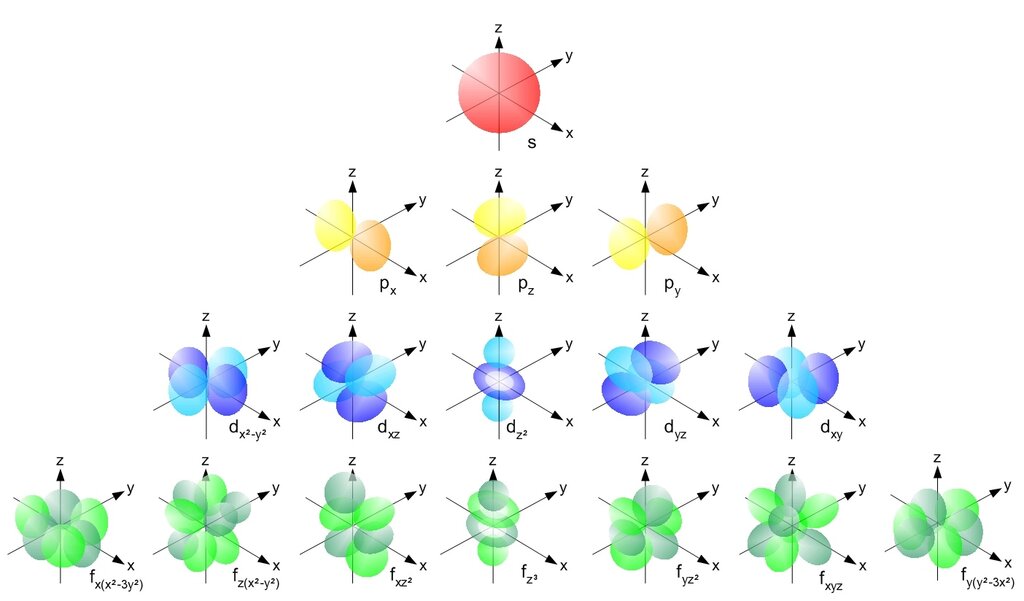
The magnetic quantum number, , specifies the orientation of that orbital in space. For example, a p orbital () can have values of -1, 0, or +1. This corresponds to three p orbitals () oriented along the x, y, and z axes. An s orbital () has only one possible orientation () because it's a sphere.
Finally, the spin quantum number, , describes an intrinsic property of the electron called spin. It can be visualized as the electron spinning on its axis, creating a tiny magnetic field. The spin can be in one of two directions: spin up () or spin down ().
Shielding and Penetration
In atoms with more than one electron, things get more complicated. Electrons repel each other. An electron in an outer shell is simultaneously attracted to the positive nucleus and repelled by the negative electrons in inner shells. This repulsion from inner-shell electrons effectively 'shields' the outer electron from the full pull of the nucleus.
This leads to the concept of effective nuclear charge (), which is the net positive charge experienced by a specific electron. It's always less than the actual nuclear charge (, the number of protons).
A simple way to estimate the screening constant, , is by using Slater's rules. These rules assign a specific shielding value to each electron based on its shell and subshell, allowing for a quantitative calculation of . For example, electrons in the same shell shield each other less effectively than electrons in inner shells do.
The shape of an orbital also influences how much an electron is shielded. Some orbitals are better at 'penetrating' the inner electron clouds and getting closer to the nucleus. For a given energy level , s orbitals penetrate the most, followed by p, then d, and finally f orbitals.
Penetration order:
An electron that penetrates more deeply experiences a higher because it spends more time inside the inner electron shells, feeling a stronger pull from the nucleus. This penetration effect lowers the energy of the orbital. This is why, for example, the 4s orbital fills before the 3d orbital—its superior penetration makes it slightly lower in energy, despite being in a higher principal shell.
These concepts—quantum numbers, orbital shapes, shielding, and penetration—provide the fundamental 'why' behind the structure of the periodic table and the chemical behavior of the elements. The way electrons fill these orbitals, known as electron configuration, dictates an atom's reactivity, bonding preferences, and ultimately, its role in the universe.
What does the square of the wave function, , represent in quantum mechanics?
Which set of quantum numbers () is NOT possible for an electron in an atom?