Atmospheric Electrodynamics of Thunder and Lightning
Cloud Polarization Mechanics
The Cloud as a Capacitor
A towering cumulonimbus cloud is more than just a mass of water vapor; it's a colossal atmospheric generator. Through a process of charge separation, these storm clouds become giant natural capacitors, storing immense electrical potential. While the general principle is understood, the precise mechanisms are a fascinating area of atmospheric physics. The leading theory points to a process called non-inductive charging, where charge is transferred through collisions between particles inside the cloud without any pre-existing electric field.
Collisions in the Chaos
Inside a mature thunderstorm, the environment is a turbulent mix of powerful updrafts and downdrafts. This chaotic airflow churns a variety of hydrometeors: regular water droplets, ice crystals, and soft hail pellets known as graupel.. The key interaction for charge separation occurs between falling graupel and rising, smaller ice crystals. They are on a constant collision course, driven by gravity and the storm's internal winds.
Graupel
noun
Soft, opaque ice particles formed when supercooled water droplets freeze onto a falling snowflake or ice crystal. Also known as soft hail or snow pellets.
When a heavier graupel pellet collides with a lighter ice crystal, a transfer of charge occurs. The direction of this transfer depends critically on the ambient temperature and the presence of ..
In the colder upper regions of the cloud (below about -15°C), the ice crystal gives up a positive ion (or gains an electron) upon collision, leaving the ice crystal with a net negative charge and the graupel with a positive charge.
However, in the warmer, moisture-rich middle section of the cloud (between -10°C and -15°C), the opposite happens. Here, supercooled water droplets are abundant. As these droplets freeze onto the surface of a graupel pellet, they release latent heat, making the graupel's surface slightly warmer than the surrounding ice crystals. During a collision in this zone, the warmer graupel transfers a net negative charge to the colder ice crystal. In reality, it is more complex, with evidence suggesting that the graupel becomes negatively charged and the ice crystal becomes positively charged in this warmer region. This is the dominant mechanism for creating the primary charge structure in a thunderstorm.
Building the Poles
These microscopic collisions, repeated billions of times, establish the storm's overall electrical structure. The storm's powerful updraft plays a crucial role in maintaining this separation. It easily lifts the lighter, now positively charged ice crystals towards the top of the cloud, forming a large positive charge region.
The heavier, negatively charged graupel pellets are less affected by the updraft and tend to sink or accumulate in the middle and lower regions of the storm. This creates a large region of net negative charge in the cloud's center.
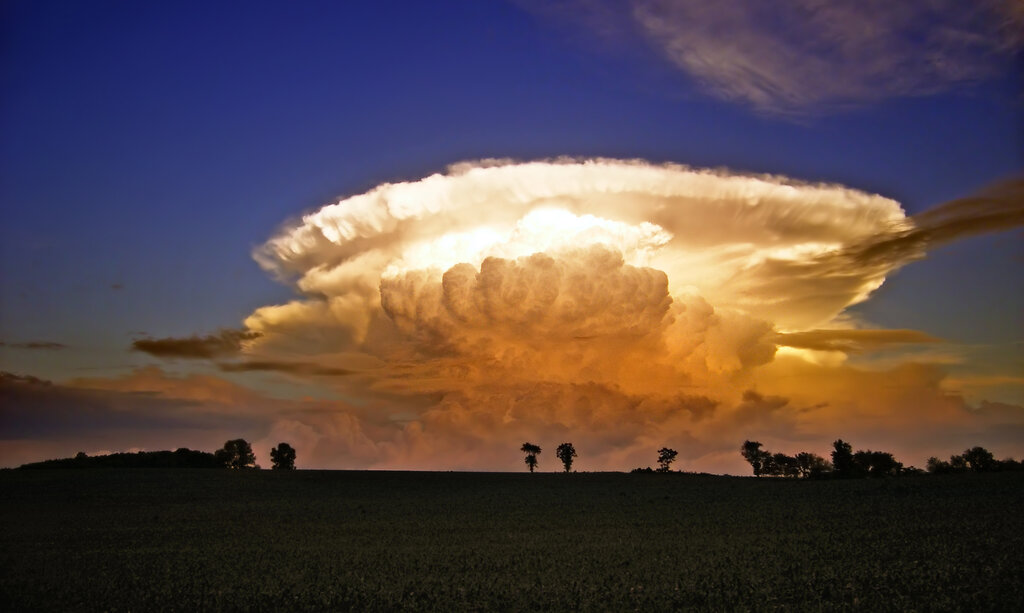
This typical arrangement is known as a positive dipole structure, with a positive pole at the top and a negative pole in the middle. Often, a smaller, third region of positive charge can form near the cloud base, as precipitation and other effects modify the structure. This creates a more complex tripole structure. It is the immense electrical potential difference between these charged regions, or between a region and the ground, that ultimately leads to lightning.
What is the primary mechanism responsible for charge separation within a thunderstorm, according to the leading theory?
In the colder upper regions of a cumulonimbus cloud (below -15°C), what is the result of a collision between a graupel pellet and an ice crystal?