Astrophysics Fundamentals Unveiled
Introduction to Astrophysics
What Is Astrophysics?
Astrophysics is where the universe's biggest questions meet the fundamental laws of physics. It's the science of figuring out what stars, planets, and galaxies are made of, how they work, and how they came to be.
Think of it this way: traditional astronomy is like mapping a forest. It tells you where the trees are, how far apart they are, and how the landscape is laid out. Astrophysics, on the other hand, is like being a biologist in that forest. It asks: How do these trees grow? What are they made of? What makes the seasons change? It applies the rules of physics—gravity, light, and atomic theory—to the entire cosmos.
Astrophysics
noun
The branch of astronomy that uses the principles of physics and chemistry to understand the nature of celestial objects and the universe itself.
Our Cosmic Address
The universe has a structure, a bit like a cosmic nesting doll. To get a sense of scale, let's zoom out from our own home.
We live on a planet called Earth. It's a rocky world that orbits a star. That star is the Sun. Stars are massive, glowing spheres of hot gas that generate energy through nuclear fusion in their cores.
The Sun is just one of hundreds of billions of stars in our galaxy, the Milky Way. A galaxy is a huge, gravitationally bound system of stars, stellar remnants, interstellar gas, dust, and dark matter. Looking up at a clear night sky, you can see a faint, milky band of light—that's the disk of our own galaxy seen from the inside.
And the Milky Way is just one of trillions of galaxies in the observable universe. When we point our most powerful telescopes at what seems like an empty patch of sky, we find it's filled with them.
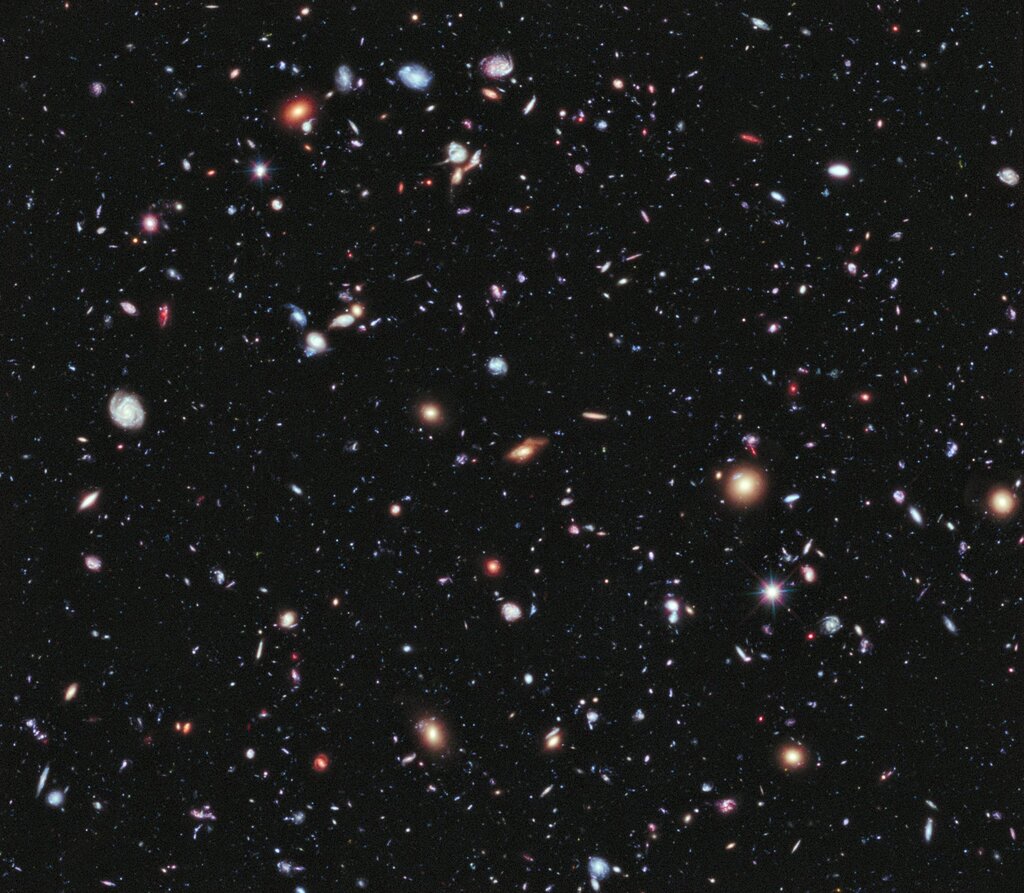
Each of those points of light is an entire galaxy, some seen as they were billions of years ago. This cosmic hierarchy—planets around stars, stars in galaxies, galaxies in the universe—forms the basic structure that astrophysicists study.
Reading the Light
So how do we know any of this? We can't visit a distant star or take a sample from another galaxy. The primary tool of astrophysics is observation, and our main source of information is light.
Everything we've learned about the cosmos comes from carefully collecting and analyzing electromagnetic radiation, which includes everything from visible light to radio waves, X-rays, and gamma rays. This light carries an incredible amount of information. By studying it, we can determine a star's temperature, its chemical composition, how fast it's moving, and even its age.
Astrophysics is the ultimate detective story. The clues are photons of light that have traveled for millions or billions of years to reach our telescopes.
This process relies on the scientific method. An astrophysicist might observe something unexpected, like a star dimming periodically. They would then form a hypothesis: perhaps an unseen planet is orbiting the star and blocking its light. Next, they would make predictions based on this idea—if it's a planet, the dimming should be regular and predictable. Finally, they would conduct more observations to test that prediction.
If the observations match the predictions, the hypothesis is strengthened. If not, it's time to go back to the drawing board. This cycle of observation, hypothesis, and testing is how we slowly build a more accurate picture of the universe.
Let's check your understanding of these foundational concepts.
What is the primary distinction between traditional astronomy and astrophysics?
Which of the following correctly lists cosmic structures in order of increasing size?
By combining observation with the laws of physics, we can begin to piece together the story of the cosmos.