Astrophysics Fundamentals
Introduction to Astrophysics
From Stargazing to Science
For most of human history, astronomy was about mapping the sky. People watched the predictable paths of the sun, moon, and planets, using them to create calendars and navigate oceans. It was a science of where things were.
Then, in the 19th century, something changed. Scientists began to apply the laws of physics and chemistry to the stars. The question shifted from where celestial objects are to what they are made of and how they work. This was the birth of astrophysics.
A key breakthrough was spectroscopy, the science of decoding light. By passing starlight through a prism, astronomers could see it split into a rainbow of colors, a spectrum. But this stellar rainbow wasn't perfect. It was crossed by dark lines.
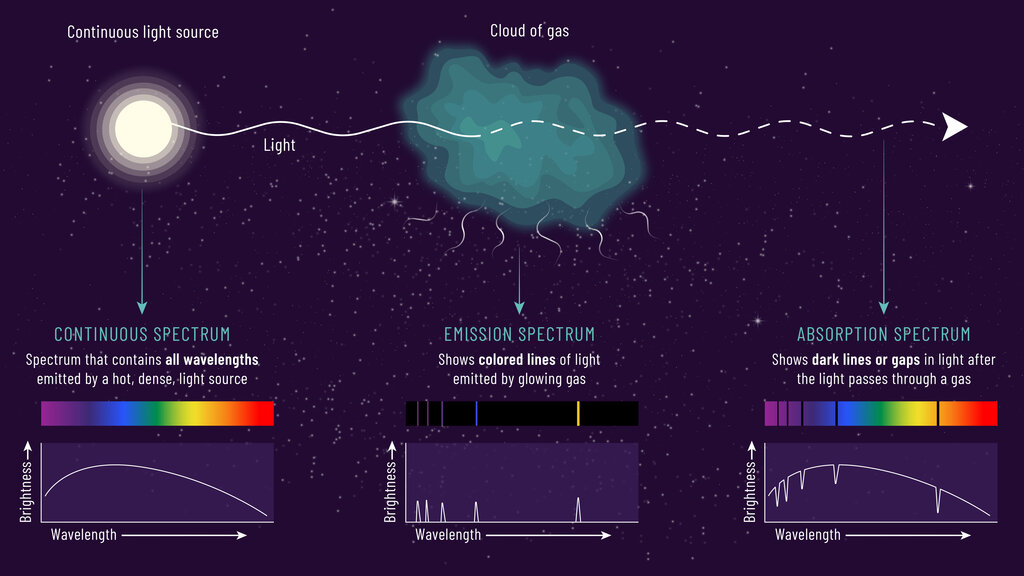
These lines were like a chemical barcode. Each element—hydrogen, helium, iron—absorbs light at specific, unique wavelengths when it's in a gaseous state. By matching the pattern of dark lines in a star's spectrum to the known patterns of elements in a lab, we could figure out what stars are made of, all from millions of light-years away. For the first time, we could analyze the chemistry of the cosmos.
Seeing the Invisible
The light our eyes can see is just a tiny fraction of the information streaming across the universe. Light is a form of electromagnetic radiation, which travels in waves of different lengths. The full range of these wavelengths is called the electromagnetic spectrum.
Visible light sits in a narrow band. On one side are longer wavelengths like infrared and radio waves. On the other are shorter, more energetic wavelengths like ultraviolet, X-rays, and gamma rays. Different cosmic objects and events shine brightest in different parts of this spectrum.
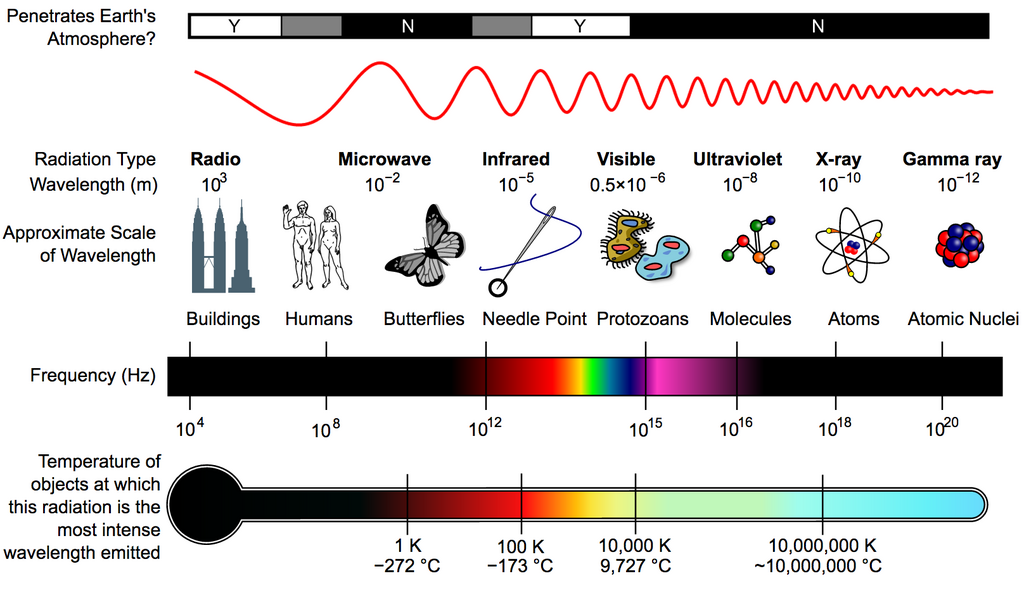
Cold, dusty clouds where stars are born glow in infrared. The superheated gas swirling around a black hole blasts out X-rays. The most violent explosions in the universe, like supernovae, release bursts of gamma rays. To get a complete picture of an object, astrophysicists need to observe it across the entire spectrum. Relying only on visible light is like listening to a symphony but only being able to hear the violins.
The Astrophysicist's Toolkit
To capture this light, astrophysicists use telescopes. These are essentially light buckets, designed to collect as much radiation as possible from faint, distant sources. Early telescopes used lenses to bend and focus light, and are called refracting telescopes. Most modern research telescopes use giant, curved mirrors to gather and focus light. These are called reflecting telescopes.
Many wavelengths of light are blocked by Earth's atmosphere. This is great for life on the surface, as it shields us from harmful X-rays and gamma rays. But it's a problem for astronomers. To see the universe in these wavelengths, we have to send telescopes into space, above the atmosphere. This is why we have observatories like the Hubble Space Telescope (which sees mostly visible and ultraviolet light) and the Chandra X-ray Observatory.
Modern astrophysics isn't just about taking pictures. Instruments attached to telescopes can perform spectroscopy, measure the brightness of objects with incredible precision, and track their motion. All this data is fed into computers, where scientists create models to test their theories about how the universe works. Astrophysics is a blend of observation, theory, and computation, all aimed at understanding our cosmic home.
What fundamental question marked the shift from classical astronomy to modern astrophysics?
An astrophysicist analyzing starlight passed through a prism sees a rainbow crossed by a specific pattern of dark lines. What do these lines directly reveal?