Astronomy Essentials
Introduction to Astronomy
What is Astronomy?
Astronomy is the science of everything in the universe beyond Earth's atmosphere. From the Moon and the Sun to distant stars and galaxies, if it's in space, it falls under the umbrella of astronomy. It’s one of the oldest sciences, born from our natural curiosity about the night sky.
Astronomy is the study of celestial objects and phenomena outside of Earth’s atmosphere.
Astronomers use observations and the laws of physics to understand how the universe began, how it evolved, and how it works today. It’s important not to confuse astronomy with astrology, which is a belief system that claims to predict human events based on the positions of celestial objects.
Our Cosmic Address
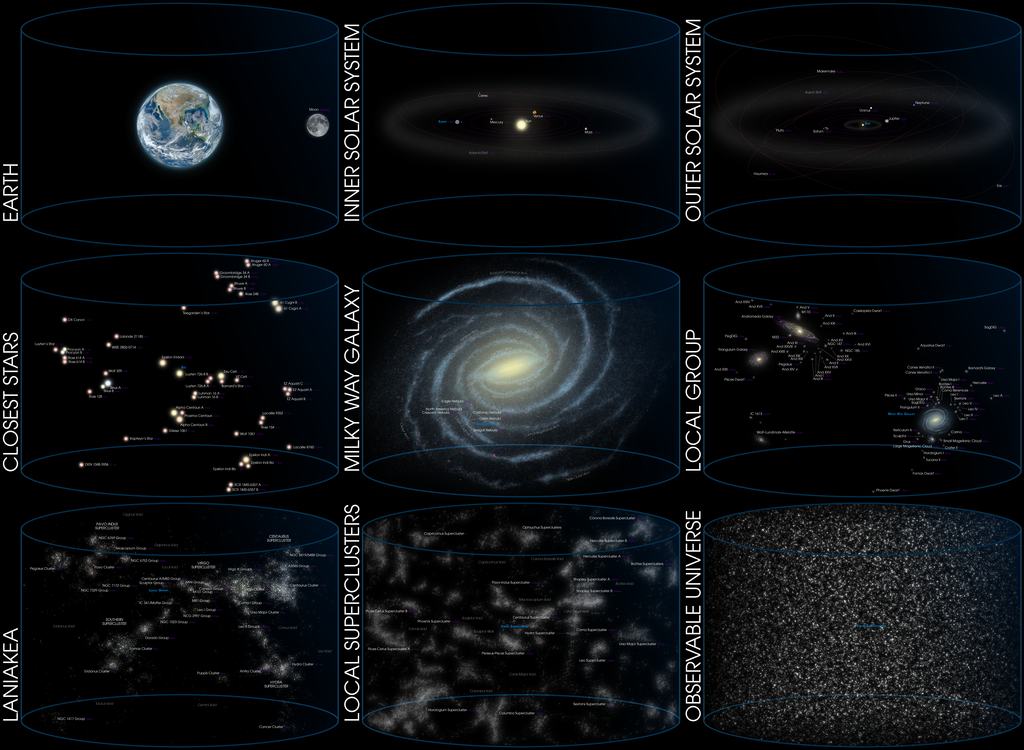
The universe is vast, almost beyond comprehension. To make sense of it, we can think of our location like a cosmic address, starting from our home and zooming out.
We live on Earth, a rocky planet. Earth is one of eight planets that travel in a path, or orbit, around a star we call the Sun.
planet
noun
A large celestial body that orbits a star and has cleared its orbital path of other debris.
The Sun, along with its family of planets, moons, and other objects, makes up our Solar System. But our solar system is just a tiny part of a much larger structure. It's located in a vast, swirling collection of billions of stars, gas, and dust held together by gravity, called the Milky Way galaxy.
And the Milky Way is just one of hundreds of billions of galaxies scattered throughout the known universe. Each of those points of light you see in deep space images is an entire galaxy, home to billions of its own stars and planets.
A Tour of Celestial Objects
Space is filled with a fascinating variety of objects. While planets and stars are the most familiar, they're just the beginning. Let's look at the main players.
| Object | Description |
|---|---|
| Star | A massive, luminous ball of hot gas, primarily hydrogen and helium, that produces energy through nuclear fusion in its core. Our Sun is a star. |
| Planet | A large body that orbits a star. Planets can be rocky, like Earth and Mars, or gas giants, like Jupiter and Saturn. |
| Moon | A natural satellite that orbits a planet. Some planets have no moons, while others have dozens. |
| Asteroid | A small, rocky object that orbits the Sun, mostly found in the asteroid belt between Mars and Jupiter. They are leftovers from the formation of the solar system. |
| Comet | A celestial body made of ice, dust, and rock. When it gets close to the Sun, the ice vaporizes, creating a glowing head and a long tail. |
These objects aren't just scattered randomly. They are all connected by the force of gravity, orbiting larger bodies in a complex cosmic dance. Understanding these basic building blocks is the first step in exploring the wonders of the universe.
What is the primary focus of the science of astronomy?
Which of the following correctly lists cosmic structures from smallest to largest?
This is just a glimpse into the vast field of astronomy. From here, we can dive deeper into our own solar system, explore the life cycle of stars, or unravel the mysteries of galaxies far, far away.