Artificial Selection Explained
Introduction to Selection
Survival of the Fittest
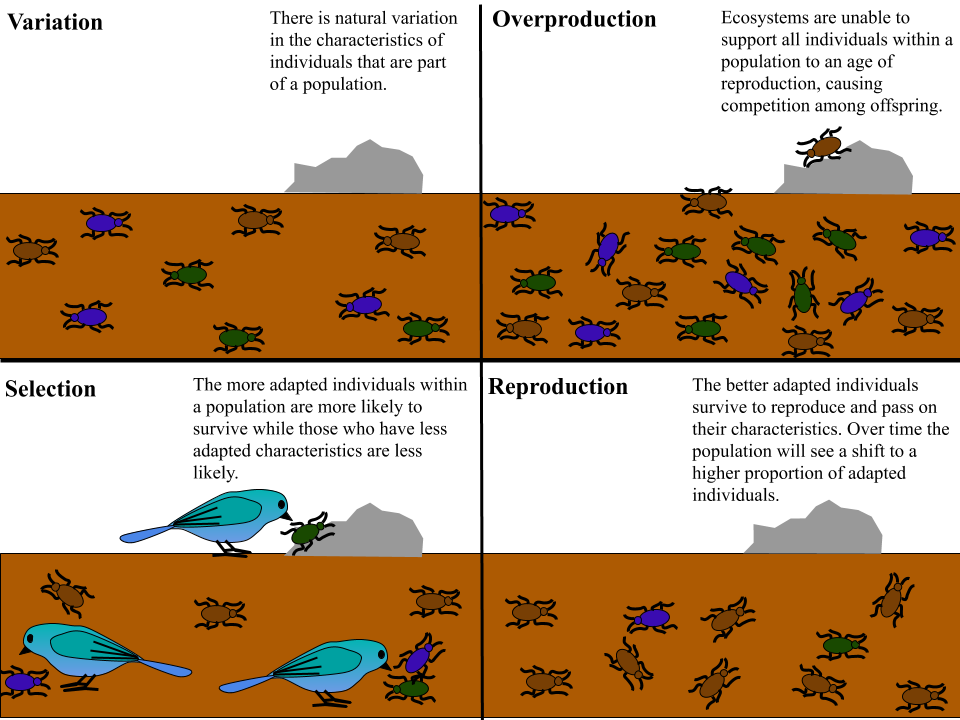
In the great lottery of life, not all tickets are winners. Some organisms are born with traits that give them an edge in the struggle for existence. This simple fact is the engine of a powerful process called natural selection. It’s not about being the strongest or fastest in absolute terms, but about being the best suited to a particular environment.
Natural selection is the process where organisms better adapted to their environment tend to survive and produce more offspring.
The mechanism of natural selection boils down to four key steps: variation, inheritance, selection, and time. First, individuals within a population are not identical; they have variations in their traits. Think of a family of dogs—some are bigger, some have thicker fur, some run faster. Second, these traits are heritable, meaning they can be passed from parents to offspring. Third, the environment puts pressure on the population. Resources are limited, and predators are hungry. Individuals with traits that give them an advantage are more likely to survive and reproduce. Over time, these advantageous traits become more common in the population.
A classic example is the peppered moth in 19th-century England. Originally, most peppered moths were light-colored, blending in perfectly with the lichen-covered trees. But as the Industrial Revolution blackened the trees with soot, the light-colored moths became easy targets for birds. A rare, dark-colored variant of the moth, however, was now beautifully camouflaged. These dark moths survived, reproduced, and passed on their dark color. Soon, almost all peppered moths in industrial areas were dark. Nature, in the form of soot-covered trees and hungry birds, had "selected" for the dark trait.
Humans Take the Wheel
What if the selector isn't a predator or a changing climate, but a human? That's artificial selection. It follows the same basic principles as natural selection—variation and inheritance—but the selective pressure is applied intentionally by people to achieve a desired outcome.
Artificial Selection
noun
The process by which humans use animal breeding and plant breeding to selectively develop particular phenotypic traits by choosing which individuals will reproduce and have offspring.
Instead of waiting for nature to take its course over thousands of years, humans can speed up the process. We pick the organisms with the traits we like—the cow that produces the most milk, the corn with the sweetest kernels, the dog with the friendliest disposition—and breed them. Their offspring are more likely to have those same desirable traits. By repeating this process over generations, we can dramatically change a species.
Look at the produce aisle in a grocery store. Broccoli, cauliflower, cabbage, kale, and kohlrabi all look incredibly different, yet they are all descendants of a single species of wild mustard plant. Ancient farmers selected for different traits—large leaves for kale, a dense cluster of flowers for broccoli, a swollen stem for kohlrabi—and created the variety we see today. This is a powerful demonstration of artificial selection at work.
What is the primary difference between natural selection and artificial selection?
In the classic example of the peppered moth, what was the selective pressure that led to the dark-colored moths becoming more common?
Whether guided by the indifferent hand of nature or the intentional choices of humans, selection is a fundamental process that shapes the living world around us. It explains both the incredible diversity of life in the wild and the familiar forms of the plants and animals that sustain us.