Artificial Intelligence Systems Fundamentals
Model Architectures
Beyond Sequential Thinking
For a long time, if you wanted an AI to understand a sequence, like a sentence or a piece of code, you'd turn to a Recurrent Neural Network (RNN). An RNN works like a person reading a book: one word at a time, in order. Each word it reads informs its understanding of the next. A more advanced version, the Long Short-Term Memory (LSTM) network, added a kind of 'memory' to help it remember important context from earlier in the sequence.
But both models have a fundamental limitation. They process information sequentially. This creates a bottleneck. As sequences get longer, it becomes difficult for the model to maintain context. Information from the beginning of a long paragraph can get lost by the time the model reaches the end, a problem known as the difficulty with This is like playing a game of telephone; the message gets distorted with each step. This sequential nature also means they can't be easily sped up. You can't read the tenth word until you've read the first nine.
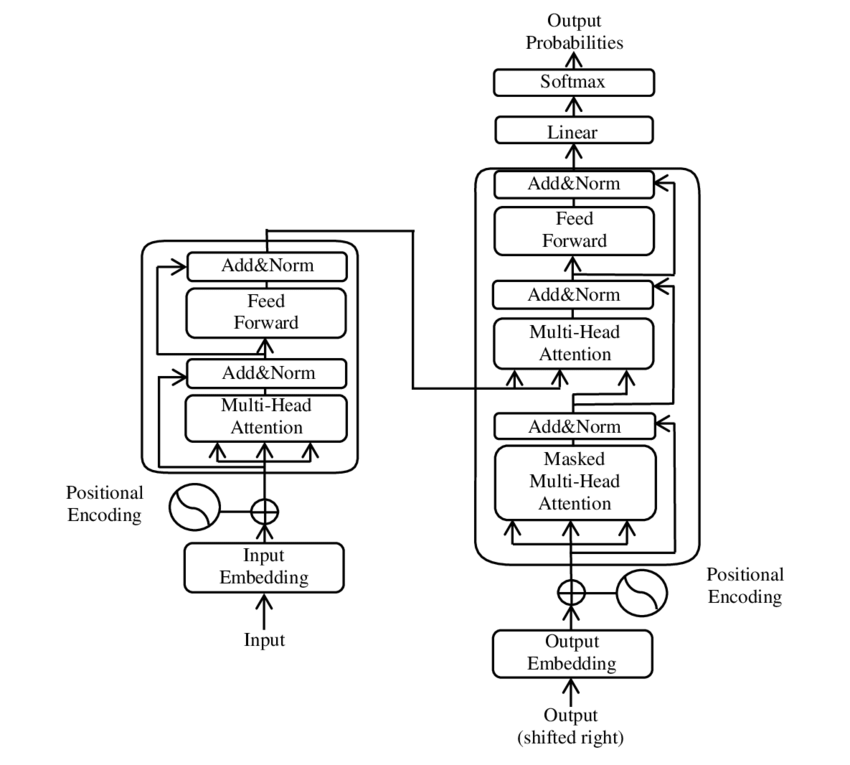
The breakthrough came with the Transformer architecture, introduced in a 2017 paper titled "Attention Is All You Need." Instead of processing data one step at a time, Transformers can process an entire sequence at once. This parallel processing is possible thanks to a mechanism called 'attention,' which allows the model to weigh the importance of different words in the sequence relative to each other, no matter where they are. It can look at the whole sentence simultaneously, drawing connections between the first word and the last just as easily as it connects adjacent words. This solved the sequential bottleneck and opened the door to training much larger and more powerful models.
Architectural Blueprints
The original Transformer had two parts: an encoder and a decoder. The encoder's job is to read and understand the input sequence, creating a rich numerical representation of its meaning. The decoder then takes this representation and generates an output sequence. Think of it like a human translator: first, they read a full sentence in French (encoding), understand its meaning, and then write the equivalent sentence in English (decoding). This Encoder-Decoder structure is ideal for tasks like machine translation or summarizing a long document.
Soon, researchers realized they didn't always need both components. This led to two specialized variants:
-
Encoder-only models, like (Bidirectional Encoder Representations from Transformers), are designed purely for understanding. They are pre-trained by masking words in a sentence and learning to predict them from the surrounding context. This makes them excellent at tasks that require a deep understanding of language, such as sentiment analysis, text classification, and named entity recognition. They are 'bidirectional' because they consider both the left and the right context of a word simultaneously.
-
Decoder-only models, like the popular (Generative Pre-trained Transformer) family, are built for generation. They work by predicting the next word in a sequence given the words that came before. This is an 'auto-regressive' process. By repeatedly predicting the next word and adding it to the input, they can generate coherent and creative paragraphs of text from a simple prompt. This makes them ideal for chatbots, story writing, and code generation.
Size, Speed, and Trade-offs
The choice of architecture isn't just about the task; it's also about trade-offs. A key trend in AI has been parameter scaling. The number of parameters in a model is roughly equivalent to the number of connections between its artificial neurons. More parameters generally mean a greater capacity to learn complex patterns and perform sophisticated reasoning. The leap from millions to billions (and now trillions) of parameters is what has given modern LLMs their impressive, human-like capabilities.
However, scale comes at a cost. Larger models are more expensive to train and require immense computational power. They also have slower inference speed, which is the time it takes for a trained model to make a prediction. For applications that need real-time responses, like a live translation app, a smaller, faster model might be better, even if it's slightly less accurate. A massive, highly accurate model might be preferable for offline tasks like summarizing scientific papers, where speed is less critical. Choosing the right architecture involves balancing accuracy, inference speed, computational cost, and the specific problem you're trying to solve.
These foundational models, whether encoder, decoder, or both, serve as general-purpose backbones that can be adapted for countless specific tasks. Their architectural differences define their strengths and weaknesses, shaping the landscape of modern AI.