Artificial Intelligence Systems and Applications
Neural Architectures
Architectures for Intelligence
Different problems require different tools. In artificial intelligence, the 'tool' is often the neural network's architecture. The structure of a network dictates what kind of data it can understand and how efficiently it learns. Let's explore the key designs that power modern AI.
Processing Spatial Data with CNNs
Imagine trying to identify a cat in a photograph. You don't just look at one pixel; you look for patterns of pixels that form edges, shapes, textures, and eventually, features like whiskers and pointy ears. This is the intuition behind Convolutional Neural Networks (CNNs).
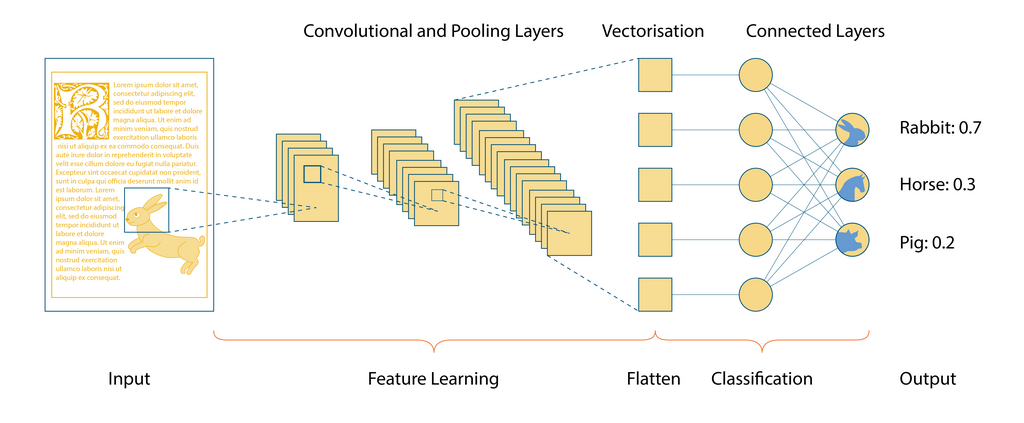
CNNs use specialized layers that apply 'filters' across an image. Each filter is a small grid of numbers trained to detect a specific low-level feature, like a vertical edge or a patch of color. The first layer might find simple edges. The next layer takes the output of the first—a map of where edges were found—and looks for combinations of edges that form more complex shapes, like corners or circles. This hierarchical process continues, with each layer learning to recognize increasingly abstract and larger features.
This method is incredibly effective for spatial data like images because it respects the spatial relationships between pixels. It understands that pixels close to each other are more related than pixels on opposite sides of the image. This makes CNNs the go-to architecture for computer vision tasks, from self-driving cars recognizing pedestrians to medical imaging systems identifying tumors.
Handling Sequences with RNNs and LSTMs
Now, consider understanding a sentence. The meaning of the word 'it' in "The dog chased the ball, and then it rolled away" depends entirely on the words that came before. This is sequential data, where order is everything. For these tasks, we use Recurrent Neural Networks (RNNs).
An RNN processes a sequence one element at a time, whether it's a word in a sentence or a data point in a time series. As it processes each element, it maintains a 'memory' or 'hidden state' that carries information from previous steps. This hidden state is combined with the next input to influence the output, allowing the network to have context. However, standard RNNs have a short memory. When sequences get long, they struggle to remember information from the distant past—a problem known as the vanishing gradient problem.
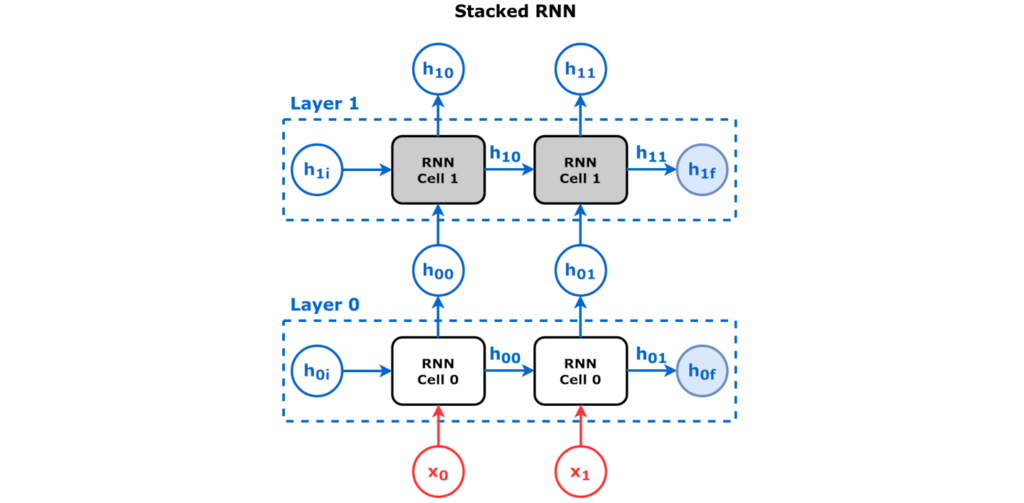
To solve this, a more advanced architecture called (LSTM) was developed. LSTMs are a special type of RNN equipped with 'gates'—a mechanism to control the flow of information. It has a 'forget gate' to discard irrelevant old information, an 'input gate' to decide which new information is important to store, and an 'output gate' to determine what to output based on its memory. This gating mechanism allows LSTMs to selectively remember or forget information over very long sequences, making them highly effective for tasks like language translation and speech recognition.
The Transformer Revolution
While LSTMs were powerful, they still processed data sequentially. This created a bottleneck; you couldn't process the end of a sentence until you'd processed the beginning. In 2017, a paper titled "Attention Is All You Need" introduced the Transformer architecture, which changed everything.
Transformers can process all elements of a sequence at once. They achieve this through a mechanism called , which allows the model to weigh the importance of every other word in the sequence when processing a given word. For example, when processing the word 'it' in our earlier sentence, the self-attention mechanism would learn to pay high 'attention' to 'ball' and less attention to 'dog'. It figures out these relationships directly, without needing to go through the sequence step-by-step.
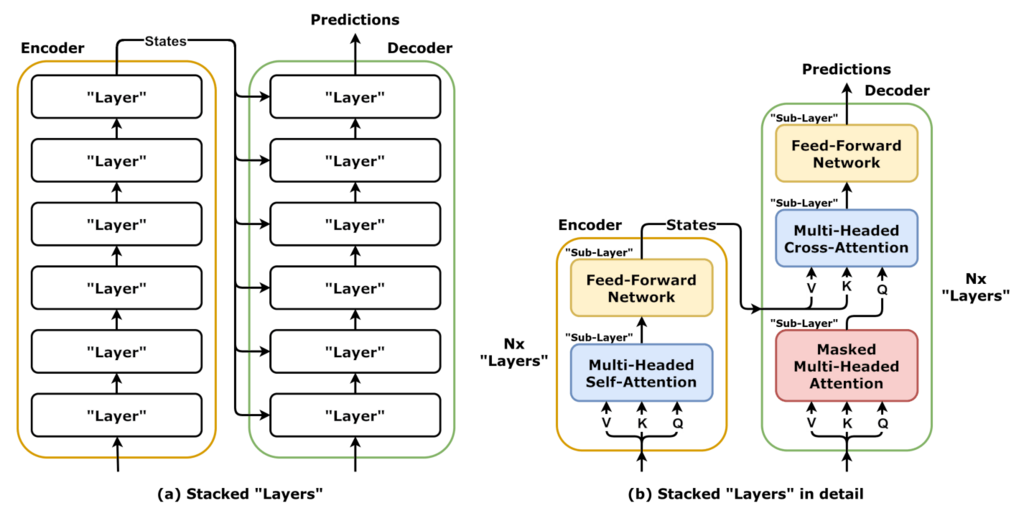
This parallel processing capability makes Transformers incredibly efficient to train on massive datasets using modern hardware like GPUs. It's the reason why models like GPT can be so large and powerful. This architecture has become the foundation for almost all modern Large Language Models (LLMs).
The Transformer architecture, introduced by Vaswani et al. in the seminal paper "Attention is All You Need", eschews the traditional recurrent and convolutional neural network structures in favor of self-attention mechanisms, thereby enabling the model to capture long-range dependencies and contextual information in a more efficient and effective manner.
Efficiency Through Specialization
As models like GPT grew larger, running them became computationally expensive. A single query might activate billions of parameters. To address this, a technique called (MoE) was introduced. An MoE model isn't one giant network, but a collection of smaller 'expert' sub-networks. For any given input, a 'gating network' or 'router' decides which one or two experts are best suited for the task and activates only them. For instance, one expert might specialize in Python code, while another specializes in Shakespearean English. If you ask a question about Python, the router only sends your query to the relevant expert, saving immense computational cost because the rest of the network remains dormant. This allows models to scale to trillions of parameters while keeping inference costs manageable.
| Architecture | Primary Use Case | Data Handling | Key Feature |
|---|---|---|---|
| CNN | Image & Video | Spatial (Parallel) | Convolutional Filters |
| RNN/LSTM | Text, Time Series | Sequential | Recurrent Memory (Gates) |
| Transformer | Text, Genomics | Parallel | Self-Attention Mechanism |
Each of these architectures represents a different way of thinking about data. Choosing the right one depends entirely on the structure of the problem you're trying to solve. The ongoing evolution of these designs continues to push the boundaries of what AI can achieve.