Artificial Intelligence Mechanisms
Neural Architectures
From Neuron to Network
An artificial neural network, at its core, is a collection of interconnected processing units called neurons. Each neuron is a simple computational machine. It receives one or more inputs, processes them, and passes a signal to the next neurons in line. Think of it like a dimmer switch for information.
Each connection to a neuron has an associated weight. These amplify or diminish the input signal, signifying its importance for the task at hand. A large positive weight means the input is strongly exciting, while a large negative weight means it's strongly inhibiting. After weighting the inputs, the neuron sums them up and adds a bias, which is a single number that can shift the result up or down. This allows the neuron to activate even when all inputs are zero, or to require a stronger signal before it fires.
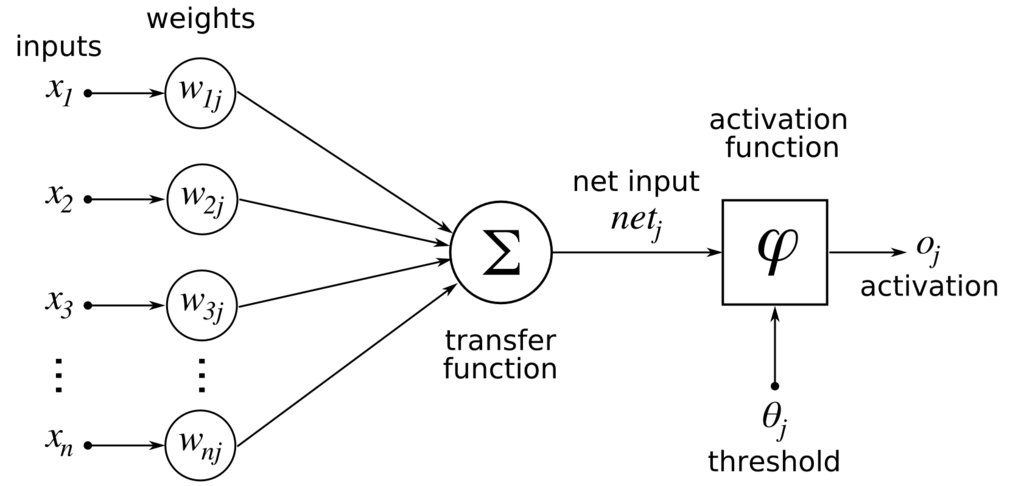
The entire operation can be captured in a concise mathematical formula. The neuron computes a weighted sum of its inputs, adds a bias, and then applies an activation function, denoted by , to produce its final output .
Layers of Logic
A single neuron isn't very powerful. The real strength of ANNs comes from organizing these neurons into layers. A typical network has at least three types of layers:
- Input Layer: This is the network's front door. It receives the raw data—be it the pixel values of an image, the words in a sentence, or numbers from a spreadsheet. The number of neurons in this layer matches the number of features in the input data.
- Hidden Layers: These are the intermediate layers between the input and output. This is where most of the computation happens. A network can have one or many hidden layers, and the term "deep learning" simply refers to networks with multiple (often many) hidden layers. Each hidden layer learns to detect more complex patterns by building on the simple patterns detected by the previous layer.
- Output Layer: This is the final layer that produces the result. The number of neurons and the activation function used here depend entirely on the task. For a classification problem with two categories (e.g., cat or dog), it might have one neuron. For predicting a number, it would also have one neuron. For classifying among 10 different categories, it would have 10 neurons.
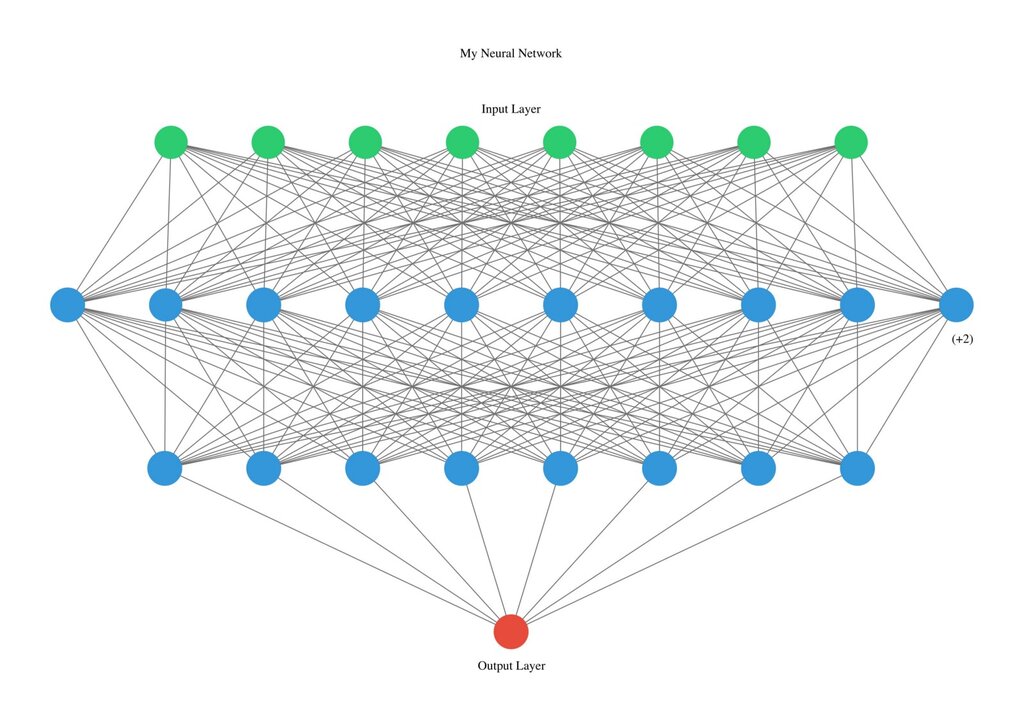
Stacking these layers allows the network to model complex, hierarchical relationships in data. Simple features from early layers are combined into more abstract concepts in deeper layers.
Specialized Layer Architectures
Not all layers are created equal. While all are made of neurons, their connection patterns define their purpose. The most common type is a Dense or Fully Connected Layer, where every neuron in the layer is connected to every neuron in the previous layer. This is a versatile, general-purpose layer.
For specific types of data, we use specialized architectures:
-
Convolutional Layers: These are the workhorses of computer vision. Instead of connecting to all previous neurons, a neuron in a convolutional layer only looks at a small, localized region of the input (like a 3x3 patch of pixels in an image). It slides this small view, called a , across the entire input, allowing it to efficiently detect spatial features like edges, corners, and textures, regardless of where they appear in the image.
-
Recurrent Layers: These are designed to handle sequential data, like text or time series. A recurrent neuron processes one element of the sequence at a time (e.g., one word in a sentence) and maintains an internal state, or "memory," which is passed along to the next step. This allows the network to remember previous information and use it to inform its processing of the current element. This is crucial for understanding context in language.
Adding Non-Linearity
There's one crucial ingredient we haven't fully discussed: the activation function. Without a non-linear activation function, a neural network, no matter how many layers it has, would behave just like a single-layer network. It would only be capable of learning linear relationships. The activation function introduces the non-linearity needed to approximate any arbitrarily complex function.
Here are some of the most common ones:
- ReLU (Rectified Linear Unit): This function is elegantly simple. If the input is positive, it passes it through unchanged. If it's negative, it outputs zero. This is the most popular activation function for hidden layers because it's fast to compute and helps mitigate the vanishing gradient problem.
- Sigmoid: This function squashes any input value into a range between 0 and 1. This makes it useful for the output layer in a binary classification task, where the output can be interpreted as a probability.
- Softmax: Softmax is a generalization of the sigmoid function used for multi-class classification. If you have an output layer with multiple neurons (e.g., one for "cat," one for "dog," and one for "bird"), softmax will transform the raw outputs into a probability distribution where all the values are between 0 and 1 and sum to 1. The highest value corresponds to the model's most likely prediction. It's almost always found in the final layer of a classifier.
By selecting and stacking these different layers and activation functions, a data scientist can construct a neural architecture tailored to a specific problem. The data flows from the input layer, is transformed by the weights, biases, and activation functions of each hidden layer, and finally arrives at the output layer to produce a prediction. This layered transformation of information is the fundamental mechanism behind deep learning.