Artificial Intelligence Fundamentals
Introduction to Artificial Intelligence
What Is Artificial Intelligence?
Artificial intelligence is about making machines smart. The goal is to build computer systems that can perform tasks that normally require human intelligence. This includes things like learning from experience, understanding language, recognizing objects, solving problems, and making decisions.
At its core, AI refers to the simulation of human intelligence in machines that are programmed to think and learn like humans.
The idea isn't new. Philosophers have long wondered if machines could think. But it wasn't until the advent of modern computers that these ideas could be put to the test. The field as we know it today is a blend of computer science, data analytics, and cognitive science, all working toward creating intelligent systems.
The Journey of AI
The story of modern AI begins in the mid-20th century. Alan Turing, a brilliant mathematician, proposed a test in 1950 to see if a machine could exhibit intelligent behavior indistinguishable from that of a human. This idea, now known as the Turing Test, laid the philosophical groundwork for AI.
This was the first time the term "artificial intelligence" was used as the group spent almost two months discussing how machines might simulate learning and intelligence.
The term itself was coined a few years later, in 1956, at a workshop at Dartmouth College. A small group of researchers gathered to explore the possibility of creating machines that could think. This event is widely considered the birth of AI as a formal field of study.
Early research was filled with optimism. Pioneers developed programs that could solve algebra problems, prove theorems, and speak simple English. But progress was slower than expected. The complexity of creating true intelligence was immense, and the available computing power was limited. This led to periods of reduced funding and interest, often called "AI winters."
Key Milestones and Growth
Despite the setbacks, AI research continued. The field was reborn in the 1990s and 2000s, driven by two key factors: a massive increase in computing power and the availability of vast amounts of data, thanks to the internet. These ingredients allowed for the development of more sophisticated AI models.
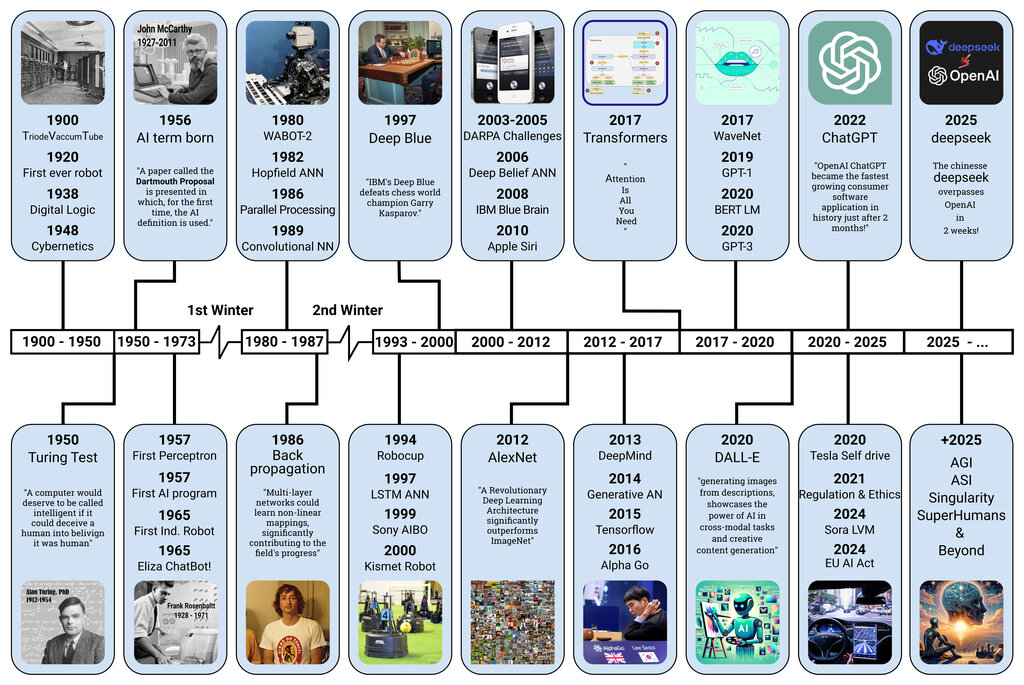
Several milestones marked this new era of AI, demonstrating its growing capabilities to the world.
| Year | Milestone | Significance |
|---|---|---|
| 1997 | Deep Blue defeats Garry Kasparov | An IBM supercomputer beat the world chess champion, showcasing AI's strategic power. |
| 2011 | Watson wins Jeopardy! | An AI system understood and answered complex natural language questions. |
| 2016 | AlphaGo defeats Lee Sedol | A Google AI mastered the ancient game of Go, a task once thought too complex for machines. |
| 2017 | Transformer Architecture | Researchers introduced a model that revolutionized how machines process language. |
These events weren't just about winning games. They were public demonstrations of how far AI had come in areas like strategic planning, natural language processing, and complex problem-solving. Each breakthrough fueled more research and investment, leading to the rapid advancements we see today.
Ready to test your knowledge? Let's see what you've learned about the foundations of AI.
What is the fundamental goal of Artificial Intelligence?
The term "Artificial Intelligence" was officially coined at a workshop held at which institution in 1956?
Understanding AI's history provides the context for where the technology is now and where it might be headed. From early theories to today's powerful systems, it has been a long and fascinating journey.