Artificial Intelligence Fundamentals
Introduction to Artificial Intelligence
What Is Artificial Intelligence?
At its core, artificial intelligence is about creating machines that can think, learn, and solve problems like humans do. It's a broad field in computer science focused on building smart systems capable of performing tasks that typically require human intelligence. This includes things like understanding language, recognizing patterns, and making decisions.
Artificial Intelligence
noun
A field of computer science dedicated to creating systems that can perform tasks that normally require human intelligence.
The dream of creating intelligent machines isn't new. It has roots in ancient myths and centuries of philosophical debate about the nature of thought itself. But the modern journey began in the mid-20th century, when pioneers started to believe that thinking machines were truly possible.
The Birth of a Field
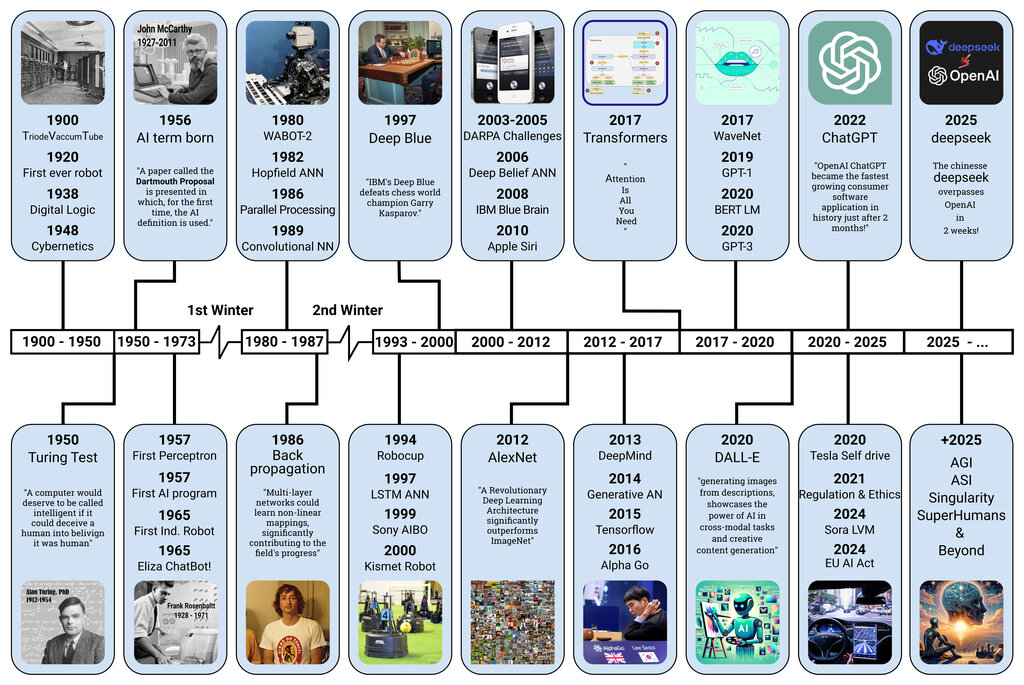
One of the most important early figures was Alan Turing, a brilliant British mathematician. In 1950, he proposed a way to test a machine's ability to exhibit intelligent behavior equivalent to, or indistinguishable from, that of a human. This became known as the Turing Test.
The Turing Test asks: Can a machine converse so well that a human can't tell if they're talking to a person or a computer?
The field got its official name in 1956 at the Dartmouth Summer Research Project on Artificial Intelligence. Organized by mathematician John McCarthy, this workshop brought together a small group of researchers who spent the summer discussing how machines might simulate learning and intelligence. It was here that the term "artificial intelligence" was first used, kick-starting serious research and laying the groundwork for the breakthroughs that followed.
1956: Dartmouth Conference: Official birth of AI as a field of study, coining the term “Artificial Intelligence.”
Early research was filled with optimism. Researchers developed programs that could solve algebra word problems, prove logical theorems, and speak simple English. The belief was that human-level intelligence was just around the corner.
Cycles of Hype and Winter
The initial excitement didn't last. The problems turned out to be much harder than expected. By the mid-1970s, progress had slowed. The computing power needed to tackle more complex tasks just wasn't available, and government funding dried up. This period became known as the first "AI winter."
But the field didn't die. In the 1980s, a new approach called "expert systems" brought a thaw. These programs captured the knowledge of human experts in a specific domain, like diagnosing medical conditions or identifying mineral deposits. They were commercially successful and revived interest in AI.
This boom was followed by another bust in the late 80s and early 90s, as the limitations of expert systems became clear. The AI field experienced another winter.
Throughout these cycles, however, researchers kept making progress. The most significant shift was the move toward machine learning. Instead of trying to program intelligence rule-by-rule, researchers began creating systems that could learn from data on their own. This approach, combined with the exponential growth of computing power and the availability of massive datasets, set the stage for the AI revolution we see today.
| Year | Milestone | Key Figure(s) |
|---|---|---|
| 1950 | The Turing Test | Alan Turing |
| 1956 | Dartmouth Conference | John McCarthy |
| 1966 | ELIZA, an early chatbot | Joseph Weizenbaum |
| 1997 | Deep Blue beats Kasparov | IBM Team |
| 2011 | Watson wins Jeopardy! | IBM Team |
| 2012 | ImageNet Breakthrough | Alex Krizhevsky & Team |
Events like IBM's Deep Blue defeating chess champion Garry Kasparov in 1997 showed that AI could master complex, strategic games. This was followed by IBM's Watson winning the quiz show Jeopardy! in 2011, demonstrating a new level of natural language understanding.
These milestones proved that machines could excel at tasks once thought to be exclusively human. They were not just theories anymore; they were tangible demonstrations of AI's growing power and potential.
What is the primary goal of artificial intelligence as a field of computer science?
The term "artificial intelligence" was first coined at what 1956 event?
Understanding AI's history gives us context for where we are today. The journey from philosophical ideas to powerful, real-world technologies has been a long one, marked by brilliant minds, ambitious projects, and cycles of excitement and disappointment.