Artificial Intelligence Explained
Introduction to Artificial Intelligence
What Is Artificial Intelligence?
Artificial intelligence is about making computers smart. The goal is to build machines that can perform tasks that typically require human intelligence, like learning, reasoning, and solving problems.
Artificial Intelligence
noun
A branch of computer science focused on creating systems that can perform tasks that normally require human intelligence.
You interact with AI every day, even if you don't realize it. When your phone suggests a faster route to work, that's AI. When a streaming service recommends a movie you might like, that's also AI. It's the technology that powers spam filters in your email and the voice assistant that answers your questions.
At its core, AI is not about creating conscious robots. It's about developing specialized tools that can analyze information and make predictions or decisions to help us with specific tasks.
The Engine of AI: Machine Learning
So how do we make a machine “smart”? One of the most important methods is machine learning. Instead of writing explicit, step-by-step instructions for every possible situation, we let the computer learn from data.
Imagine teaching a child to recognize a cat. You wouldn't list rules like “it has pointy ears, whiskers, and a tail.” Instead, you’d show them pictures of many different cats. Eventually, the child learns to identify a cat on their own. Machine learning works in a similar way. We feed a computer program, called a model, thousands of labeled images. The model learns the patterns associated with “cat” and can then identify cats in new, unseen photos.
This process of learning from examples is what allows AI to do things like forecast weather, detect fraudulent transactions, and even diagnose diseases from medical scans.
Inspired by the Brain
A powerful type of machine learning is inspired by the structure of the human brain. It's called a neural network. Our brains are made of billions of neurons that are connected to each other. When we learn something new, the connections between these neurons change.
Artificial neural networks mimic this structure. They consist of layers of interconnected digital “neurons.” Data is fed into the first layer, which processes it and passes it to the next. Each layer looks for different patterns, and the final layer produces an output, like identifying an object in an image or translating a sentence.
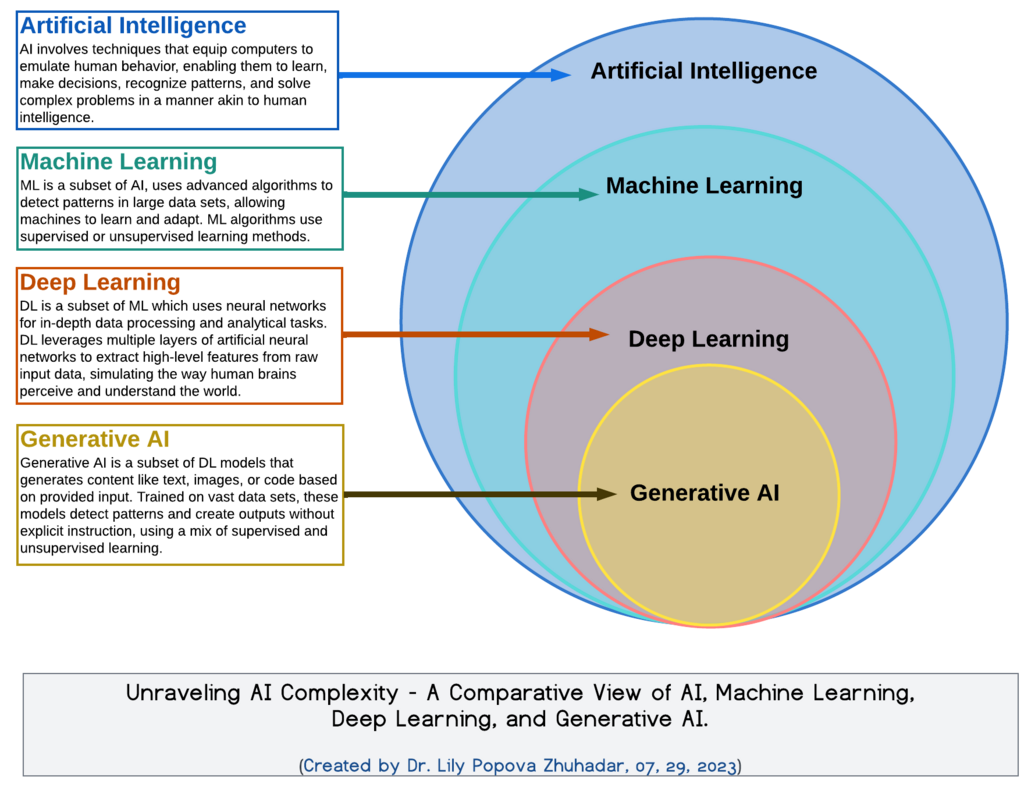
When a neural network has many layers, it's often called “deep learning.” This depth allows the network to learn incredibly complex patterns from vast amounts of data, which is behind many of the recent breakthroughs in AI, from self-driving cars to advanced image recognition.
Teaching Computers to Understand Us
One of the most challenging tasks for AI is understanding human language. It’s full of slang, nuance, and context that computers find difficult to interpret. This is where Natural Language Processing (NLP) comes in.
NLP is a field of AI that gives machines the ability to read, understand, and generate human language. It’s the technology behind your phone's autocorrect, the chatbot you talk to for customer service, and language translation apps.
Hello, world
NLP breaks down language into two main areas. The first is understanding the meaning behind words (Natural Language Understanding). The second is constructing grammatically correct and coherent sentences (Natural Language Generation). Together, these capabilities create a bridge between humans and computers, allowing us to interact with technology in a more natural way.
Now that we've covered the basics, let's test your knowledge.
What is the primary goal of Artificial Intelligence as described in modern applications?
The process of teaching a computer to recognize a cat by showing it thousands of cat pictures is an example of what?