Aristotle's Metaphysics Explained
Introduction to Aristotle's Metaphysics
The Study of Being
What is real? It's one of the oldest and biggest questions we can ask. While many sciences study specific parts of reality—like biology studying living things or physics studying matter and energy—philosophy has a branch that asks about the nature of reality itself. This is metaphysics.
Metaphysics is the branch of philosophy that examines the fundamental nature of reality itself.
The ancient Greek philosopher Aristotle was one of the first to systematically tackle this subject. He didn't call it "metaphysics," though. That name came later from librarians organizing his works; this particular book came after his book on physics (meta means "after" in Greek). Aristotle called it "first philosophy" because he believed it dealt with the most fundamental principles of all things. His central question was: what does it mean for something to be?
He wanted to study "being qua being," or "being as being." This sounds abstract, but the idea is simple. Instead of studying a being as a tree, or a being as a person, or a being as a star, he wanted to understand what all these things have in common just by existing. What are the basic properties of existence itself?
Beyond the World of Forms
Aristotle wasn't the first to think about these things. His teacher, Plato, had a famous theory of his own. Plato believed that the physical world we see is just a shadow of a higher, more real world: the World of Forms. In this separate realm, perfect and unchanging versions of everything exist—the perfect Form of a chair, the perfect Form of justice, the perfect Form of a dog. The chairs and dogs we see are just imperfect copies.
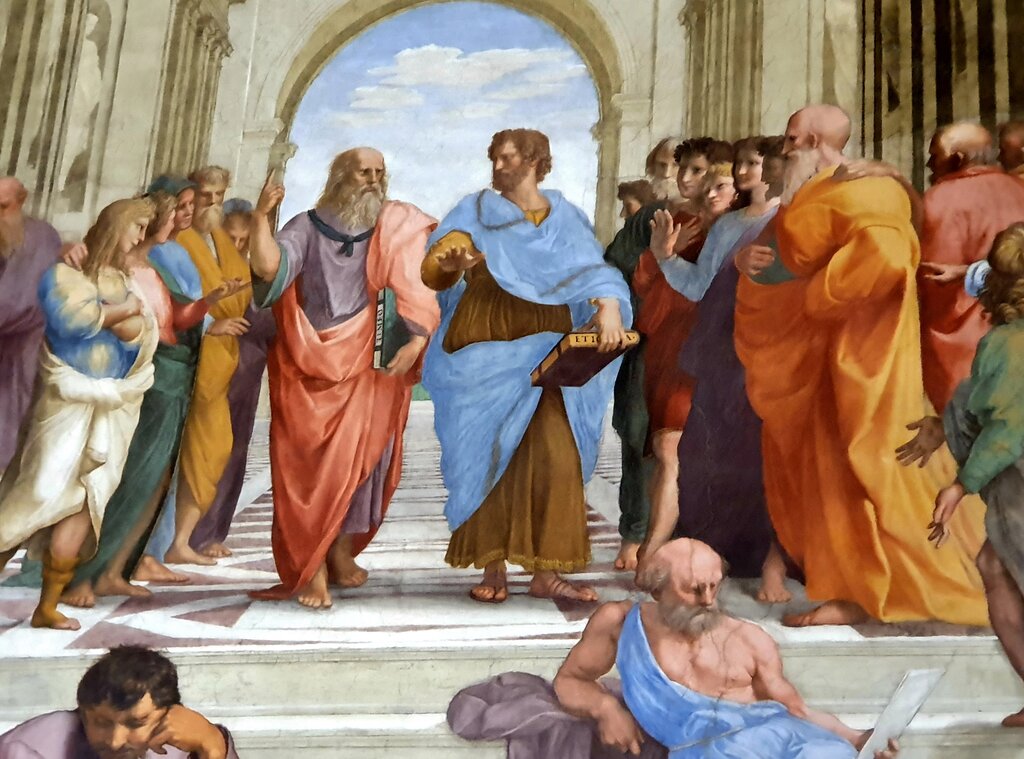
Aristotle disagreed. He argued that reality isn't in some other world; it's right here in front of us. To understand what a dog is, you don't need to think about a perfect, otherworldly Dog Form. You should study actual dogs. For Aristotle, the essence of a thing—what makes it what it is—is found within the thing itself, not in a separate, abstract realm. He brought philosophy back down to Earth.
Organizing Reality
If reality is found in the objects around us, how can we make sense of it all? Aristotle's next step was to create a system for classifying the different ways something can be said to exist. He developed what are known as the Categories of Being.
He noticed that when we describe something, like a specific horse, we talk about it in different ways. First, there's the thing itself—the horse. Aristotle called this the substance. It's the fundamental subject that has other properties. Then there are all the properties it has. It has a certain height (quantity), it's brown (quality), it's in a field (place), and it's related to its mother (relation).
These categories are the basic classifications of reality. They are not just grammatical categories, but the fundamental structures of existence itself. Everything that exists can be described using them.
| Category | Question it Answers | Example |
|---|---|---|
| Substance | What is it? | A human, a horse |
| Quantity | How much/many? | Six feet tall, 200 pounds |
| Quality | What kind is it? | Brown, muscular, intelligent |
| Relation | How is it related to something else? | Taller than, child of |
| Place | Where is it? | In the marketplace, at home |
By outlining these categories, Aristotle created a powerful framework. His goal in the Metaphysics was to build a foundation for all other knowledge. By understanding the principles of being itself, he believed we could then better understand everything else, from ethics to politics to biology. It was the ultimate search for the first principles and causes of everything that is.
Let's test your understanding of these foundational ideas.
What is the central question of metaphysics, as described in the text?
How did Aristotle's view on where to find reality fundamentally differ from Plato's?
Aristotle's investigation into 'being qua being' moved philosophy away from the abstract and toward the tangible world, creating a framework for studying reality that has influenced Western thought for centuries.