Area Between Curves
Understanding Definite Integrals
The Area Under a Curve
Imagine you're driving a car. If you travel at a constant 60 miles per hour for two hours, calculating the distance is simple: miles. But what if your speed is constantly changing? How do you find the total distance then?
This is where definite integrals come in. A definite integral is a tool for calculating the total accumulation of a quantity that changes over an interval. Most often, we visualize this as finding the area under the graph of a function between two points.
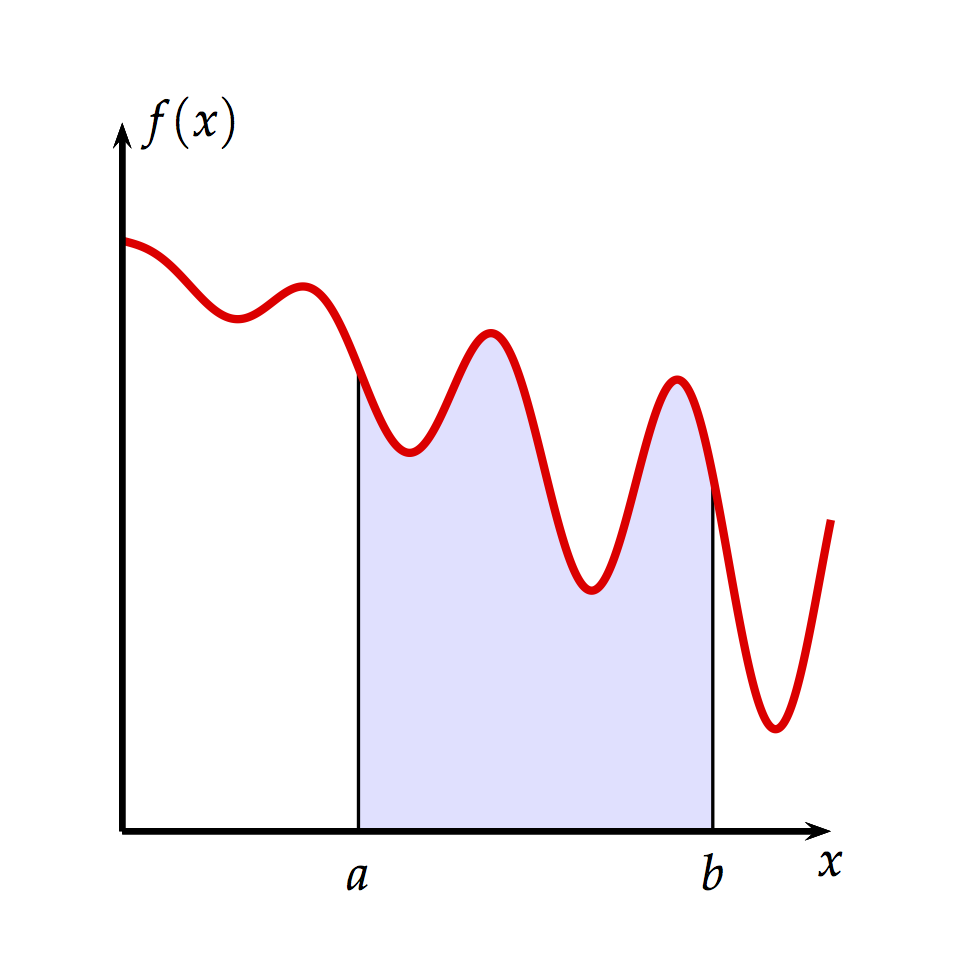
The notation for a definite integral looks like this:
Let's break that down:
- The symbol is the integral sign.
- and are the limits of integration. They define the start and end of our interval on the x-axis.
- is the function we're integrating (our curve).
- indicates that we're integrating with respect to the variable . It signifies that we're summing up infinitesimally thin slices along the x-axis.
Conceptually, we're slicing the area into an infinite number of tiny rectangles and adding their areas together. The integral gives us the exact value of that sum.
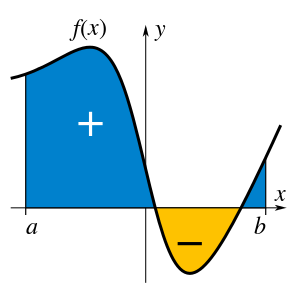
It's important to know that area below the x-axis counts as negative. The definite integral calculates the net area: the area above the axis minus the area below it.
Rules of Integration
Definite integrals follow a few straightforward rules that make them easier to work with. These properties help us break down complex problems into simpler parts.
One key rule is additivity. If you want to find the area from to , you can find the area from to and add the area from to . This works as long as is between and .
Another useful property is linearity. This means we can pull out constant multipliers and split up sums or differences inside an integral.
Finally, if you flip the limits of integration, the value of the integral is negated.
The Fundamental Theorem
So how do we actually calculate an integral without summing infinite rectangles? This is where the most important idea in calculus comes in: The Fundamental Theorem of Calculus. It provides a stunningly simple link between differentiation (finding slopes) and integration (finding areas).
The theorem has two parts, but the second part gives us a practical way to compute definite integrals.
The Fundamental Theorem of Calculus states that differentiation and integration are inverse operations.
Here’s what it says: If is an antiderivative of (meaning the derivative of is ), then the definite integral of from to is simply the change in from to .
This is a huge breakthrough. Instead of dealing with complicated sums, we just need to find a function whose derivative is our original function , and then plug in the endpoints and .
Let's take a simple example. Suppose we want to find the area under the curve from to .
First, we need an antiderivative of . We know from differentiation that the derivative of is . So, our antiderivative is .
Now, we apply the theorem:
The area under the line between and is exactly 8. The Fundamental Theorem of Calculus allows us to solve this problem elegantly, connecting the concepts of slope and area in a deep and powerful way.
What does the definite integral conceptually represent?
In the notation , what are 'a' and 'b' called?