Architectures of the Human Mind
Neural Signaling Dynamics
The Gatekeepers of the Signal
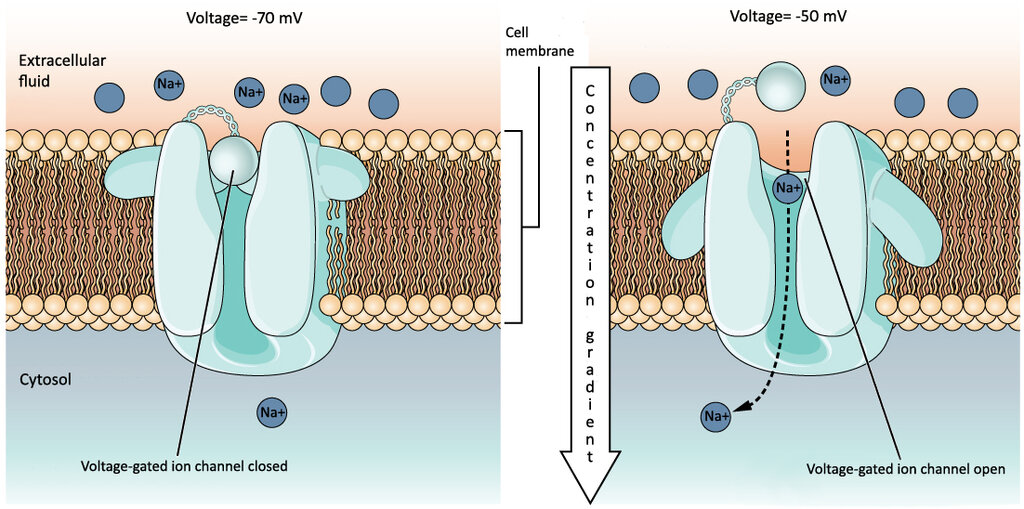
A neuron's signal isn't a simple on-off switch. It's a precisely controlled event orchestrated by molecular gatekeepers: voltage-gated ion channels. These protein channels, embedded in the neuron's membrane, are incredibly sensitive to changes in electrical potential. When the membrane potential reaches a certain threshold, they snap open, but their story doesn't end there.
Take the voltage-gated sodium channel, crucial for the rising phase of an action potential. It has two gates: an activation gate and an inactivation gate. At resting potential, the activation gate is closed, blocking sodium ions. When the neuron is depolarized, this gate swings open rapidly. But almost immediately, a second, slower process begins: the inactivation gate, like a ball on a chain, plugs the channel from the inside. This automatically shuts off the sodium influx, even if the neuron is still depolarized. The channel can only become ready to open again once the membrane repolarizes and both gates reset to their original positions. This two-gate mechanism creates the absolute refractory period, ensuring the action potential moves in one direction only.
Potassium channels have a simpler, single-gate mechanism, but they open more slowly in response to depolarization. This delay is critical. It allows the sodium-driven depolarization to peak before the potassium efflux begins, which then repolarizes the membrane, bringing the action potential to an end. The precise timing of these channel kinetics, first described in the , dictates the shape and duration of the action potential, which is fundamental to how information is encoded.
Sum of the Parts
A single neuron can receive thousands of inputs from other neurons, some excitatory and some inhibitory. It doesn't fire in response to every signal it receives. Instead, it acts as a sophisticated calculator, continuously summing these inputs through processes called temporal and spatial summation.
Temporal summation occurs when a single presynaptic neuron fires repeatedly in quick succession. Each firing releases neurotransmitters, causing a small, temporary change in the postsynaptic neuron's membrane potential, known as a postsynaptic potential (PSP). If these PSPs occur close enough in time, they build on each other, like waves adding up. A rapid series of excitatory postsynaptic potentials (EPSPs) can push the membrane potential towards the firing threshold.
Spatial summation, on the other hand, involves inputs from multiple different presynaptic neurons arriving at different locations on the dendrites at the same time. The neuron integrates these simultaneous PSPs across its surface. If multiple EPSPs from different synapses arrive together, their combined effect can trigger an action potential. Crucially, this summation also includes inhibitory postsynaptic potentials (IPSPs), which make the neuron less likely to fire. The final decision to fire is made at the , where the net effect of all summed EPSPs and IPSPs is determined.
This integration of signals is metabolically expensive. Maintaining the precise electrochemical gradients necessary for signaling requires the constant action of the sodium-potassium pump, which uses a significant amount of the brain's energy budget. There's a constant trade-off between signaling speed and metabolic cost. Myelination, for instance, dramatically increases conduction velocity but requires energy to produce and maintain. The brain optimizes this trade-off, using myelinated axons for long-distance communication and unmyelinated axons for shorter, local circuits where speed is less critical.
The Synaptic Relay
When an action potential successfully reaches the axon terminal, it must cross the synaptic cleft to the next neuron. This conversion from an electrical to a chemical signal is a marvel of molecular machinery.
Synaptic vesicles, tiny sacs filled with neurotransmitters, are already docked at the presynaptic membrane, ready for release. This readiness is maintained by a set of proteins known as the , which acts like a molecular winch, holding the vesicles in place. The arrival of the action potential depolarizes the terminal, which opens voltage-gated calcium channels. Calcium ions () flood into the cell, acting as the critical trigger. The influx of calcium causes a conformational change in another protein, synaptotagmin, which in turn prompts the SNARE complex to fully fuse the vesicle with the presynaptic membrane, releasing its neurotransmitter contents into the synapse in less than a millisecond.
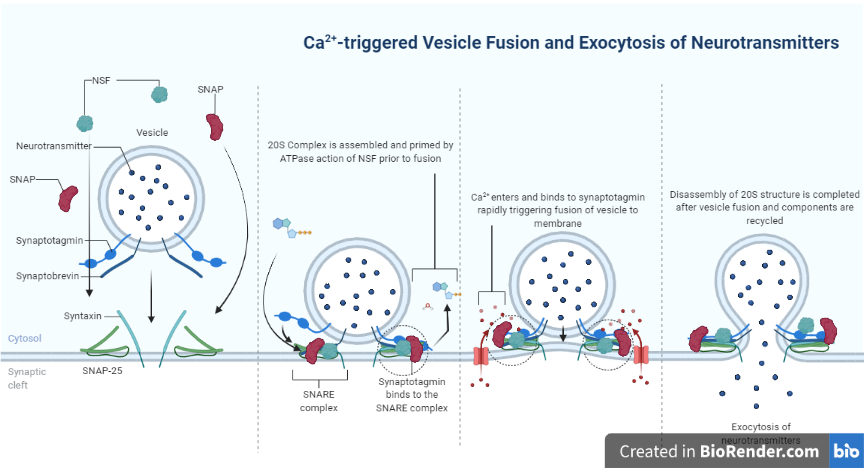
The precision of this entire process relies on the delicate balance of electrochemical gradients. The steep concentration gradient for calcium—with levels over 10,000 times higher outside the neuron than inside—is what allows for such a rapid and localized influx when channels open. This ensures that neurotransmitter release is tightly coupled to the arrival of an action potential, preventing accidental signaling and allowing for the complex encoding of information based on the frequency and timing of neuronal firing.
What is the primary function of the inactivation gate on a voltage-gated sodium channel?
A neuron fires an action potential after receiving simultaneous inputs from several different presynaptic neurons at various locations on its dendrites. This is an example of __________.
These intricate dynamics, from the flick of a channel gate to the fusion of a single vesicle, are what allow the brain's circuits to process information with such incredible speed and complexity.