Architecture and Power of Computer Abstraction
Hardware Software Interface
The Contract Between Worlds
Software can't talk directly to hardware. They speak different languages. The bridge between the code you write and the logic gates on a chip is called the Instruction Set Architecture, or ISA. Think of the ISA as the processor's official dictionary. It defines every single command the hardware can understand, from adding two numbers to fetching data from memory.
This is a critical layer of abstraction. Because software is written to target a specific Instruction Set Architecture, not a specific physical chip, the same program can run on countless different processors. An application compiled for the x86 ISA can run on a chip from Intel or AMD, even though their internal designs are completely different. The ISA is the contract they both agreed to follow.
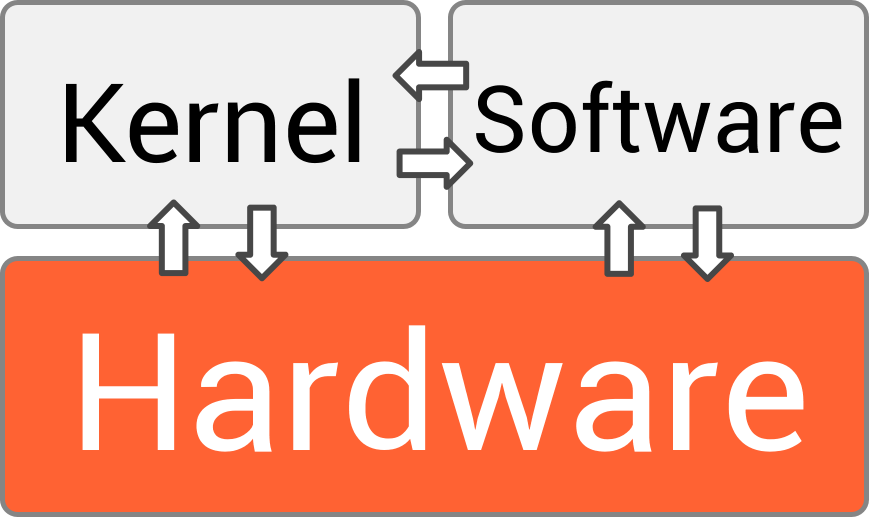
There are two main philosophies for designing an ISA. The first is Complex Instruction Set Computing (CISC). The goal of CISC is to make the hardware do more work with each command. A single CISC instruction might perform several low-level operations, like loading a value from memory, doing a calculation, and storing the result back in memory. This was useful when memory was slow and expensive, as it reduced the number of times the CPU had to fetch instructions.
The second philosophy is Reduced Instruction Set Computing (RISC). RISC takes the opposite approach. It uses a smaller set of highly optimized, simple instructions. Each instruction does one thing and does it very quickly, usually in a single clock cycle. More complex tasks require combining multiple RISC instructions, which puts more of the burden on the software (specifically, the compiler).
| Feature | CISC (Complex) | RISC (Reduced) |
|---|---|---|
| Goal | Minimize instructions per program | Minimize cycles per instruction |
| Instruction Size | Variable length | Fixed length |
| Memory Access | Integrated into complex instructions | Limited to specific load/store instructions |
| Complexity | In hardware | In the compiler |
| Examples | Intel x86, AMD x86-64 | ARM, MIPS, RISC-V |
You've likely used both without realizing it. Most desktop and server CPUs use the x86 ISA, a classic example of CISC. Almost every smartphone and tablet, on the other hand, runs on an processor, which is based on the RISC philosophy.
From Code to Commands
When a programmer writes code in a language like C++ or Python, it's abstract and human-readable. To run it, that code must be translated into the only language the CPU understands: Machine code is just binary, a sequence of 1s and 0s where each unique pattern corresponds to a specific instruction in the processor's ISA.
Writing raw binary is nearly impossible for humans, so we use an intermediate step called assembly language. Assembly provides mnemonics, which are short, text-based names for each machine code instruction. A tool called an assembler performs the final, direct translation from these mnemonics into binary.
// High-Level Code (C)
a = b + c;

; Assembly Language (hypothetical)
LOAD R1, b   ; Load value of b into register 1
LOAD R2, c   ; Load value of c into register 2
ADD R3, R1, R2 ; Add R1 and R2, store in R3
STORE a, R3  ; Store value of R3 into a

// Machine Code (binary representation)
0010000101...
0010001011...
1000001101...
0011001110...
The CPU's Rhythm
So how does the CPU actually process these binary commands? It follows a relentless, simple loop known as the fetch-execute cycle (or fetch-decode-execute cycle). This cycle is the fundamental rhythm of computing, repeated billions of times per second.
- Fetch: The CPU retrieves the next instruction from memory. The address of this instruction is kept in a special register called the Program Counter.
- Decode: The Control Unit inside the CPU examines the instruction. It figures out what operation needs to be done and what data is involved.
- Execute: The instruction is carried out. This might involve the Arithmetic Logic Unit (ALU) for calculations, or it might involve moving data between memory and internal storage.
Two key hardware components make this cycle possible: registers and the memory addressing system. are small, extremely fast storage locations built directly into the CPU. They hold the current instruction being processed, the data it's working on, and the results of calculations. Because they are on the chip itself, accessing registers is much faster than going out to the main system memory (RAM).
When an instruction needs data that isn't already in a register, the CPU uses memory addressing. This is the mechanism it uses to find the exact location of a piece of data within the vast expanse of RAM. The ISA defines the different ways the CPU can calculate these addresses, allowing for efficient access to variables, arrays, and other data structures.
Ready to check your understanding?
What is the primary role of an Instruction Set Architecture (ISA)?
A key advantage of the Complex Instruction Set Computing (CISC) philosophy is that a single instruction can perform multiple low-level operations (like loading from memory, performing a calculation, and storing the result).
The ISA is the elegant solution that allows the incredibly complex world of software to run on the equally complex, but fundamentally different, world of hardware. It is the single most important abstraction in modern computing.