Architecture and Dynamics of the Plasma Membrane
Phospholipid Dynamics
The Self-Assembling Barrier
Every living cell is defined by its boundary. This isn't a static wall, but a dynamic, intelligent border called the plasma membrane. The primary architects of this structure are phospholipids, a class of lipids with a fascinating dual nature.
Being amphipathic, they are physically driven to assemble into a structure called ‘lipid bilayer‘, which allows them to keep their hydrophobic tails together, while exposing only their hydrophilic head groups to the surrounding water (Fig. 25).
This property is called being amphipathic—having both a water-loving (hydrophilic) and a water-fearing (hydrophobic) part within the same molecule. The hydrophilic component is the phosphate-containing head group, which is polar and readily interacts with water. The hydrophobic part consists of two long fatty acid tails, which are nonpolar and shun water. When placed in an aqueous environment, phospholipids spontaneously arrange themselves to hide their hydrophobic tails from water, creating structures like micelles or, more importantly for cells, a bilayer.
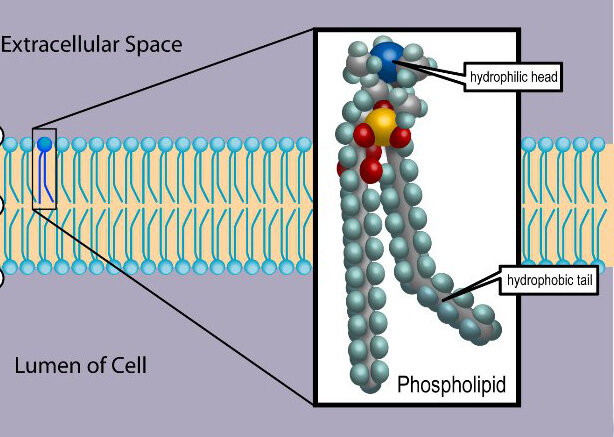
This self-assembly is a powerful organising principle in biology. It doesn't require energy or genetic instruction. It's simply the most energetically favorable arrangement for these molecules in water. The result is a stable, flexible barrier that separates the cell's interior from the outside world.
Structure and Fluidity
Let's look closer at the molecular structure. A typical phospholipid is built on a glycerol backbone. Two of glycerol's carbon atoms are attached to fatty acid tails, while the third is attached to the phosphate head group. A common example is phosphatidylcholine, one of the most abundant phospholipids in animal cell membranes.
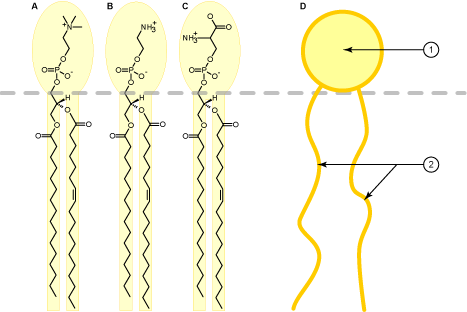
The character of the fatty acid tails is crucial for membrane fluidity. These tails are long hydrocarbon chains, and they can be either saturated or unsaturated.
- Saturated tails have only single bonds between their carbon atoms. This allows them to be straight and pack together tightly, like neatly stacked logs. Membranes rich in saturated fats are more viscous and less fluid.
- Unsaturated tails contain one or more double bonds. Each double bond creates a permanent kink or bend in the tail. These kinks prevent the phospholipids from packing closely together, increasing the space between them and thus enhancing the fluidity of the membrane.
The length of the hydrocarbon chains also plays a role. Shorter tails have less surface area to interact with their neighbours, which reduces the van der Waals forces between them and increases fluidity. Nature fine-tunes membrane fluidity by adjusting the mix of these different phospholipids in response to environmental changes, like temperature.
A Dynamic Mosaic
The term 'fluid' in the is quite literal. Phospholipids within the bilayer are in constant motion. They exhibit several types of movement:
- Lateral diffusion: Phospholipids rapidly exchange places with their neighbours within the same leaflet (one half of the bilayer). A single phospholipid can travel several micrometres in just one second.
- Rotation: Molecules spin rapidly around their long axis.
- Flexion: The hydrocarbon tails are flexible and constantly in motion.
However, one type of movement is extremely rare: transverse diffusion, or a 'flip-flop'. This is when a phospholipid moves from one leaflet of the bilayer to the other. The hydrophilic head would have to travel through the intensely hydrophobic core of the membrane, which is energetically very unfavorable. This event happens spontaneously only about once a month for any given lipid. When it does need to happen for biological reasons, cells use special enzymes called flippases to facilitate the process.
This combination of rapid lateral movement and rare transverse movement creates a structure that is stable yet highly dynamic. It forms a reliable barrier while allowing for the movement and function of embedded proteins, which are essential for transport, signalling, and communication. This dynamic interplay is the essence of the cell membrane.
Time to check your understanding of these dynamic molecules.
The term 'amphipathic' describes a molecule that possesses which of the following properties?
A cell needs to increase the fluidity of its plasma membrane. Which of the following changes would be most effective?
The constant motion and clever chemistry of phospholipids provide the foundation for the cell's very existence, creating a boundary that is both a fortress and a gateway.