Architectural Foundations of Modern Computers
Von Neumann Architecture
The Stored-Program Blueprint
Before the mid-1940s, reprogramming a computer meant physically rewiring it. Technicians would unplug and replug a dizzying array of cables on massive plugboards, a process that could take days. The great leap forward came with the concept of the stored-program computer, an elegant idea most famously detailed by mathematician John von Neumann and his colleagues.
The architecture they proposed, now known as the Von Neumann architecture, is deceptively simple. It treats instructions—the steps in a program—and data—the information the program works on—as the same kind of thing: bits stored in memory. There's no special, separate place for the program. The recipe and the ingredients list are written on the same sheet of paper.
This single innovation transformed computers from single-purpose behemoths into the versatile, general-purpose machines we use today. To change a computer's function, you no longer needed a wrench; you just needed to load a different program into its memory.
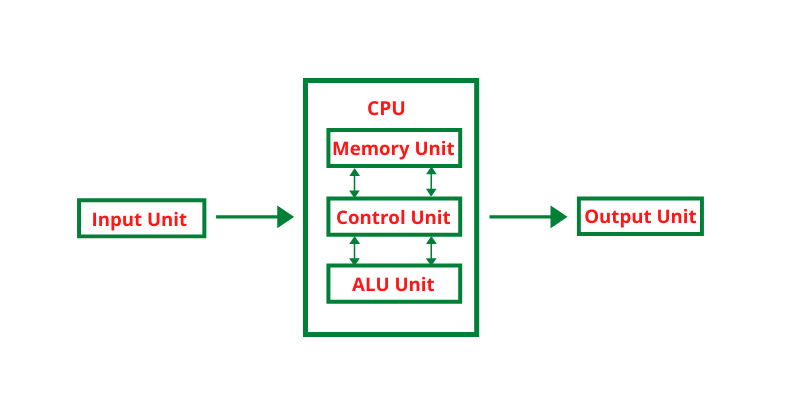
The Brains of the Operation
At the heart of this architecture is the Central Processing Unit (CPU), the component that executes program instructions. The CPU isn't a single entity but is primarily composed of two key parts that work in tandem: the Control Unit (CU) and the Arithmetic Logic Unit (ALU).
Think of the Control Unit as the orchestra conductor. It doesn't play an instrument, but it reads the musical score (the program instructions) and directs all the other components. It fetches instructions from memory, decodes them to understand what needs to be done, and sends signals to the ALU, memory, and I/O devices to carry out the task.
The Arithmetic Logic Unit is the orchestra's star musician. It's the part that performs all the calculations. The CU hands it a task, like adding two numbers or comparing them to see which is larger, and the ALU executes it. It handles both arithmetic operations (+, -, *, /) and logical operations (AND, OR, NOT).
To work efficiently, the CPU can't wait for data to travel all the way from main memory (RAM) for every single operation. That's where come in. Registers are extremely small, extremely fast memory locations built directly into the CPU. They act as a scratchpad for the ALU, holding the data it's currently working on and the immediate results of its calculations. This is much faster than constantly sending data back and forth to RAM.
The Information Superhighway
For the CPU, memory, and input/output devices to communicate, they need a pathway. This is the system bus, a set of parallel electrical wires that acts as a digital highway connecting all the major components of the computer. It's not just one bus, but three working together.
| Bus Type | Direction | Purpose |
|---|---|---|
| Address Bus | CPU → Memory/I/O | Specifies the memory location or device the CPU wants to communicate with. |
| Data Bus | CPU ↔ Memory/I/O | Carries the actual data being transferred between components. |
| Control Bus | CPU ↔ Memory/I/O | Transmits command and timing signals, like 'read from memory' or 'write to memory'. |
Imagine you want to mail a letter. You write the destination on the envelope (the Address Bus), put the letter inside (the Data Bus), and the postal service provides the signals for pickup and delivery (the Control Bus). All three are necessary for the message to get where it's going.
This elegant design has a famous limitation. Because instructions and data share the same bus, the CPU can't fetch an instruction and fetch data at the same time. It has to do one, then the other. This traffic jam is known as the and can limit the processing speed of the system.
Despite this bottleneck, the Von Neumann architecture's simplicity and flexibility have made it the dominant model for general-purpose computing for over 75 years.
Ready to check your understanding of this foundational architecture?
What is the fundamental principle of the stored-program computer, as described in the Von Neumann architecture?
In the CPU, the _______ is responsible for performing calculations like addition and subtraction, while the _______ is responsible for decoding instructions and directing other components.
The principles of the stored-program computer, the CPU's internal logic, and the system bus form the fundamental operating model for nearly every device you use.