Architects of Information The Evolution of Computing
Mechanical Blueprints
A Machine That Could Think
After designing the Difference Engine to calculate polynomial tables, the English mathematician imagined something far more ambitious. His earlier machine was a specialist, built for one task. His next idea, the Analytical Engine, was a generalist. It wasn't just designed to calculate; it was designed to be programmed. This conceptual leap marked the birth of the general-purpose computer.
The design of the Analytical Engine was revolutionary because it separated the concepts of data and instructions. The machine's architecture had two main parts: the 'Store' and the 'Mill'. The Store was where numbers were held for later use. The Mill was where the actual arithmetic operations happened. An operator would feed in instructions and data via punched cards, the Mill would process them using numbers from the Store, and the results would be printed out.
If this sounds familiar, it should. The Store is the direct conceptual ancestor of modern computer memory (RAM), and the Mill is the precursor to the central processing unit (CPU).
The First Programmer
While Babbage designed the hardware, it was , a gifted mathematician and the daughter of the poet Lord Byron, who understood its true potential. She translated a paper on the Analytical Engine and added her own extensive notes, which ended up being longer than the original text. In these notes, she detailed a step-by-step process for using the machine to calculate a sequence of Bernoulli numbers.
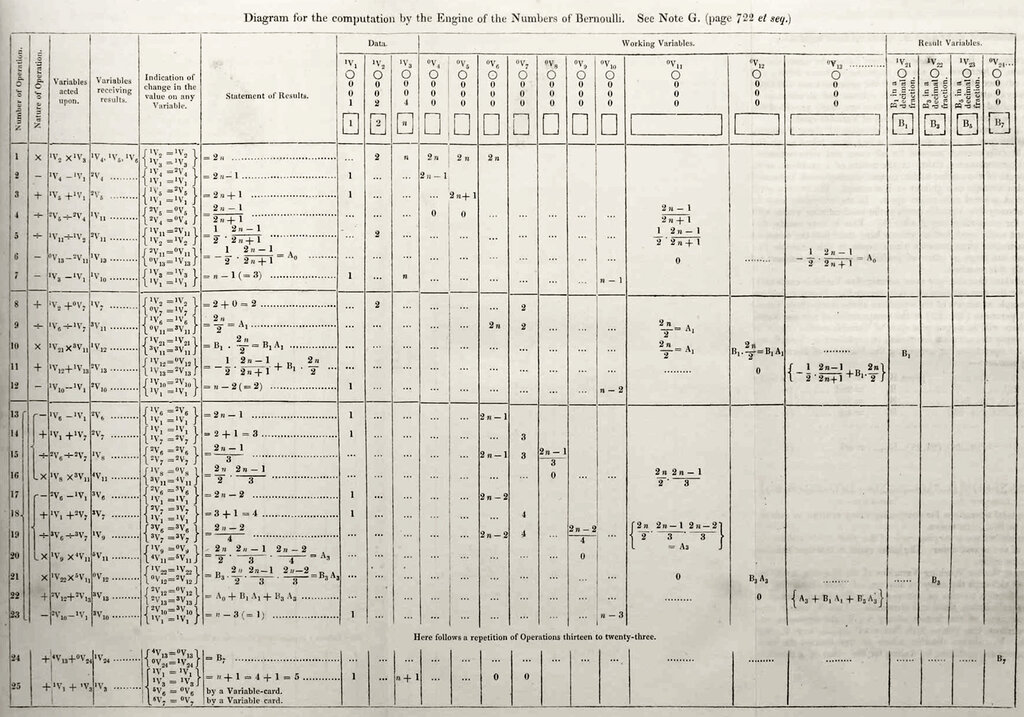
This wasn't just a mathematical exercise. It was the world's first published algorithm, a finite sequence of instructions designed for a computer. Lovelace realized the Engine wasn't just a number cruncher. She saw that because it could manipulate symbols according to rules, it could theoretically process anything that could be represented symbolically, like music, language, or images. It could move beyond pure calculation into the realm of general computation.
The Analytical Engine weaves algebraical patterns just as the Jacquard-loom weaves flowers and leaves.
Crucially, the design included the ability for conditional branching—the machine could alter its sequence of operations based on the result of a previous calculation. This is the mechanical equivalent of an if-then statement in modern programming, a fundamental building block of any complex algorithm. It allowed the machine to make 'decisions' and follow different computational paths.
A Vision Ahead of Its Time
Despite its brilliant design, the Analytical Engine was never built. Babbage's plans were incredibly complex, requiring thousands of precisely interlocking gears and levers. The manufacturing capabilities of the 19th century simply weren't up to the task. The precision engineering needed to create the components with the required tolerances did not yet exist.
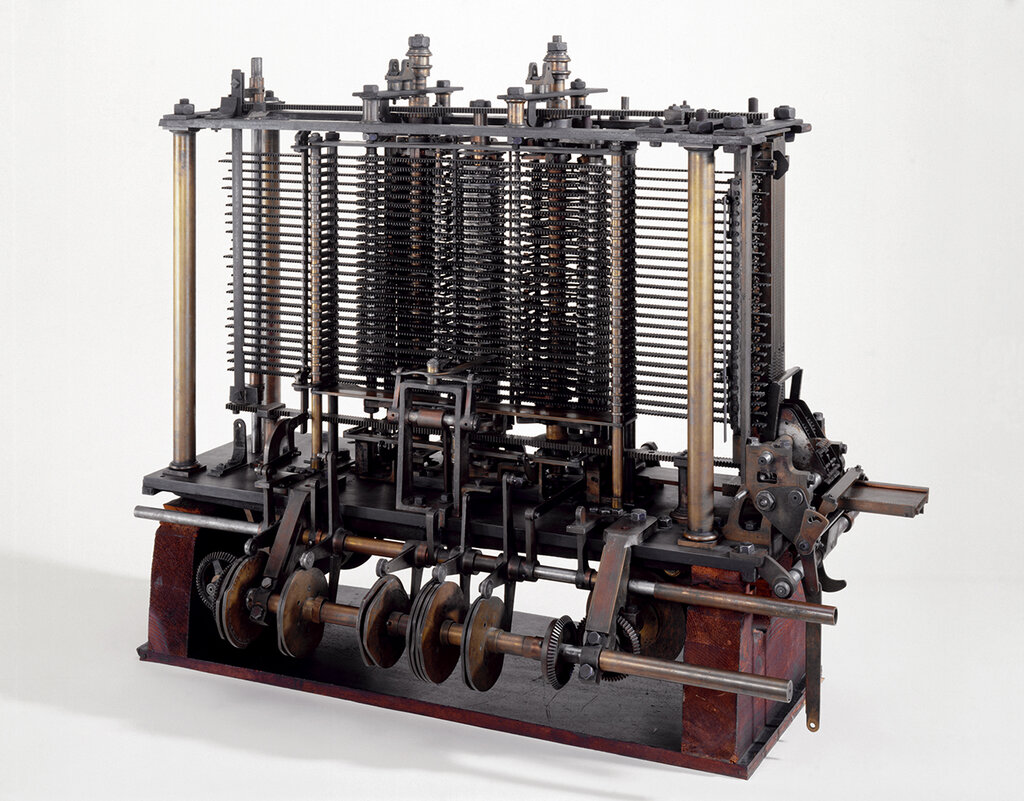
The concepts of a stored program, a separate memory and processor, and symbolic logic were all there on paper. It would take another century, and the advent of electronics, for Babbage and Lovelace's vision to be fully realized.
What was the primary conceptual difference between Babbage's Difference Engine and his Analytical Engine?
In the design of the Analytical Engine, the 'Store' was to memory as the 'Mill' was to the _______.