Architects of Conflict and Global Transformation
Interwar Geopolitical Failures
The Long Fuse Ignites
The end of World War I was supposed to usher in an era of lasting peace. Instead, it lit a twenty-year fuse to an even greater conflict. The architecture of this peace, built on the Treaty of Versailles and the , proved fundamentally unstable. The League was designed for collective security, the idea that an attack on one member was an attack on all. In practice, it was a toothless giant. It had no army of its own and relied on the goodwill of its members, who were often unwilling to risk their own soldiers or economies to punish aggressors. When Japan invaded Manchuria in 1931, or Italy conquered Ethiopia in 1935, the League could only condemn them. The world saw that aggression had no real consequences.
This political weakness was amplified by economic collapse. The Great Depression shattered the global trade system that had linked nations together. Facing mass unemployment and social unrest, countries abandoned cooperation and turned inward. The new economic model was autarky, a drive for national self-sufficiency. Nations like Germany and Japan, lacking vast colonial empires for resources, saw expansion as the only path to economic survival. Germany's quest for Lebensraum (living space) wasn't just ideology; it was an economic strategy to secure food and industrial resources by force. Global trade was no longer a path to prosperity, but a vulnerability to be eliminated.
The Price of Peace
Faced with a failing system of collective security and rising aggression, Britain and France adopted a new strategy: Appeasement. Today, the policy is seen as a synonym for cowardice, but in the 1930s it was a pragmatic calculation. The memory of World War I’s slaughter was fresh, and the public had no appetite for another war. Militarily, both Britain and France knew they were unprepared to face a rearmed Germany. They needed to buy time.
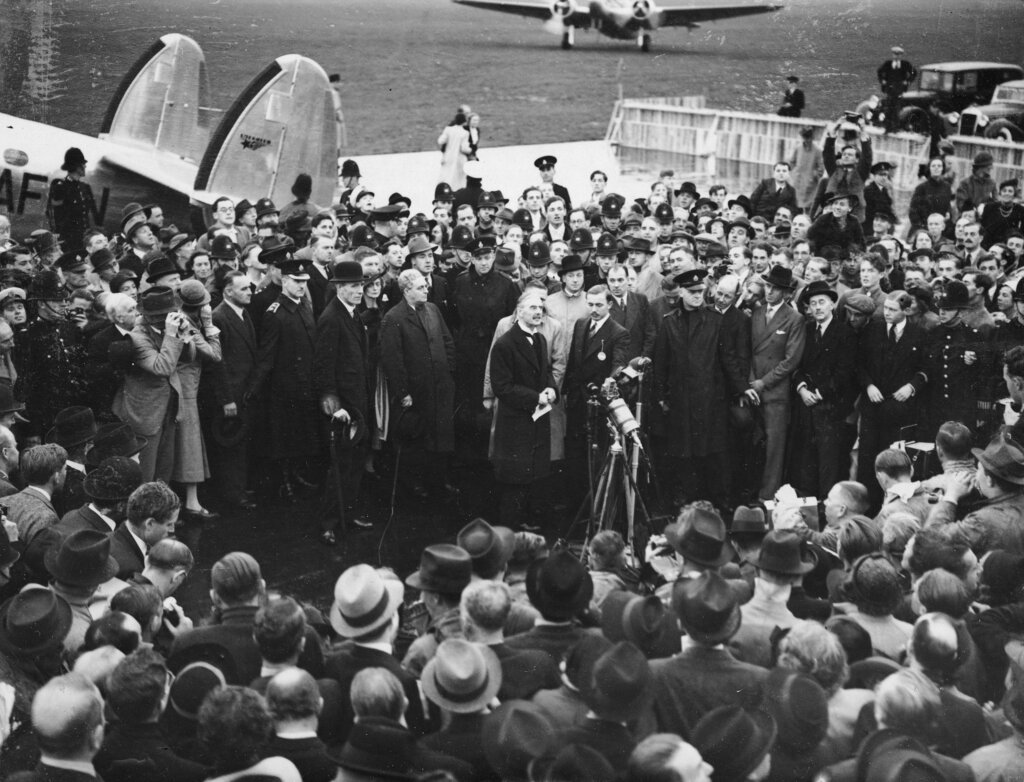
Appeasement reached its peak with the in 1938. In a desperate bid to avoid war, Britain and France agreed to Hitler's demand to annex the Sudetenland, a German-speaking region of Czechoslovakia. Czechoslovakia itself was not even invited to the negotiations. For Prime Minister Neville Chamberlain, it was a painful but necessary trade-off. He believed he had secured “peace for our time,” but critically, the year he bought allowed Britain to accelerate its rearmament, particularly the Royal Air Force, which would be decisive in the Battle of Britain.
A Devil's Bargain
The final illusion of a united front against fascism shattered in August 1939. The world was stunned when Nazi Germany and the Soviet Union, two sworn ideological enemies, signed a non-aggression pact. The was the height of cynical realpolitik. For Hitler, it meant he wouldn't have to fight a two-front war when he invaded Poland. For Stalin, it bought time to build up his military and offered a share of Polish territory, as detailed in a secret protocol.
The pact wasn't about friendship; it was a pragmatic alliance between two dictators who needed to neutralize each other to achieve their immediate goals.
With the Soviet Union neutralized, the path was clear. On September 1, 1939, German forces invaded Poland. The long fuse that was lit in 1919 had finally reached the powder keg. The diplomatic and economic systems designed to prevent another global catastrophe had failed completely, making World War II inevitable.
What was the fundamental weakness of the League of Nations that rendered it ineffective in stopping aggression in the 1930s?
The Great Depression encouraged a policy of national self-sufficiency, which directly contributed to expansionist ambitions in countries like Germany and Japan. What is the term for this policy?