Architecting Scalable Distributed Systems
Scalable Infrastructure Architecture
Handling the Flood
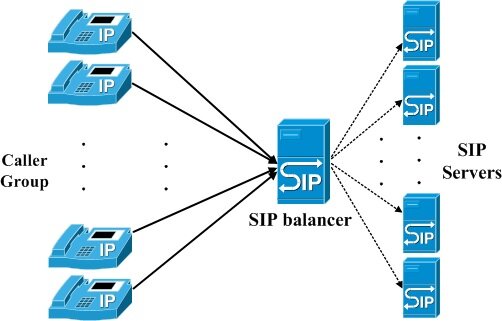
When an application goes from a few hundred users to millions, a single server can't handle the load. The immediate solution is to add more servers, a process called horizontal scaling. But this creates a new problem: how do you distribute incoming requests evenly among them? If every user still hits the same initial server, you've just moved the bottleneck. The solution is a load balancer, a dedicated server or service that acts as a traffic cop for your application.
A load balancer sits in front of your servers and routes client requests across all servers capable of fulfilling those requests in a way that maximizes speed and capacity utilization.
By distributing the workload, a load balancer prevents any single server from becoming overwhelmed, which improves responsiveness and availability. It also eliminates a single point of failure. If one of your application servers goes down, the load balancer simply stops sending traffic to it, and users are none the wiser. This is the first step in building a resilient, high-traffic system.
Smart Traffic Cops
Not all load balancers work the same way. They operate at different layers of the network model, which gives them different capabilities. The two most common types are Layer 4 and Layer 7.
A Layer 4 load balancer operates at the transport layer. It makes routing decisions based on information like the source and destination IP addresses and ports. It doesn’t know anything about the content of the traffic itself, only where it's coming from and where it's going. This makes it extremely fast, but also limited. It’s like a mail sorter that only looks at the zip code on an envelope.
A Layer 7 load balancer operates at the application layer. It can inspect the content of the network packet, such as HTTP headers, URLs, and cookies. This allows for much more intelligent routing. For example, it can route requests for /api/video to a set of servers optimized for video processing and requests for /api/images to a different set. It’s like a receptionist who reads the name on the envelope and delivers it to the correct person in a specific department.
To decide which specific server to send a request to, load balancers use different algorithms. Round Robin sends requests to servers in a simple rotation. A more advanced version is Weighted Round Robin, which accounts for servers having different processing capacities. If one server is twice as powerful as the others, you can assign it a weight of 2, and the load balancer will send it twice as many requests.
Another common algorithm is Least Connections, which is great for managing long-lived connections. The load balancer keeps track of how many active connections each server has and sends the next request to the server with the fewest connections. This helps distribute the load evenly based on how busy the servers actually are.
Caching for Speed and Scale
Handling traffic is only half the battle. You also need to respond to requests quickly. Hitting a database for every piece of information is slow and expensive. Caching solves this by storing frequently accessed data in a fast, in-memory store like Redis or Memcached. When a request comes in, the application checks the cache first. If the data is there (a cache hit), it's returned immediately, saving a trip to the database.
The goal of caching is to reduce latency and decrease the load on your backend systems. It's one of the most effective ways to improve application performance.
But what happens when your cache itself becomes too large to fit on a single machine? You distribute it across multiple cache servers. A naive approach might use a simple hash function like server_index = hash(key) % N, where N is the number of servers. This works until you need to add or remove a server. When N changes, almost every key maps to a new server, causing a massive cache invalidation event where nearly all requests suddenly miss the cache and hammer the database. This is where a smarter technique, Consistent Hashing, comes in.
With the cache distributed, we need strategies for keeping it up-to-date. There are three primary patterns:
-
Cache-Aside (Lazy Loading): This is the most common pattern. The application code is responsible for managing the cache. It first tries to read data from the cache. If it's a miss, the application reads the data from the database, then writes it into the cache before returning it. The main downside is that the first user to request a piece of data will always experience the latency of a database call.
-
Write-Through: In this pattern, the application writes data to the cache and the database simultaneously (or the cache writes to the database itself). This ensures the cache is always consistent with the database. The benefit is data consistency, but the drawback is higher write latency, as every write operation has to go to two systems.
-
Refresh-Ahead: This strategy tries to prevent cache misses by proactively refreshing frequently accessed items before they expire. A background process can predict which items are likely to be needed soon and reload them into the cache. This is complex to implement but can significantly reduce read latency for popular data.
Going Global
Load balancing and caching work great within a single data center. But what if your users are spread across the globe? Sending a user in Japan to a server in Virginia creates significant latency. To solve this, we use techniques for global traffic management.
Global Server Load Balancing (GSLB) is a method of distributing traffic among servers located in different geographical locations. The most common way to implement this is through DNS. When a user's browser requests your domain, a specialized DNS server responds not with a single IP address, but with the IP address of the data center that is geographically closest to the user. This is often called geo-DNS routing.
For serving content, especially static assets like images, videos, and CSS files, a (CDN) is essential. A CDN is a globally distributed network of proxy servers. It caches your static content in locations all over the world, known as Points of Presence (PoPs).
When a user requests a file, the request is routed to the nearest PoP, which serves the file directly from its cache. This dramatically reduces latency for users and offloads a massive amount of traffic from your origin servers, allowing them to focus on processing dynamic requests.
An application needs to route traffic based on the URL path, sending requests for /api/video to servers optimized for video processing and requests for /api/images to a different set of servers. Which type of load balancer is required to accomplish this?
Which load balancing algorithm is most suitable for an application with long-lived connections, such as a real-time chat service, to ensure that new connections are sent to the least busy server?
By combining intelligent load balancing, multi-layered caching, and global traffic management, you can build an architecture capable of serving millions of users with high performance and reliability.