Architecting SAP Datasphere at Enterprise Scale
Advanced Architecture Patterns
Beyond Centralization
The monolithic enterprise data warehouse, a staple of business intelligence for decades, is no longer sufficient for the modern data landscape. Its centralized, top-down approach creates bottlenecks, stifles domain-specific innovation, and struggles with the scale and diversity of today's data sources. To address these limitations, organizations are shifting towards decentralized architectural patterns. The most prominent of these is the , an organizational and technical paradigm that transfers data ownership from a central team to the business domains that generate and understand the data.
In SAP Datasphere, a data mesh architecture is realized through a federated structure of Spaces. Each Space can be aligned with a specific business domain, granting that domain autonomy over its data models, connections, and user access. The domain team becomes responsible for creating and exposing analytical models as 'data products' within their Space. These products are then discoverable and consumable by other domains via the central Data Marketplace, enforcing clear contracts between data producers and consumers while maintaining decentralized control.
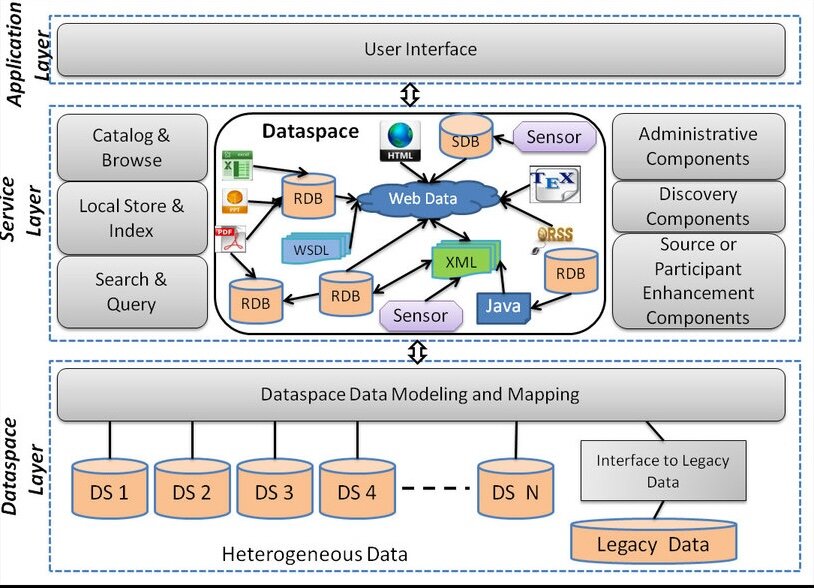
The Data Fabric Weave
While a data mesh provides an organizational blueprint, a provides the technological foundation to connect disparate data sources seamlessly. It is an architectural approach that abstracts away the complexity of the underlying data storage and locations, presenting a unified, intelligent layer for data access and governance. The fabric automates data discovery, integration, transformation, and security, effectively weaving together data from across the enterprise, regardless of where it resides.
SAP Datasphere is inherently a data fabric implementation. Its Catalog indexes metadata from all connected sources, making data assets discoverable. The semantic layer ensures that business terms and logic are consistent, whether the data is in an S/4HANA system, a BW/4HANA instance, or an Azure Data Lake. By leveraging intelligent lookups and a unified business model, Datasphere can generate query plans that dynamically access data from multiple sources without requiring extensive manual integration efforts from data consumers.
Governance Across Layers
Implementing these advanced architectures introduces significant governance challenges. In a multi-space Datasphere environment, managing access and resource allocation requires a sophisticated strategy. A key element is the use of , which allows data products from one Datasphere tenant to be securely consumed by another. This is critical for large enterprises with multiple subsidiaries or business units, each with its own tenant, enabling a 'network of fabrics' that can share governed data without centralizing it all in one place.
Within a single tenant, governance is managed through a hierarchy of Spaces. A central IT or governance Space might house foundational data models (e.g., master data for customers or materials). Domain-specific Spaces then consume these foundational models and build their own specialized data products. Access controls, row-level security, and data masking policies are applied at the model level, ensuring that security follows the data regardless of where it's consumed.
| Feature | Centralized Warehouse | Data Mesh (in Datasphere) | Data Fabric (in Datasphere) |
|---|---|---|---|
| Data Ownership | Central IT Team | Business Domains (via Spaces) | Hybrid; domains own products, fabric manages access |
| Governance | Top-down, monolithic | Federated and computational | Automated via active metadata |
| Primary Unit | Centralized Star Schema | Domain-owned Data Products | Unified Semantic Model |
| Key Challenge | Agility and bottlenecks | Consistency and duplication | Complexity of integration |
Hybrid Connectivity Strategies
Most enterprises operate in a hybrid reality, with critical systems like SAP S/4HANA or BW/4HANA remaining on-premise while new analytics capabilities are built in the cloud. Connecting SAP Datasphere to these systems requires a careful decision between data federation (virtual access) and replication (physical copy).
Federation is ideal for real-time operational reporting where the latest data is paramount and data volumes are manageable. Replication is better suited for analytical workloads that require high performance across large historical datasets and complex transformations.
For an SAP S/4HANA system, federation using remote tables allows for live reporting directly against the operational source. However, this places a load on the S/4HANA system and can be impacted by network latency. For larger analytical queries, replicating data into Datasphere using replication flows is often the better choice. The same trade-off applies to hyperscalers. Connecting to a data lake in AWS or Azure can be done via federation to explore new datasets, but for production-level dashboards, replicating the necessary data into Datasphere will provide superior performance and reliability.
A well-crafted architecture doesn’t merely move data—it ensures it flows:Reliably, even under peaks of real-time streaming or batch loadsSecurely, with access controls, encryption, and compliance baked inScalably, supporting spikes in IoT or API-generated dataFlexibly, adapting to structured, semi-structured, or unstructured formatsMaintainably, with observability, retries, schema evolution, and automated tests
Before you test your knowledge, take a moment to review the core concepts we've discussed.
Now, let's check your understanding of these architectural patterns.
What is the primary organizational principle behind a data mesh architecture?
In the context of SAP Datasphere, which statement best describes the role of a data fabric?
Designing an enterprise-scale data architecture involves balancing decentralization with unified governance. By leveraging the data fabric capabilities of SAP Datasphere, architects can implement flexible, hybrid models that empower business domains while ensuring data remains a cohesive and reliable asset for the entire organization.