Architecting Private AI Search Systems
Architectural Strategy and Trade-offs
Choosing Your Path
When building a sovereign AI system, the goal is to adapt a general-purpose Large Language Model (LLM) for a specific, private context. You don't need to build a new model from scratch. Instead, you can use one of two powerful techniques: Retrieval-Augmented Generation (RAG) or fine-tuning.
Choosing the right approach depends entirely on what you want the AI to do. Are you feeding it new information to answer questions, or are you teaching it a new skill or behaviour?
Think of it this way: RAG gives the model an open book to reference for facts. Fine-tuning sends the model to school to learn a specific style or task.
Grounding Models in Fact
Retrieval-Augmented Generation is the go-to method for grounding an LLM in your specific, proprietary data. It connects the model to an external knowledge base, typically a vector database, that lives within your secure, air-gapped environment. When a user asks a question, the system first retrieves relevant chunks of information from your documents and then passes that context to the LLM along with the original prompt. The model uses this just-in-time information to formulate its answer.
This makes RAG ideal for tasks that require factual accuracy based on a specific corpus of documents, like a chatbot for internal company policies or a search tool for technical manuals.
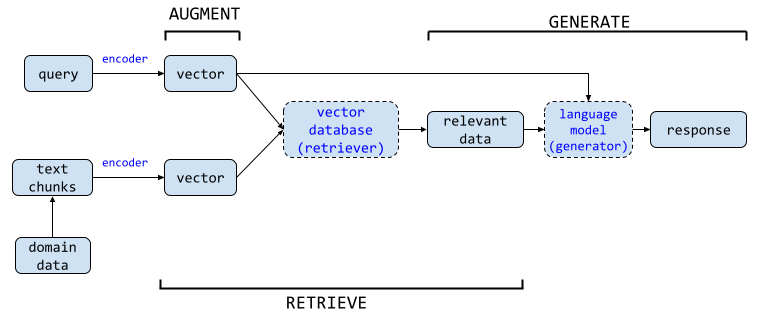
One of the biggest challenges with LLMs is knowledge staleness. A model's information is frozen at the time it was last trained. RAG elegantly solves this. To update the AI's knowledge, you don't touch the model at all. You simply update the documents in your vector database. This separation of knowledge and reasoning makes RAG highly efficient for environments where information changes frequently.
Shaping Model Behaviour
Fine-tuning is a different process. Instead of giving the model external documents, you're adjusting its internal weights by training it on a curated dataset of examples. This process modifies the model itself, teaching it to respond in a particular way.
This technique isn't about teaching the model new facts. It's about shaping its behaviour. Fine-tuning is the right choice when you need the model to adopt a specific communication style, follow complex instructions, or consistently produce structured output like JSON or SQL.
Fine-tuning focuses on the how—how to write, how to structure an answer, how to interact. RAG focuses on the what—what information to use in the answer.
The training process for fine-tuning directly alters the model's parameters, such as the query, key, and value (Q, K, V) matrices within its attention layers. This is a more computationally intensive process than simply updating a database. Once fine-tuned, the model's new behaviour is baked in. However, any factual knowledge it learned is static and will become stale over time, requiring a full re-tuning to update.
Making the Right Choice
Your decision should be guided by your end goal. The trade-offs are clear when you compare resource needs and performance characteristics.
| Feature | Retrieval-Augmented Generation (RAG) | Fine-Tuning |
|---|---|---|
| Primary Use | Factual grounding, knowledge-based Q&A | Behavioural change, style adaptation, format adherence |
| Data Updates | Easy & real-time (update vector DB) | Difficult & periodic (requires re-training) |
| Knowledge | Dynamic, external | Static, internalised |
| Infrastructure | Requires ongoing retrieval/database infrastructure | Requires upfront compute for training |
| Risk of Hallucination | Lower (grounded in retrieved context) | Higher (relies on internal memory) |
For a sovereign AI, a hybrid pattern is often the most robust solution. You can fine-tune a model to understand the nuances of your organisation's language and desired output formats, then deploy it with a RAG system to ensure its responses are always grounded in the latest, most accurate proprietary data. This layered approach provides both behavioural consistency and factual accuracy, creating a powerful and reliable tool.
When building a sovereign AI, what is the primary purpose of using Retrieval-Augmented Generation (RAG)?
A legal firm wants an AI assistant that can draft contracts in the firm's specific, complex formatting and verbose style. Which technique is the most appropriate for this task?
By understanding these core architectural trade-offs, you can design a system that is secure, accurate, and perfectly tailored to your organisation's needs.