Architecting Intelligence Beyond the Basics
Mapping AI Architectures
The AI Family Tree
Artificial Intelligence (AI) isn't a single technology. It's a broad field of study, like biology or physics. Within that field are specific disciplines and techniques, each building on the last. The most common way to visualize this is as a set of nested dolls.
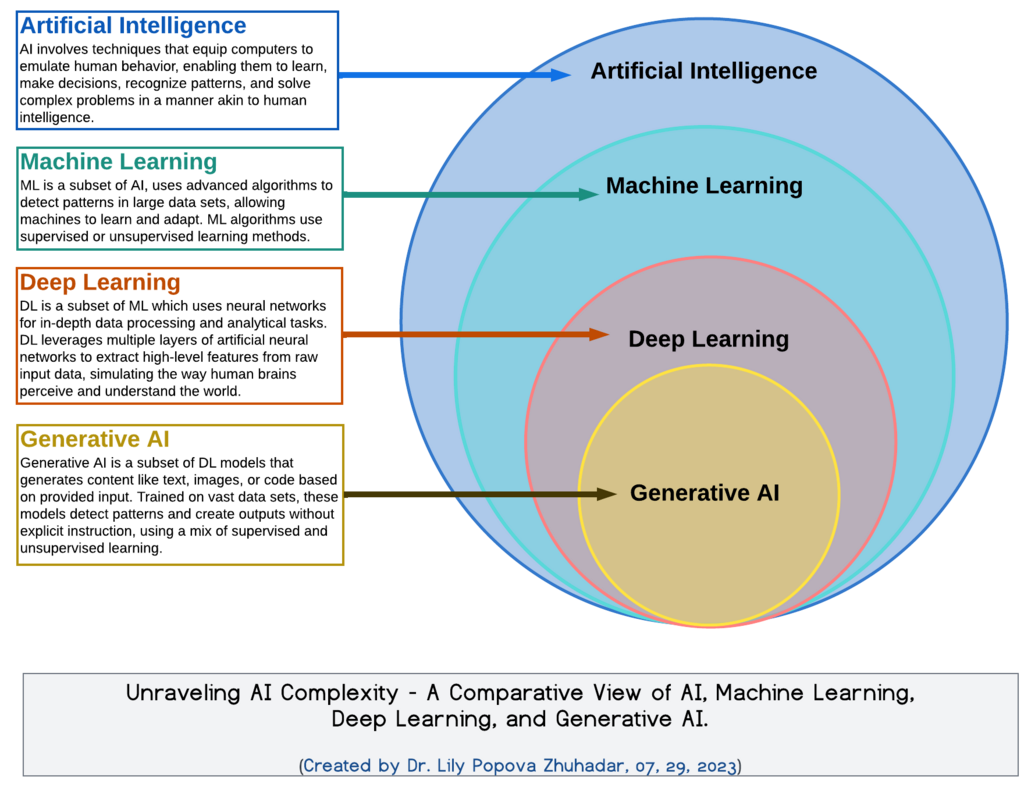
At the outer layer, you have Artificial Intelligence, the general concept of machines performing tasks that typically require human intelligence.
Inside that is Machine Learning (ML), a specific approach to AI where algorithms learn patterns from data without being explicitly programmed for a task. Instead of writing rules, we provide examples, and the model learns its own rules.
Next comes Deep Learning (DL), a subfield of ML that uses structures called artificial neural networks with many layers. This layered approach allows them to learn incredibly complex patterns from vast amounts of data, making them ideal for tasks like image recognition and natural language processing.
Finally, Generative AI is a category of deep learning models that can create new, original content. While other models might classify or predict, generative models produce text, images, or music that has never existed before.
Predictive vs Creative
The fundamental difference between most traditional ML/DL models and generative models lies in their objective. Most ML models are discriminative. Their goal is to learn the boundary between different types of data. A classic example is an email spam filter. It learns to distinguish, or discriminate, between 'spam' and 'not spam' based on patterns in the text. It's making a prediction about a label.
A discriminative model learns the conditional probability – the probability of a label given an input . It asks, "Given this email, what's the chance it's spam?"
In contrast, generative models learn the underlying distribution of the data itself. They don't just learn the line separating cats from dogs; they learn what a 'cat' looks like in its entirety—the distribution of pixels, shapes, and textures. Because they learn the joint probability , they can generate entirely new, plausible examples of cats.
| Model Type | Goal | Example Question | Core Function |
|---|---|---|---|
| Discriminative | Find the boundary between data categories. | Is this image a cat or a dog? | Prediction |
| Generative | Learn the distribution of the data itself. | Generate an image of a new cat. | Creation |
Complexity and Cost
With the rise of powerful generative models like those based on the architecture, it's easy to assume that more complex is always better. This is a critical misconception. The right tool depends entirely on the job.
Consider predicting house prices. A simple can do this effectively. It takes inputs like square footage, number of bedrooms, and location, and it learns a straightforward mathematical relationship to predict the price. This model is fast, cheap to run, and highly interpretable. You can easily see exactly which features are influencing the price the most.
Now, imagine trying to use a large language model (LLM) for the same task. You could format the house data as a text prompt and ask the model to predict the price. It might even be accurate. However, the computational cost would be orders of magnitude higher. The process would also be a 'black box'—you'd get a price, but with little insight into how the model arrived at that number.
Choosing a model is always a trade-off between performance, cost, and transparency. For many business problems focused on prediction and classification, simpler ML models are not just adequate; they are superior.
Use a generative model when your goal is creation: drafting emails, brainstorming ideas, generating images, or creating code. Use a simpler, discriminative model when your goal is prediction or classification, especially when you need speed and the ability to explain the results.
Ready to check your understanding of these different AI models?
Which of the following statements best describes the relationship between Artificial Intelligence (AI), Machine Learning (ML), and Deep Learning (DL)?
An email system that analyses incoming messages and categorises them as either 'spam' or 'not spam' is a classic example of what type of model?
Understanding this hierarchy is key. It allows you to move beyond the hype and see AI not as a magical black box, but as a set of powerful, specialised tools. Choosing the right one is the first step to building something useful.