Architecting Complex Web Applications
Scaling Strategy
The Monolith and Its Limits
Most applications start life as a monolith. This isn't a bad thing. A monolithic architecture means the entire application is built as a single, unified unit. The user interface, business logic, and data access layer are all contained within one codebase, deployed as a single file.
For a small team or a new product, this is often the fastest way to get started. Everyone works on the same code, testing is straightforward, and deployment is simple: you just deploy the whole application at once. A well-structured monolith, often called a modular monolith, organizes its code into distinct, logical modules. This approach maintains the simplicity of a single deployment while setting the stage for future growth.
Think of a modular monolith as a well-organized house. All the rooms are under one roof, but the kitchen is separate from the bedroom, and the plumbing doesn't run through the living room walls. Everything is contained, but internally organized.
But as the application grows, this single unit can become a liability. A small change requires redeploying the entire system, which is slow and risky. If one small feature has a bug, it can crash the whole application. And what if only one part of your app, like the video processing service, experiences heavy traffic? With a monolith, you have to scale the entire application, which is inefficient and expensive. You can't just add more resources to the one part that needs it.
The Shift to Microservices
This is where microservices come in. Instead of one giant application, a microservice architecture breaks it down into a collection of small, independent services. Each service is responsible for a single piece of business functionality. For an e-commerce site, you might have separate services for user accounts, product catalogs, shopping carts, and payments.
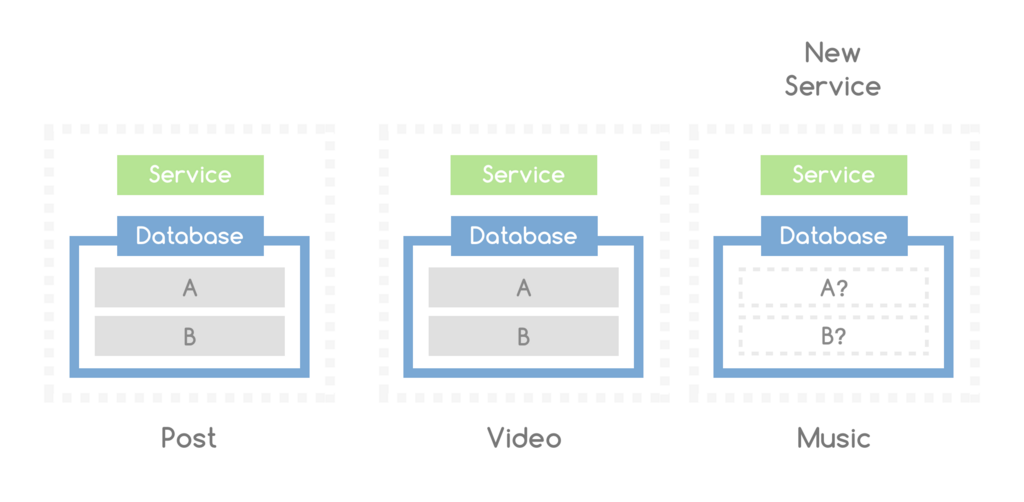
This approach offers powerful advantages for scaling. One of the key benefits is independent scaling. If your product catalog service is getting hammered with requests, you can scale it horizontally by adding more server instances just for that service. This is far more efficient than the vertical scaling approach of a monolith, which would require upgrading the entire server. This also provides fault isolation. If the recommendation service crashes, it doesn't take down the checkout service with it. The rest of the application can continue running.
Furthermore, small, autonomous teams can own and deploy their services independently. A team working on the payments service can deploy updates multiple times a day without coordinating with the team managing user profiles. This dramatically increases development velocity.
Avoiding the Hidden Trap
However, simply breaking an application into separate services doesn't guarantee success. Many teams fall into a common anti-pattern: the . This occurs when services are technically separate but remain tightly coupled. For instance, if deploying the 'inventory' service requires a simultaneous deployment of the 'shipping' and 'catalog' services, you haven't gained any real independence. You've just created a more complex system with all the operational overhead of microservices but none of the key benefits.
True microservices require loose coupling. Services should communicate through well-defined APIs and not share databases. Each service should be independently deployable and resilient to the failure of others. The choice between a monolith and microservices isn't about which is better, but which is right for your team, complexity, and scale. Starting with a modular monolith and strategically breaking out services as needed is often the most effective path to building a scalable, maintainable system.
What is the primary characteristic of a monolithic architecture?
An e-commerce application's product catalog service is experiencing extremely high traffic. If the application uses a microservice architecture, what is the most efficient way to handle the load?