Architecting Clear Communication
Minto Pyramid Principle
Start with the Answer
Most of us learn to communicate by building up to a conclusion. We present facts, walk through our analysis, and finally, reveal the main point. The Pyramid Principle flips this script entirely. It argues that you should always start with the answer first.
The Pyramid Principle advocates that “ideas in writing should always form a pyramid under a single thought.”
This top-down approach forces you to lead with your single most important message, or the "Governing Thought." Everything that follows is organized to support that single idea in a clear, hierarchical structure. This method, developed by while at McKinsey, is designed to reduce the cognitive load on your audience. By giving them the main takeaway upfront, you provide a mental framework that helps them organize and absorb all the supporting details that follow.
Building the Structure
A strong pyramid is built on clear logical relationships, both vertically and horizontally.
The Vertical Relationship The connection between each level of the pyramid is a question-and-answer dialogue. The point at the top of any group should create a question in the reader's mind, which is immediately answered by the points directly below it. For example, if your top-level statement is "We must redesign our mobile app," the natural question is "Why?" The next level down must answer that question with a series of arguments, such as "User engagement is down 30%," "Competitors offer a better experience," and "Key features are crashing."
This dialogue ensures that every piece of information is relevant and directly supports the main idea. Nothing is extraneous.
The Horizontal Relationship While the vertical relationship ensures relevance, the horizontal relationship ensures logic. All ideas on the same level of the pyramid must be of the same kind and presented in a logical order. To achieve this, they must adhere to the —they must be Mutually Exclusive and Collectively Exhaustive.
Once you've grouped your points, you must order them. Common logical orders include chronological (1, 2, 3), structural (Boston, New York, DC), or by degree (first, second, third most important).
Thinking vs. Communicating
It's important to distinguish between the process of figuring out the solution and the process of communicating it. The Pyramid Principle is primarily a tool for communication, but it requires a specific kind of thinking.
Bottom-up Thinking is the discovery phase. You gather data, identify facts, and look for patterns. You group related ideas together and draw conclusions from those groups. You work your way up from the details to the main insight. This is how most analysis is done.
Top-down Thinking is the communication phase. Once your bottom-up analysis has revealed the Governing Thought, you switch to a top-down approach to present it. You state your conclusion first and then lay out the supporting arguments in the pyramid structure. This is the clearest way to convey your message to an audience.
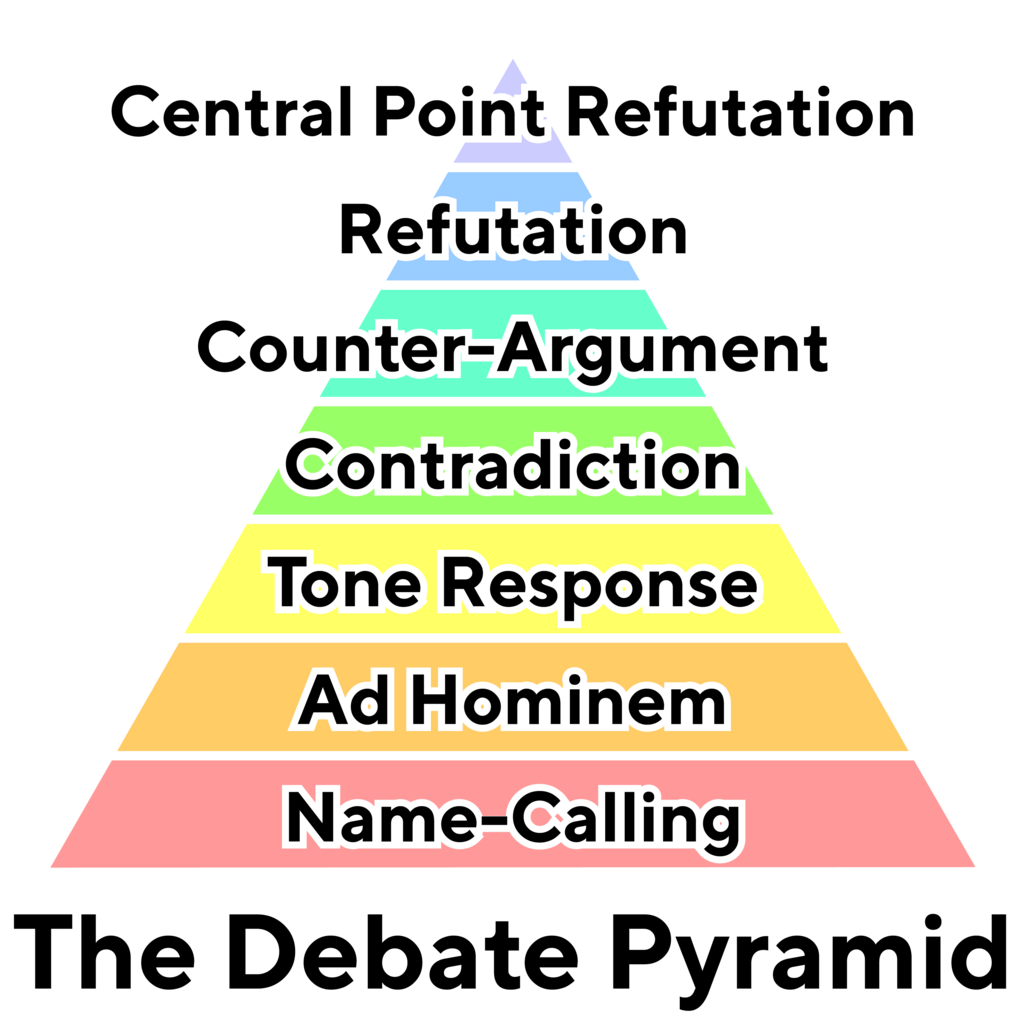
The goal is to complete the messy, bottom-up work in private. Your audience should only see the clean, logical, top-down pyramid. This structure not only makes your argument more persuasive but also demonstrates clarity of thought.
What is the fundamental rule of the Pyramid Principle?
In the Pyramid Principle's structure, what defines the vertical relationship between different levels?
By mastering this structure, you can turn complex ideas into clear, compelling messages.