Architecting Autonomous AI Agents
Agentic Reasoning Loops
The Agent's Brain
A standard Large Language Model (LLM) is a powerful text generator. You give it a prompt, it gives you a single, continuous response. An AI agent, however, does more than just respond. It works on a problem.
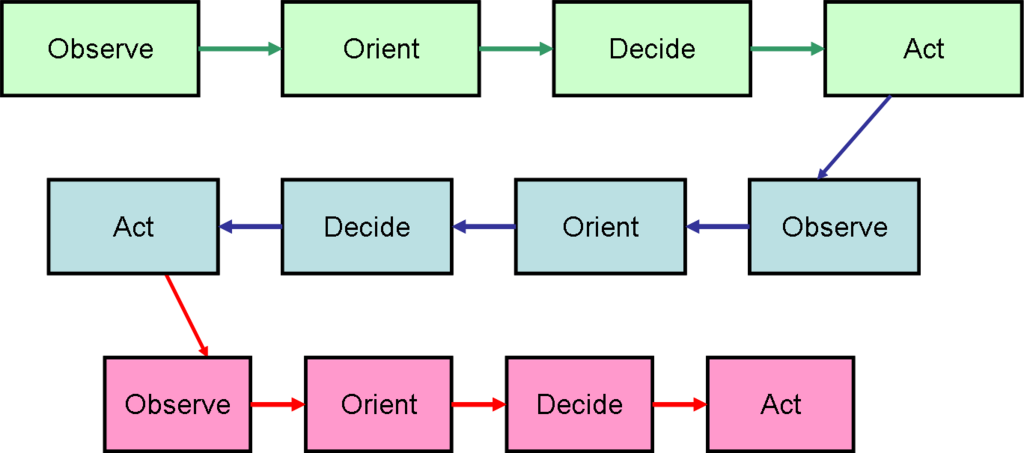
The core difference lies in its ability to operate in a loop, breaking a complex goal into smaller, manageable steps. Instead of trying to solve everything at once, it thinks, acts, observes the result, and then thinks again. This iterative process is what allows an agent to tackle multi-step problems autonomously.
This "looping" capability—where the AI takes an action, observes the result, and takes another action—is what separates an agent from a chatbot.
The ReAct Loop
One of the most effective patterns for this process is called ReAct, which stands for Reason and Act. It structures the agent's problem-solving process into a simple, powerful cycle with three distinct phases: Thought, Action, and Observation.
This isn't a single transaction but a continuous dialogue the agent has with itself and its tools until the task is complete. It mimics a fundamental aspect of human problem-solving: we assess a situation, decide on a step, take it, see what happens, and then plan our next move based on the new information.
Let's break down each phase:
-
Thought: This is the reasoning step. The agent analyzes the overall goal and its current progress. Using a technique called reasoning, it formulates an internal monologue, like, "Okay, I've found the person's birth date. Now I need to calculate their current age. The best tool for that is a calculator."
-
Action: Based on its thought, the agent chooses and executes an action. This usually involves using a specific tool, like performing a web search, running a piece of code, or querying a database. The action is concrete and singular.
-
Observation: The agent receives the output from its action. This is the feedback. If it performed a web search, the observation is the text from the search results. If it used a calculator, the observation is the answer. This new information feeds directly into the next Thought phase, starting the cycle over.
The Cycle in Action
Imagine you give an agent a goal: "Who was the monarch of the United Kingdom when the Eiffel Tower was completed, and how old were they at the time?"
An LLM might try to answer this in one go and could easily make a mistake. An agent, however, would decompose the problem. Here’s how its internal process might look:
| Iteration | Thought | Action | Observation |
|---|---|---|---|
| 1 | I need to find out when the Eiffel Tower was completed. A web search is the best tool for this. | search("when was the Eiffel Tower completed?") | The Eiffel Tower was completed on March 31, 1889. |
| 2 | Okay, the date is March 31, 1889. Now I need to find the UK monarch at that time. Another search is needed. | search("UK monarch in 1889") | Queen Victoria. |
| 3 | The monarch was Queen Victoria. Now I need her birth date to calculate her age in 1889. | search("Queen Victoria birth date") | May 24, 1819. |
| 4 | I have the completion date (March 31, 1889) and her birth date (May 24, 1819). I can now calculate her age. I will use a calculator tool. | calculate_age("May 24, 1819", "March 31, 1889") | 69 years old. |
| 5 | I have all the pieces of information. The monarch was Queen Victoria and she was 69. I am ready to give the final answer. | finish("Queen Victoria was the monarch of the United Kingdom when the Eiffel Tower was completed; she was 69 years old at the time.") | End of task. |
This cycle of Thought-Action-Observation continues until the agent determines it has fully achieved the original goal. This is called a termination condition. The final action is often to present the synthesized answer to the user. This iterative, self-correcting loop is the fundamental mechanism that enables to solve complex, real-world problems that go far beyond simple text generation.
What is the fundamental difference between a standard Large Language Model (LLM) and an AI agent?
The ReAct framework structures an agent's problem-solving process into a cycle. What does ReAct stand for?