Architecting Artificial Intelligence Systems
Learning Paradigms Compared
Choosing Your Learning Path
Selecting the right machine learning paradigm is a strategic decision. It’s not about which one is “best,” but which one is best suited for your specific problem. The choice hinges on two key factors: the kind of data you have and the goal you want to achieve. Do you have a dataset with clear, labeled answers? Or are you staring at a mountain of unlabeled data, hoping to find some hidden structure? Maybe your goal isn't to analyze static data at all, but to teach an agent how to make decisions in a dynamic world. Each scenario points to a different approach: supervised, unsupervised, or reinforcement learning.
Supervised Learning: The Power of Labels
Supervised learning is your tool of choice when you have a dataset with known outcomes. You provide the model with examples, and each example is tagged with the correct answer, or “label.” The model’s job is to learn the relationship between the input data and the output labels so it can make accurate predictions on new, unseen data.
This paradigm splits into two main tasks:
- Classification: When the goal is to predict a category. Is this email spam or not spam? Does this X-ray show a tumor or not? The output is a distinct class.
- Regression: When the goal is to predict a continuous value. What will be the price of this house? How many units will this product sell next month? The output is a number.
The entire process is guided by an objective function, which measures how far off the model's predictions are from the true labels. The model then adjusts its internal parameters to minimize this error, effectively “learning” from its mistakes.
Unsupervised Learning: Finding Hidden Patterns
What happens when you have data without any labels? That's where unsupervised learning comes in. Its purpose is not to predict a known outcome, but to discover the underlying structure or patterns within the data itself.
This approach is crucial for tasks like:
- Clustering: Grouping similar data points together. A marketing team might use clustering to segment customers into different personas based on their purchasing habits. Unlike classification, the groups (or clusters) aren't predefined. The algorithm finds them on its own.
- Dimensionality Reduction: Simplifying complex datasets by reducing the number of variables. If you have data with hundreds of features, can help distill it down to the most important components, making it easier to visualize and analyze without losing critical information.
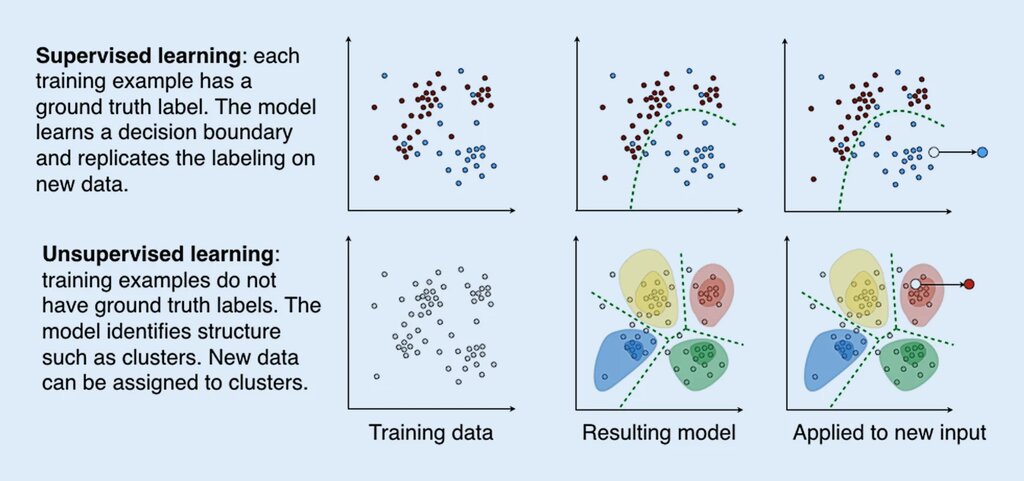
The key difference: Classification sorts data into known categories, while clustering discovers unknown groupings within the data.
Reinforcement Learning: Learning from Experience
Reinforcement learning (RL) is a different beast altogether. It’s not about learning from a static dataset, but about learning through interaction. An operates in an environment and learns to make a sequence of decisions by performing actions and receiving rewards or penalties.
The goal is to develop a policy—a strategy for choosing actions—that maximizes the total cumulative reward over time. Think of training a dog: a treat for rolling over (positive reward) reinforces that behavior, while a scolding for chewing the furniture (negative reward) discourages it.
A central challenge in RL is the exploration versus exploitation trade-off. Should the agent exploit the strategy it already knows works for a decent reward, or should it explore new, untried actions that might lead to an even greater reward? Balancing these two is critical for effective learning. An agent that only exploits might get stuck in a suboptimal strategy, while one that only explores will never master any single task.
Each paradigm offers a unique way to solve problems. The key is to analyze your goal and your data to choose the right tool for the job.
| Learning Type | Data Requirement | Primary Goal | Example Use Case |
|---|---|---|---|
| Supervised | Labeled Data | Predict outcomes | Email spam detection |
| Unsupervised | Unlabeled Data | Find hidden structure | Customer market segmentation |
| Reinforcement | No pre-existing data; needs an environment | Maximize cumulative reward | Training a robot to walk |
Let's test your understanding of these trade-offs.
A real estate company wants to build a model to predict the selling price of a house based on its features (e.g., size, number of bedrooms, location). Which machine learning paradigm is most appropriate for this task?
What is the primary goal of unsupervised learning?
By matching the paradigm to the problem, you can leverage the full power of machine learning, whether that means making accurate predictions, uncovering valuable insights, or creating intelligent systems that learn on their own.