Architecting Artificial Intelligence Systems
Modern Model Architectures
Architecture Follows Function
Choosing a neural network architecture is like picking the right tool for a job. You wouldn't use a hammer to cut a piece of wood. Similarly, the structure of your data—whether it's an image, a sentence, or a time-series—heavily influences which model will perform best. The key isn't just stacking layers; it's about arranging them in a way that respects the data's inherent patterns.
CNNs and Spatial Hierarchies
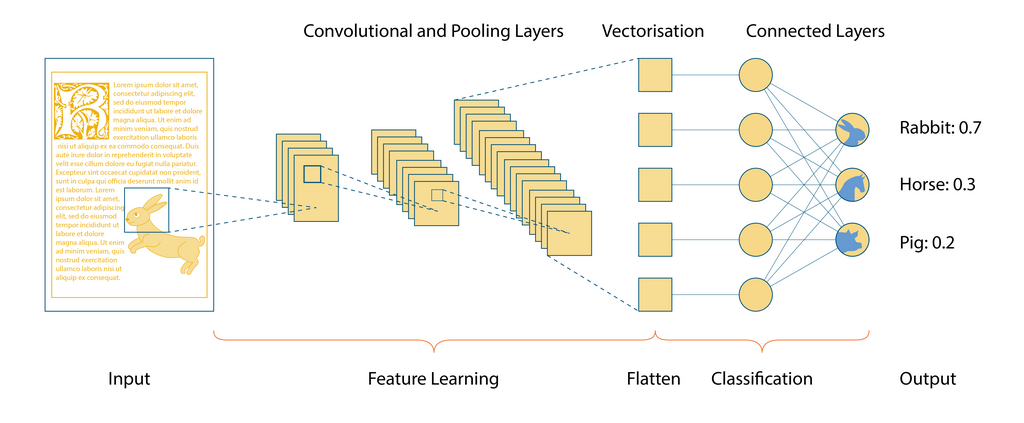
For tasks involving images or other spatial data, Convolutional Neural Networks (CNNs) are the go-to architecture. Their power comes from a structure that mimics how humans process visual information: by building up complex understanding from simple parts.
A CNN doesn't see a whole car at once. Instead, its initial layers act like feature detectors, identifying basic elements like edges, corners, and colour patches. As data passes through subsequent layers, these simple features are combined into more complex concepts. Edges and curves become wheels and windows. Wheels, windows, and a chassis become a car.
This process is called building a spatial hierarchy. It's efficient because a feature learned in one part of an image (like the curve of a tyre) can be recognised anywhere else. This is achieved through two key layer types: convolutional layers that scan for features and pooling layers that downsample the image, making the network less sensitive to the exact location of those features.
Handling Sequences
When data has a temporal or sequential order, like text, speech, or stock prices, the relationships between elements depend on their position. The meaning of a word in a sentence often depends on the words that came before it. This is where Recurrent Neural Networks (RNNs) come in.
An RNN processes a sequence one element at a time, maintaining an internal state or 'memory' that carries information from previous steps. Think of it as reading a sentence and keeping the context in your mind as you go. This loop allows the network to capture temporal dependencies.
However, simple RNNs struggle with long sequences due to the vanishing gradient problem. Information from early in the sequence tends to fade by the time the network reaches the end. To solve this, Long Short-Term Memory networks (LSTMs) were developed. LSTMs are a special type of RNN with a more complex internal structure involving 'gates'—an input gate, an output gate, and a forget gate. These gates regulate the flow of information, allowing the network to selectively remember important context over long durations and forget irrelevant details.
This gating mechanism makes LSTMs much more powerful for capturing long-range dependencies, making them a standard choice for tasks like machine translation and sentiment analysis for many years.
The Transformer Revolution
The sequential nature of RNNs, while intuitive, creates a bottleneck. A sentence must be processed word by word, which is slow and hinders parallelisation. In 2017, the Transformer architecture proposed a radical alternative: process all elements of a sequence at once.
It achieves this through a powerful concept called the self-attention mechanism. Instead of a recurrent loop, self-attention allows the model to weigh the importance of all other words in the input sequence when encoding a specific word. For example, in the sentence "The bee landed on the flower because it wanted nectar," self-attention helps the model learn that "it" refers to the "bee," not the "flower."
This is done by creating three vectors for each input word: a Query, a Key, and a Value. The model compares the Query vector of the current word with the Key vectors of all other words to calculate attention scores. These scores determine how much focus to place on other parts of the sequence. The Value vectors of all words are then combined based on these scores to produce the final output for the current word.
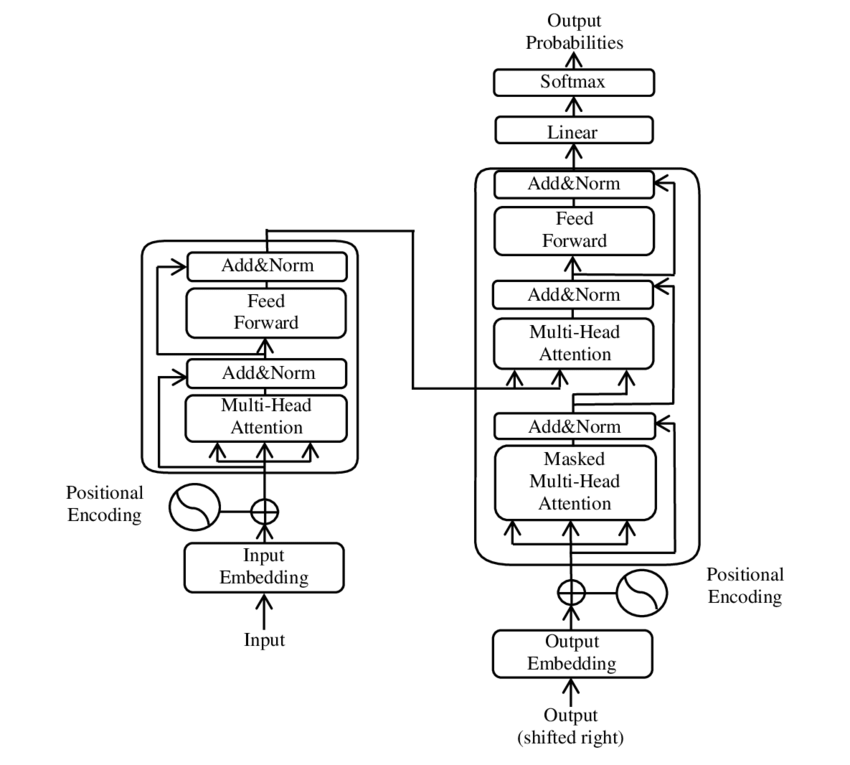
This parallel approach dramatically speeds up training and allows models to handle much longer sequences than LSTMs. However, it comes with a trade-off. The computational cost of standard self-attention grows with the square of the sequence length, a property known as . This can make it very expensive to process extremely long documents or high-resolution images. Researchers are actively developing more efficient, sparse attention patterns to mitigate this challenge.
Today, hybrid architectures are common. For instance, a model might use a CNN backbone to extract features from an image and then feed those features into a Transformer head for a more nuanced understanding or to generate a text description. This blending of architectures allows developers to leverage the strengths of each approach for a specific task.
In a Convolutional Neural Network (CNN), the process of identifying simple features like edges and combining them into more complex objects like faces is known as building a __________.
What primary problem inherent in simple Recurrent Neural Networks (RNNs) do Long Short-Term Memory networks (LSTMs) use 'gates' to solve?
Understanding these core architectural patterns—spatial hierarchies, recurrent memory, and parallel self-attention—is key to navigating the world of modern AI.