Architecting Artificial Intelligence Systems
Neural Architectures
From Features to Hierarchies
In classical machine learning, a model's success often depended on something called feature engineering. This was a manual process where data scientists would carefully select and transform the most relevant pieces of information from a dataset to feed into the model. For example, to predict house prices, you might manually create features like 'price per square foot' or 'age of the house in decades'. The model was only as good as the features it was given.
Deep learning changes the game by automating this process. Instead of relying on human experts to define what's important, deep neural networks learn the features themselves, directly from the raw data. They build a hierarchy of understanding, where each level learns progressively more complex and abstract concepts.
This shift from manual feature engineering to automated feature learning is the fundamental bridge between classical machine learning and deep learning.
The Anatomy of a Network
The basic structure that enables this automatic learning is the Multi-Layer Perceptron (MLP). It's a type of neural network composed of interconnected nodes, or neurons, organized into a series of layers. Every MLP has three types of layers:
| Layer | Purpose |
|---|---|
| Input Layer | Receives the initial raw data. Each node in this layer represents a single feature of the input data. |
| Hidden Layers | The computational core of the network. One or more hidden layers process the inputs, with each layer learning different levels of abstraction. |
| Output Layer | Produces the final result, such as a classification (e.g., 'cat' or 'dog') or a numerical prediction (e.g., stock price). |
The term 'deep' in deep learning simply refers to the presence of multiple hidden layers. While a network with one hidden layer is a 'shallow' neural network, a network with two or more is considered a deep one.
Why Depth Matters
So why is adding more layers so effective? The power of depth comes from creating an abstraction hierarchy. Each successive layer learns to recognize more complex patterns by combining the simpler patterns identified by the layer before it.
Consider image recognition. The first hidden layer might learn to detect simple edges and color gradients. The second layer could combine these edges to recognize basic shapes like circles and squares. A third layer might assemble these shapes into more complex features like eyes, noses, or ears. Finally, a deeper layer could combine these features to recognize a complete face.
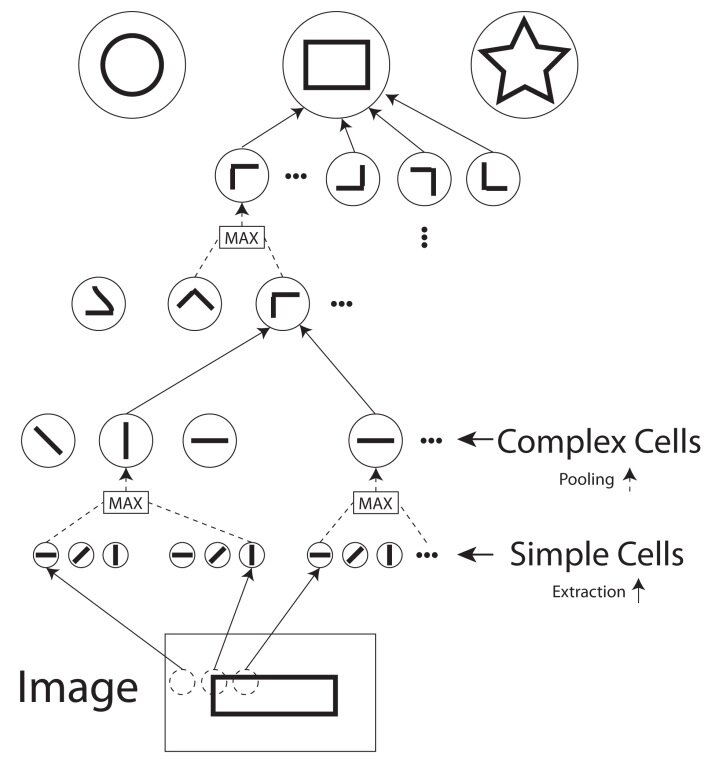
This layered approach allows the network to understand intricate, non-linear relationships in data. Many real-world problems, from financial market prediction to medical diagnosis, involve patterns that are far too complex for a shallow model to capture. A shallow model might find a simple linear trend, but a deep model can learn the elaborate, twisting relationships that define the problem.
Mathematically, each neuron in a hidden layer applies a two-step process to the outputs from the previous layer: it calculates a weighted sum and then passes the result through a non-linear activation function. This non-linearity is crucial. Without it, a multi-layer network would behave just like a single-layer network, losing its ability to model complex patterns.
By stacking these layers, the network can create incredibly rich and complex representations of the data, forming the bridge from the simpler statistical methods of classical machine learning to the powerful capabilities of modern deep learning.
Ready to test your understanding of neural architectures?
What is the primary advantage of deep learning over classical machine learning in terms of data processing?
In the context of image recognition, a deep neural network might learn to identify edges in its first hidden layer, shapes in its second, and facial features in a third. This process is an example of a(n) ____.
Understanding these structural blueprints is the first step toward seeing how AI models actually learn and make decisions.