Architecting Artificial Intelligence Systems
Learning Paradigms and Trade-offs
Choosing Your Learning Path
You already know the names: Supervised, Unsupervised, and Reinforcement Learning. But knowing the definition of a hammer doesn't tell you when to use it instead of a screwdriver. Choosing the right machine learning paradigm is a strategic decision that shapes your entire project, from data collection to deployment. It's about matching the tool to the task and understanding the compromises you'll make along the way.
Supervised Learning: The Cost of Clarity
Supervised learning is the go-to when you have a specific target and the data to match. It excels at prediction because it learns from examples where the right answer is already known. The core trade-off here isn't about the algorithm's complexity, but about the economics of your data. High-quality predictions demand high-quality labels, and those labels have a price.
This is the world of — the time, money, and expertise required to annotate your dataset. Think about training a model to detect cancerous cells in medical images. You need expert radiologists to meticulously label thousands of scans. This process is slow and expensive, but the resulting model can achieve incredible accuracy. The strategic question is: does the potential predictive power justify the upfront investment in labelling? For many applications, like credit scoring or spam filtering, the answer is a clear yes.
The rule is simple: the quality of your supervised model is capped by the quality of its labels. A model trained on noisy, inconsistent data will only produce noisy, inconsistent predictions.
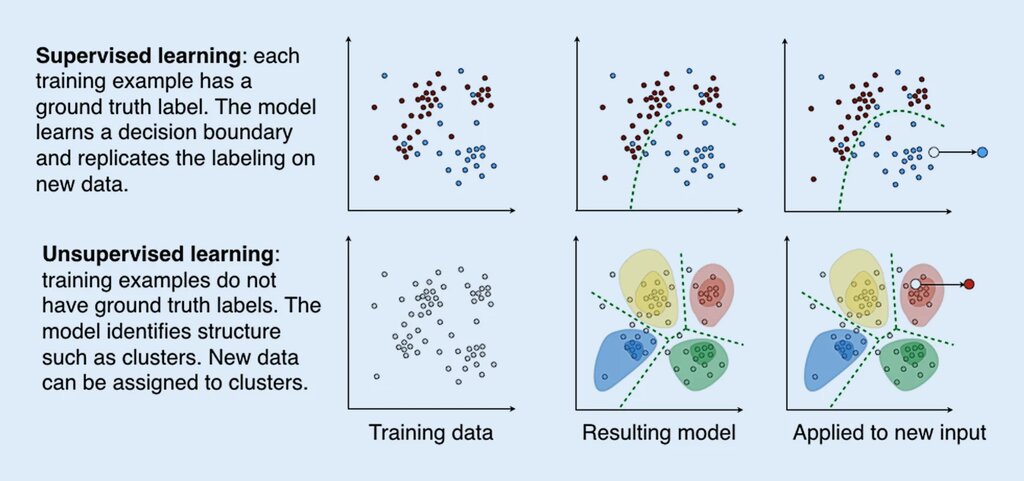
Unsupervised Learning: Finding Patterns in the Wild
What if you don't have labels? Unsupervised learning is designed for this exact scenario. It's about exploration — finding the hidden structure in a dataset without any predefined targets. The two main applications are clustering, for grouping similar data points, and for simplifying complex data.
Imagine an e-commerce platform with millions of users. You don't have a label called 'potential high-value customer,' but you can feed their purchase history, browsing habits, and session times into a clustering algorithm. The algorithm might identify distinct groups: the bargain hunters, the brand loyalists, the seasonal shoppers. This insight is powerful for marketing, but it comes with its own trade-offs. Running clustering algorithms at scale can be computationally expensive. More importantly, interpreting the results requires domain expertise. The algorithm gives you clusters; it's up to you to figure out what they mean and if they're useful.
Reinforcement Learning: Learning Through Action
Reinforcement Learning (RL) is a different beast entirely. It's not about learning from a static dataset but about learning through interaction with an environment. An RL agent takes actions, observes the outcomes, and receives rewards or penalties. The goal is to develop a policy — a strategy for choosing actions — that maximises the cumulative reward over time.
This paradigm is perfect for dynamic optimisation problems. Think of a robot learning to navigate a warehouse, a system managing a cloud server farm to minimise costs, or an AI learning to play a complex game like Go. In these scenarios, the best action often depends on the current state of the environment.
The central challenge in RL is the dilemma. Should the agent exploit its current knowledge and take the action it knows yields a good reward? Or should it explore by trying a new, uncertain action that might lead to an even better reward? Balancing this trade-off is critical. Too much exploitation, and the agent might get stuck in a sub-optimal routine. Too much exploration, and it wastes time on fruitless actions.
A fundamental dilemma in RL is the exploration vs. exploitation tradeoff.
Hybrid Systems
In the real world, problems are messy, and the lines between these paradigms often blur. Many of the most effective AI systems are hybrids that combine different approaches.
A fraud detection system, for instance, might use an unsupervised clustering algorithm to identify unusual transaction patterns that could signal a new type of scam. These suspicious transactions are then flagged for review by human analysts. Once labelled as fraudulent, this data is used to train a supervised classification model to automatically block similar fraudulent activity in the future.
Similarly, a recommendation engine might use unsupervised techniques to group users with similar tastes (collaborative filtering) and then use supervised models to predict how a specific user will rate a new item. These hybrid systems leverage the strengths of each paradigm to solve complex, multi-faceted problems.
A good way to transition into the quiz is to review what you've learned. So, let's review.
Now, let's see how well you can apply these concepts.
An e-commerce company wants to group its millions of users into distinct market segments based on their browsing and purchase history. They have no pre-existing labels for these segments. Which machine learning paradigm is most suitable for this initial task?
A hospital wants to build a system to predict whether a mole in a skin image is cancerous. They have a large dataset of images, each meticulously labelled by expert dermatologists as either 'cancerous' or 'benign'. The high cost and time spent on this labelling process is a key consideration known as:
Understanding these core paradigms and their trade-offs is the first step toward architecting effective AI solutions. It's not just about knowing what they are, but about knowing when and why to use them.