Architecting and Managing Modern Computer Networks
Advanced TCP Mechanics
The Sliding Window Protocol
TCP's reliability and efficiency hinge on a core concept: the sliding window. Instead of sending one packet and waiting for an acknowledgment (ACK) before sending the next, TCP sends a whole series of packets, called a "window," without waiting. This keeps data flowing continuously, dramatically improving throughput.
Think of it like a mailroom clerk sorting packages. A naive clerk would take one package, walk it to the delivery truck, come back, and then pick up the next. A smart clerk uses a conveyor belt. They can place multiple packages on the belt (the window), and as the truck driver (the receiver) takes one off the end and signals for more, the clerk adds another to the start. The belt slides along, always full of packages in transit.
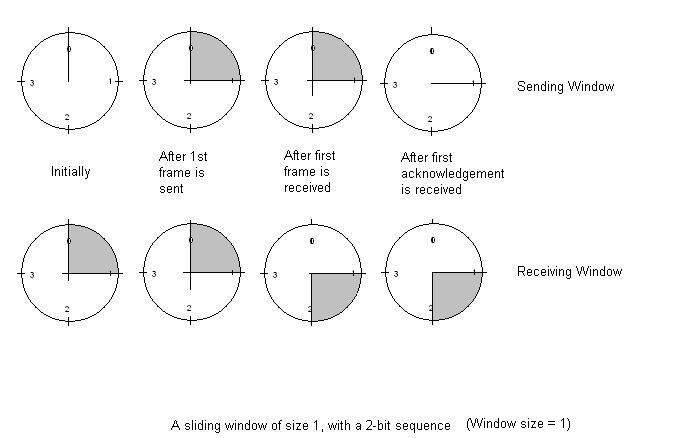
This mechanism allows the sender to have multiple unacknowledged packets in flight at any given time. The size of this window isn't fixed; it dynamically adjusts based on feedback from the receiver and the perceived state of the network. This adjustment is managed by two critical variables.
Juggling Two Windows
The sender's actual transmission ability is governed by not one, but two windows. It's a careful balancing act between what the receiver can handle and what the network path can support.
-
Receiver Window (rwnd): This value is communicated from the receiver to the sender in every ACK packet. It essentially says, "I have this much buffer space left." It's a direct form of flow control, preventing the sender from flooding the receiver's memory.
-
Congestion Window (cwnd): This is a value maintained by the sender itself. It's the sender's estimate of the network's capacity. Unlike
rwnd,cwndis inferred, not explicitly communicated. The sender increasescwndwhen packets are successfully acknowledged and decreases it when it detects packet loss, assuming loss means congestion.
The sender can only transmit the minimum of these two values. If the receiver has a huge buffer (rwnd is large) but the network is congested (cwnd is small), the sender will hold back. Conversely, if the network path is clear (cwnd is large) but the receiver's buffer is nearly full (rwnd is small), the sender will also hold back. This is how TCP avoids overwhelming both the end host and the network itself.
Sometimes, a receiver gets so busy its buffer fills completely. It will then send an ACK with an rwnd of zero, a signal known as a . This tells the sender to stop transmitting data immediately. The sender will then periodically send small "window probe" packets to see if the receiver's buffer has cleared, at which point transmission can resume.
Taming Network Congestion
The magic of TCP's congestion control lies in how it manipulates the cwnd. It uses a suite of four interconnected algorithms to find the sweet spot between maximum speed and network stability.
1. Slow Start: Despite its name, this phase is aggressive. A connection begins with a small cwnd (usually between 1 and 10 MSS). For every ACK received, cwnd is increased, effectively doubling the window size every round-trip time (RTT). This exponential growth allows TCP to quickly probe the network and find its approximate capacity. This continues until cwnd reaches a predefined threshold called ssthresh.
2. Congestion Avoidance: Once cwnd passes ssthresh, TCP slows down. Instead of doubling, it enters a linear growth phase, increasing cwnd by about one MSS per RTT. The goal is to carefully approach the network's limit without overshooting it and causing massive packet loss.
If a timeout occurs (the most severe sign of congestion),
ssthreshis set to half of the currentcwnd, andcwndis reset all the way back to 1. The whole process begins again with Slow Start.
3. Fast Retransmit: Waiting for a timeout to resend a lost packet is slow. If a receiver gets a packet that is out of order (e.g., it receives packet 5 after packet 3), it knows packet 4 is missing. It will immediately send a duplicate ACK for the last in-order packet it received (packet 3). If the sender sees three of these duplicate ACKs in a row, it takes this as a strong signal that packet 4 was lost. Instead of waiting for a timeout, it immediately retransmits the missing packet.
4. Fast Recovery: When Fast Retransmit is triggered, TCP assumes the network is only lightly congested, not completely broken. Instead of dropping cwnd to 1, it halves cwnd (setting the new ssthresh to this value as well) and immediately enters the Congestion Avoidance phase. This avoids the slow ramp-up of Slow Start and helps maintain higher throughput.
Optimizing for Modern Networks
The original TCP specification had limitations, especially on high-speed, long-latency networks (often called "long fat networks"). Two key extensions help address this: Window Scaling and Selective Acknowledgments.
Window Scaling (RFC 7323): The original TCP header allocated 16 bits for the rwnd, limiting it to just 65,535 bytes (64 KB). On a 1 Gbps link with 100ms latency, you'd need a window of over 12 MB to fully utilize the connection. The Window Scale option, negotiated during the three-way handshake, acts as a multiplier, allowing for window sizes up to 1 GB.
(SACK): Standard TCP ACKs are cumulative. An ACK for packet 3 means packets 1, 2, and 3 were all received. If packets 1, 2, 4, and 5 arrive, but 3 is lost, the receiver can only send duplicate ACKs for packet 2. The sender has no idea that 4 and 5 were successful. allows the receiver to include extra information in its ACKs, specifying non-contiguous blocks of data it has received (e.g., "I got packets 4-5"). This gives the sender a much clearer picture of what's missing, allowing it to retransmit only the lost segments, which is far more efficient on links with high packet loss.
When you're troubleshooting a slow network connection in a tool like , you're essentially watching these mechanics play out in real time. You can graph the window size and look for sharp drops, which indicate packet loss and congestion control kicking in. You can filter for duplicate ACKs to spot Fast Retransmits or look for zero-window advertisements to diagnose a bottlenecked receiver. Understanding these advanced TCP mechanics transforms a confusing packet capture into a clear story about network performance.
By observing how the rwnd and cwnd interact, and how algorithms like Slow Start and Fast Recovery respond to network conditions, you can precisely identify whether a performance issue stems from the sender, the receiver, or the path in between.
Ready to test your knowledge?
What is the primary advantage of using a sliding window in TCP instead of a simple stop-and-wait protocol?
A TCP sender's ability to transmit data is constrained by two values: the receiver window (rwnd) and the congestion window (cwnd). The actual amount of data the sender can transmit is equal to the __________ of these two values.
These mechanisms are the foundation of a stable and efficient internet, constantly adapting to ensure reliable data transfer across an unpredictable global network.