Arcesilaus and Academic Acatalepsy
Socratic Aporetics
Arcesilaus' Socratic Turn
When Arcesilaus took leadership of the Academy, he initiated a dramatic pivot. He claimed not to be an innovator, but a restorer, returning the school to its Socratic roots. This was a bold move, reinterpreting the Academy's legacy by asserting a direct line from Socrates' aporetic practice to his own brand of skepticism. The central question is whether this was a genuine philosophical recovery or a clever institutional rebranding.
Arcesilaus argued that Plato’s dialogues, particularly the early ones, were not meant to convey doctrine. Instead, he saw them as showcases of the in action. For him, the Euthyphro dilemma wasn't just a puzzle about piety; it was a demonstration of a method. Socrates’ repeated failure to find definitions was the point. This reading transformed Plato from a dogmatist into a fellow skeptic, one who used writing to preserve the Socratic spirit of inquiry rather than to legislate philosophical truths.
This leads to his signature method: arguing in utramque partem, or on both sides of a question. Unlike the Socratic elenchus, which tests an interlocutor's belief, Arcesilaus’ method was more systematic. He would argue for a proposition with equal force as he argued against it. The goal was to demonstrate that for any given claim, an equally plausible counter-claim exists, thus making the only rational response a suspension of judgment, or epochē.
Irony vs. Method
A key distinction lies in the perceived aims of Socrates and Arcesilaus. Socratic irony is often seen as a pedagogical tool. By feigning ignorance, Socrates guides his conversation partner toward recognizing their own lack of knowledge, hopefully instilling a desire for truth. The aporia is a starting point for genuine inquiry.
For Arcesilaus, however, the suspension of judgment was the endpoint. His method wasn't necessarily about guiding others to truth, but about demonstrating the unattainability of certainty. This shift from a pedagogical to a purely epistemological goal is where Arcesilaus diverges most sharply from the traditional image of Socrates. The Socratic persona became less about moral exhortation and more about intellectual discipline.
Did Arcesilaus recover the 'real' Socrates, or did he create a Plato in his own skeptical image to justify his school's new direction?
Legitimacy Through Lineage
Arcesilaus' Socratic claim was also a masterful act of institutional politics. By rooting his skepticism in the figure of Socrates, he wasn't just a radical breaking from tradition; he was a purifier restoring the Academy to its founder's true spirit. This provided a powerful defense against critics who saw him as abandoning Platonism. He could argue that the dogmatic interpretations of his predecessors, like Speusippus and Xenocrates, were the actual deviation.
This effectively weaponized the Socratic legacy. It allowed the Academy to maintain its prestige and institutional continuity while undergoing a fundamental philosophical transformation. It framed the skeptical turn not as a rebellion, but as a reformation, securing the Middle Academy's place within the Platonic tradition.
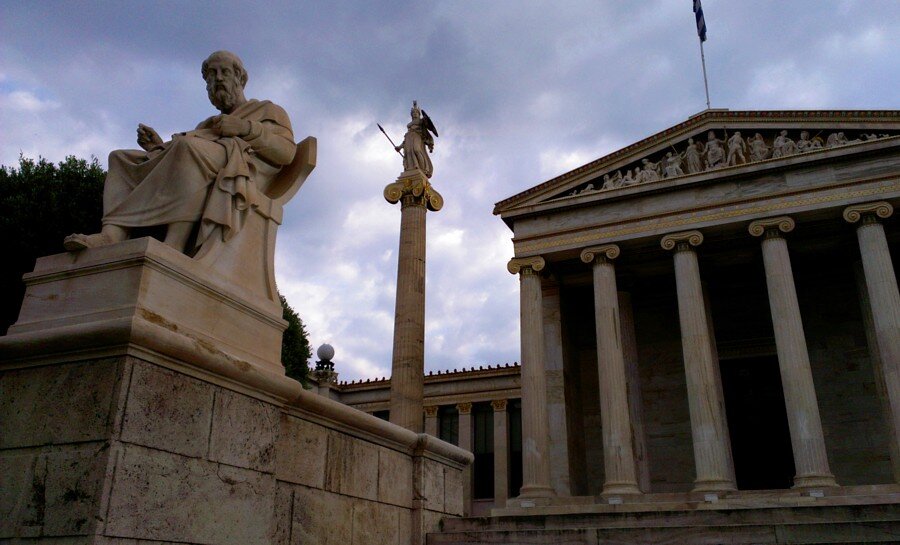
Ultimately, whether Arcesilaus was a restorer or a revolutionary depends on how one reads Plato. If Plato's dialogues are primarily protreptic, meant to turn the soul toward philosophy, then Arcesilaus' focus on method over doctrine is a plausible, if extreme, continuation. If, however, the Theory of Forms and other doctrines are Plato's core contribution, then Arcesilaus represents a definitive break. His genius was in framing the debate in such a way that his position could be seen as an authentic return to the source.