Arbitrage in Prediction Markets
Introduction to Prediction Markets
What Are Prediction Markets?
Prediction markets are exchanges where people bet on the outcomes of future events. Think of them like a stock market, but instead of buying shares in a company, you buy shares in an outcome. Will a certain candidate win an election? Will a specific movie win a major award? These are the kinds of questions a prediction market tackles.
A prediction market is a platform that aggregates information and forecasts future outcomes through market mechanisms.
The core idea is to tap into the "wisdom of the crowd." By allowing a diverse group of people to buy and sell contracts based on what they think will happen, these markets aggregate countless individual beliefs and pieces of information into a single, constantly updating forecast. This often results in surprisingly accurate predictions.
How They Work
The mechanics are straightforward. Most prediction markets are based on a simple binary question with a "Yes" or "No" answer. For any given event, you can buy "Yes" shares or "No" shares.
The price of a share at any given moment reflects the market's perceived probability of that outcome. Prices range from $0.01 to $0.99. If a "Yes" share for the event "Will it rain in London tomorrow?" is trading at $0.70, it means the market collectively believes there is a 70% chance of rain.
Share Price = Perceived Probability
When the event's outcome is known, the market resolves. If the event happens (it rains), all "Yes" shares become worth $1.00 each, and all "No" shares become worthless. If the event doesn't happen, the "No" shares become worth $1.00, and the "Yes" shares go to zero. Your profit or loss is the difference between what you paid for your shares and their final value.
| Outcome | Price of "Yes" Share | Final Value of "Yes" Share | Final Value of "No" Share |
|---|---|---|---|
| Event Happens (Yes) | $0.70 | $1.00 | $0.00 |
| Event Doesn't Happen (No) | $0.70 | $0.00 | $1.00 |
Platforms in Practice
Several platforms facilitate these markets. One of the most prominent is Polymarket, a decentralized platform built on the Polygon blockchain. It allows users worldwide to create markets and trade on a wide variety of topics, from politics and current events to cryptocurrency prices.
Polymarket is a decentralized prediction market built on Polygon, allowing individuals to trade on whether future events will occur or their outcomes.
On these platforms, you can browse active markets, see the current prices (probabilities), and place trades based on your own knowledge and predictions. The interface typically shows a list of events you can bet on, much like an online brokerage.
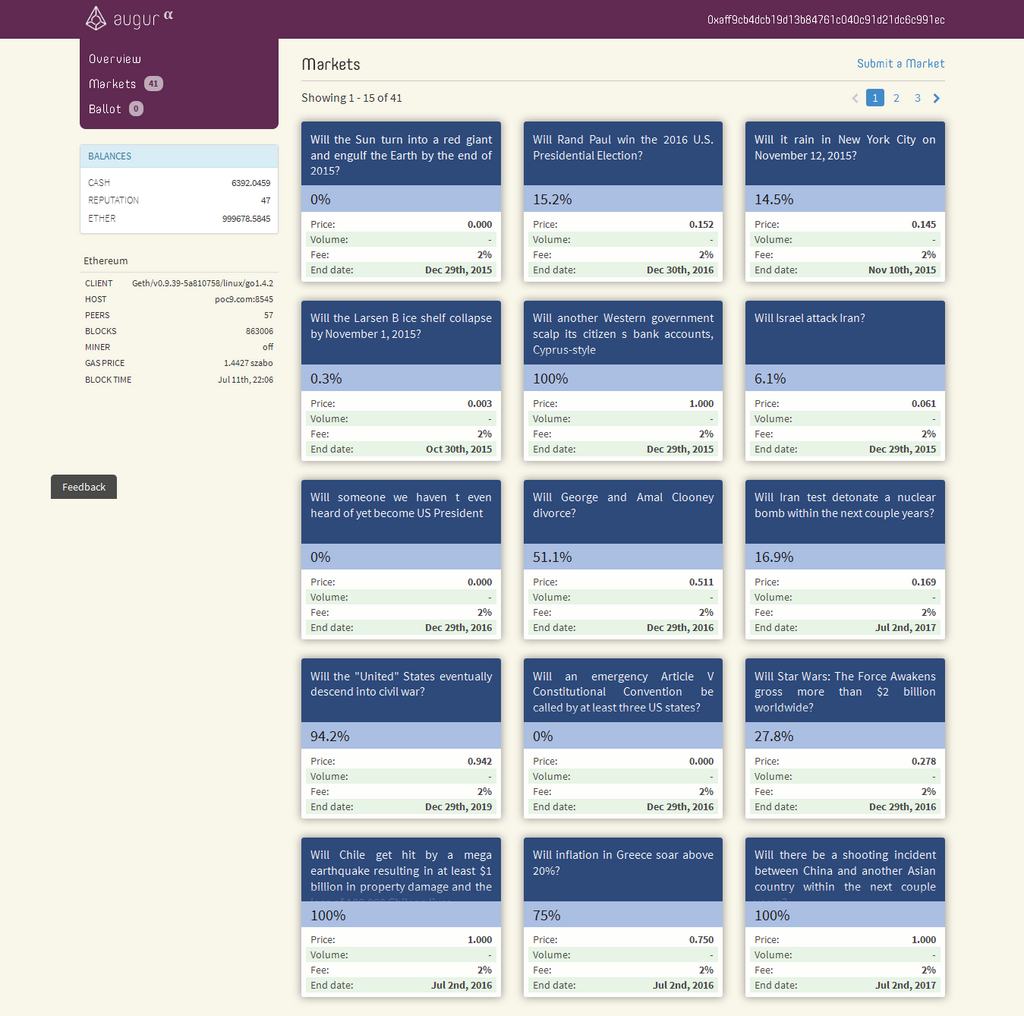
The power of these markets comes from financial incentives. Because real money is on the line, participants are motivated to seek out accurate information and make well-reasoned trades, rather than just stating an opinion.
Having “skin in the game” is likely to be the key to the predictive power of prediction markets.
This process efficiently gathers and weighs information scattered among many different people, creating a powerful forecasting tool. The resulting share prices give us a real-time probability of future events.
What is the primary function of a prediction market?
In a prediction market, if a "Yes" share for an event is priced at $0.82, what does this price represent?
Now that you understand the fundamentals, you can begin to see how prices reflect collective belief. When different markets predict related outcomes, their prices should be consistent, but sometimes they aren't, which opens the door to other opportunities.