Aquatic Biodiversity and Ecosystem Dynamics
Community Ecology Dynamics
An Ocean of Interactions
No fish is an island. In any body of water, from a coral reef to a quiet river, species are constantly interacting. These relationships—predator and prey, competitors, and even collaborators—form the invisible architecture of an aquatic community. Community ecology is the study of this architecture: how groups of different species live together, what rules they follow, and how their interactions shape the ecosystem as a whole.
Think of it as the social dynamics of the underwater world. It’s not just about who is present, but about who is eating, hiding from, or helping whom.
The Universal Rivalry
One of the most powerful forces shaping a community is competition. When two or more organisms require the same limited resource, conflict is inevitable. This can happen within a single species, known as intraspecific competition. Imagine a school of salmon competing for the best spawning spots in a stream. The strongest and fittest individuals will likely succeed, influencing the genetic future of the population.
More complex is interspecific competition, which occurs between different species. If two types of reef fish, say a parrotfish and a surgeonfish, both feed on the same type of algae, they are in direct competition. Over time, this pressure can lead to one species outcompeting the other, or to both species adapting to reduce the conflict. One might start feeding at night, while the other feeds during the day. This drive to avoid direct confrontation is a major engine of evolution and diversification.
A Delicate Balance
The relationships between predators and their prey create some of the most dramatic dynamics in any ecosystem. When a top predator is removed, the effects can cascade down through the entire food web, an event known as a trophic cascades. Imagine an ocean environment where sharks are overfished. Their primary prey, such as large groupers, might experience a population boom. With more groupers hunting smaller fish and invertebrates, the populations of these lower-level species could crash, fundamentally altering the community.
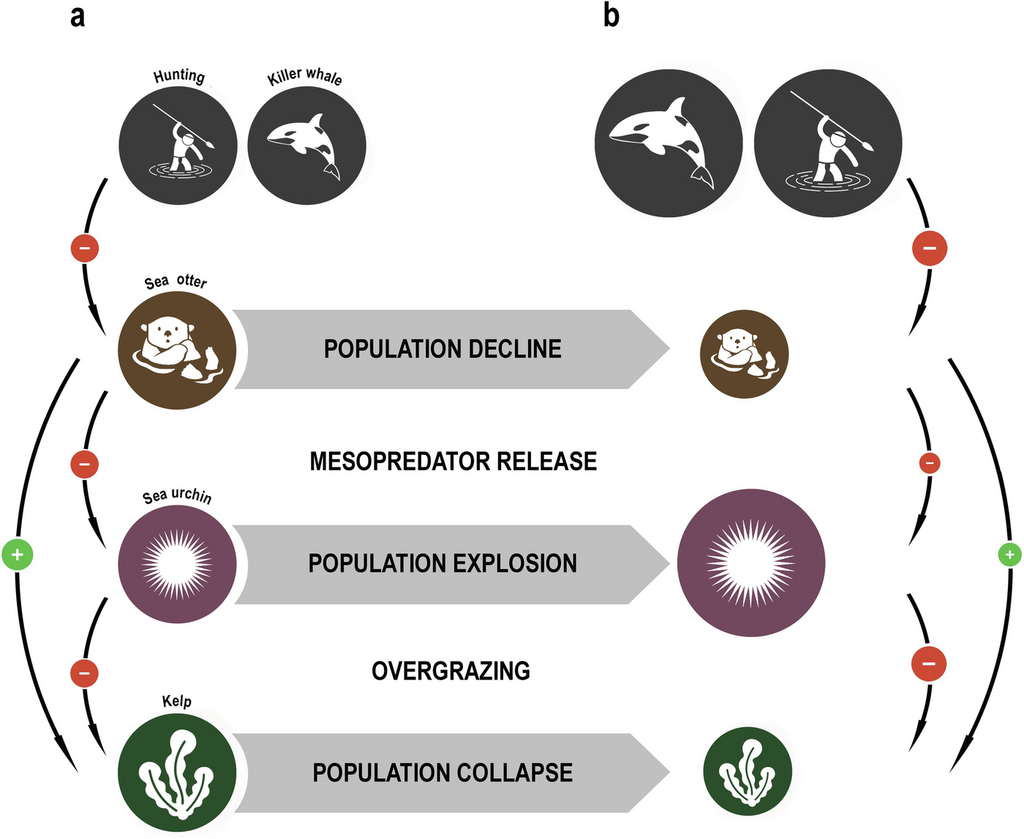
This highlights the importance of so-called s. These are organisms that have a disproportionately large effect on their environment relative to their abundance. Sea otters in the North Pacific are a classic example. They prey on sea urchins, which graze on kelp. Without otters, urchin populations explode and mow down the kelp forests, turning a vibrant, three-dimensional habitat into a barren underwater desert. The otter, though not the most numerous creature, is the keystone holding the entire arch of the ecosystem together.
Finding a Niche
With so much competition, how do so many species manage to coexist in crowded places like coral reefs? The answer often lies in the concept of the ecological niche. A niche isn't just an organism's address; it's its profession. It includes everything the species needs to survive and reproduce: what it eats, where it lives, when it's active, and how it interacts with other species.
Niche
noun
The specific role or function of an organism or species within an ecosystem, including its relationship to food and enemies.
When species divide up resources to avoid direct competition, it’s called s. On a single coral head, you might find several species of goby. One might live only on the branching tips, another near the base. A third might be nocturnal, emerging only after the others are asleep. By specialising in slightly different microhabitats, diets, or times of activity, they can share the same general area without driving each other to extinction. This partitioning is a key reason for the incredible biodiversity found in many aquatic systems.
Finally, we must consider factors that depend on the population size itself. Density-dependent factors are forces that have a greater effect as population size increases. In a densely packed fish farm, for instance, diseases can spread like wildfire, a phenomenon you're familiar with from studying fish pathology. Parasites also find more hosts, and competition for food becomes more intense. These pressures can act as a natural brake, regulating population size and preventing it from growing indefinitely.
What is interspecific competition?
A sea otter has a disproportionately large effect on its environment by controlling sea urchin populations, which in turn preserves kelp forests. This makes the sea otter a...
Understanding these interactions—competition, predation, and resource partitioning—is the key to seeing an ecosystem not as a random collection of species, but as a complex, interconnected community.