Applied Vector Mastery
Dot Product Mechanics
Multiplying Vectors with the Dot Product
We know how to add and subtract vectors, but how do we multiply them? One common method is the dot product, also known as the scalar product. The name gives a clue: when you take the dot product of two vectors, the result is a single number—a scalar—not another vector.
Algebraically, the process is straightforward. You multiply the corresponding components of the two vectors and then add up the results. For two vectors and in two dimensions, the formula is simple.
This extends easily to three dimensions or more. For example, if and , their dot product is:
.
The Geometric Meaning
The number we get from the dot product tells us something important about the vectors' relationship in space. Specifically, it measures how much one vector points in the direction of the other. Think of it as a measure of alignment. The dot product is the length of the projection of one vector onto another, scaled by the magnitude of the second vector.
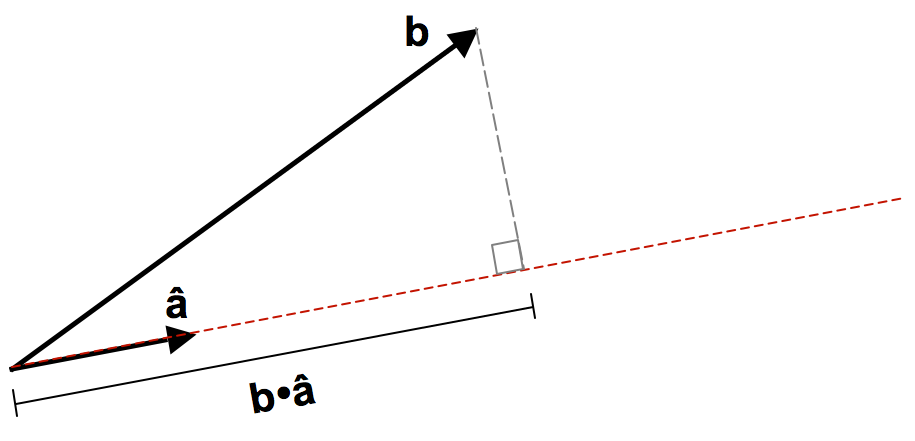
This geometric insight gives us a second way to calculate the dot product, using the magnitudes of the vectors and the angle, , between them.
This formula reveals the dot product's core purpose: it's a tool for comparing directions.
If two vectors point in the same direction, , and the dot product is simply the product of their magnitudes. If they are perpendicular, , and their dot product is zero. This property of orthogonality is one of the most useful applications of the dot product.
Applications in Science and Data
The dot product isn't just a mathematical curiosity. In physics, the work done on an object is the dot product of the force vector and the displacement vector: . This formula neatly captures the idea that only the component of force in the direction of movement does any work.
In data science, the dot product is the engine behind cosine similarity, a metric used to determine how similar two documents or pieces of data are. By representing documents as vectors, we can calculate the cosine of the angle between them using the dot product formula. A cosine of 1 means the documents are very similar, while a cosine of 0 means they are unrelated.
The dot product is the key tool for calculating vector projections, vector decompositions, and determining orthogonality.
A fundamental rule governing the dot product is the Cauchy-Schwarz inequality. It provides an upper bound for the dot product of two vectors.
This makes intuitive sense if you look at the geometric formula. Since the maximum value of is 1, the dot product can never be greater than the product of the magnitudes. Equality only happens when the vectors are parallel ( or ), meaning they are perfectly aligned.
Now, let's test your understanding of these concepts.
What is the dot product of the vectors and ?
If the dot product of two non-zero vectors is zero, what can you conclude about their orientation?
The dot product provides a powerful way to understand the relationship between vectors, measuring their alignment and enabling key calculations in fields from physics to data science.