Applied Vector Analysis in Physics
Vector Analysis Fundamentals
Beyond Tip-to-Tail
You already know that vectors have magnitude and direction. Drawing arrows tip-to-tail is useful for visualizing problems, but for precise calculations in physics and engineering, we need a more analytical approach. This involves breaking vectors down into components along a coordinate system.
In a 2D Cartesian plane, any vector can be expressed as the sum of its horizontal () and vertical () components. These components are projections of the vector onto the x and y axes. We write this using a special notation involving called and .
This method extends perfectly into three dimensions. We simply add a third axis, the z-axis, with its own unit vector, .
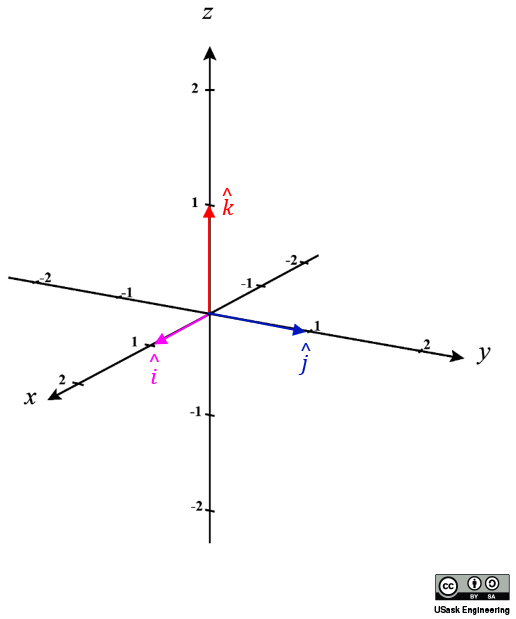
Any vector in 3D space can be written as the sum of its x, y, and z components:
This component form makes vector algebra much simpler. To add two vectors, and , you just add their corresponding components:
Finding Your Direction
While components give us a vector's makeup, they don't immediately tell us its orientation in space. For that, we use direction cosines—the cosines of the angles the vector makes with each positive coordinate axis.
If a vector makes an angle with the x-axis, with the y-axis, and with the z-axis, then its direction cosines are:
An interesting property arises from this: the sum of the squares of the direction cosines is always equal to 1.
Changing Your Perspective
A vector itself is a physical quantity that exists independent of any coordinate system. A force of 10 Newtons pulling southeast doesn't change just because we tilt our graph paper. However, its components will change if we rotate our coordinate system.
This is a crucial concept for solving physics problems, especially those involving inclined planes. By rotating the coordinate system to align with the problem's geometry, we can simplify the vector components significantly.
If a 2D coordinate system is rotated counter-clockwise by an angle to become a new system , the original components of a vector transform into new components according to these transformation equations:
Vector resolution is a powerful tool in physics and engineering, that enables the analysis and prediction of complex physical phenomena by simplifying vectors into manageable components.
Now, let's test your understanding of these analytical vector methods.
Given two vectors, and , what is their sum, ?
What do the direction cosines of a vector represent?