Applied Vector Algebra and Spatial Reasoning
3D Spatial Projections
Projections in 3D Space
Imagine standing in a field at noon, with the sun directly overhead. Your shadow on the ground is a flat, two-dimensional version of your three-dimensional self. Vector projection works in a similar way. It's like casting a shadow of one vector onto another. This shadow, or projection, tells us how much of the first vector points in the direction of the second.
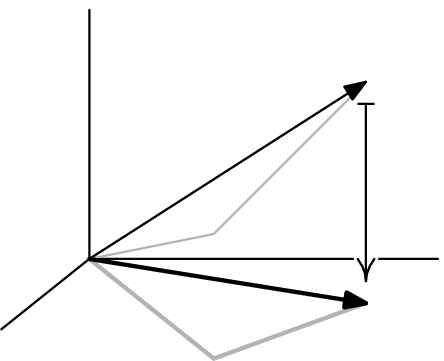
This concept is incredibly useful in fields like physics and engineering. For instance, when a force is applied at an angle to a surface, we can project that force vector onto the surface to find the component of the force that actually does the work. To calculate this, we use the vector projection formula. It relies on the dot product and the magnitude of the vector we're projecting onto.
Parallel and Perpendicular Components
The real power of projection comes from vector decomposition. Any vector can be broken down into two distinct parts relative to another vector : a component that is parallel to and a component that is perpendicular to .
The parallel component, which we'll call , is simply the projection of onto that we just calculated. It's the part of that runs in the exact same (or opposite) direction as . The perpendicular component, , is what's left over. Together, these two components add up to the original vector: . This forms a right-angled triangle in 3D space.
Finding the perpendicular component is straightforward. Since we know the original vector and its parallel part, we can find the perpendicular part through simple vector subtraction.
Orthogonality and Distance
The idea of perpendicularity in vector space is called orthogonality A key takeaway from projections is the test for orthogonality: two non-zero vectors and are orthogonal if and only if their dot product is zero. Think about it: if , the projection formula gives a zero vector. The 'shadow' has no length, which can only happen if the light source is hitting the vector at a perfect 90-degree angle.
Two vectors are orthogonal if their dot product equals zero.
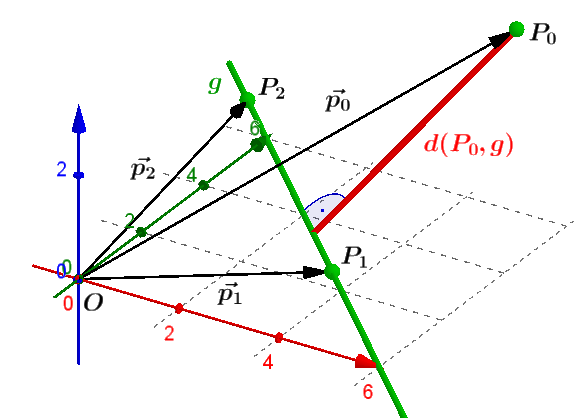
This principle has a direct application in finding the shortest distance from a point to a line in 3D space. Imagine a point and a line defined by a direction vector . The shortest path from the point to the line will always be a perpendicular line segment.
To find this distance, we can create a vector from any point on the line to point . The length of the perpendicular component of relative to the line's direction vector gives us the shortest distance. In essence, we decompose and find the magnitude of its orthogonal part, .
With these tools, you can now break down 3D vectors into meaningful components and solve geometric problems involving angles and distances.